Scientists in South Korea have developed a fully automated catalyst testing system that replaces manual laboratory work with robotic precision.
The innovation promises to dramatically shorten research timelines while improving experimental accuracy and data reliability.
The technology was developed by a research team led by Dr. Ji Chan Park at the Clean Fuel Research Laboratory of the Korea Institute of Energy Research (KIER).
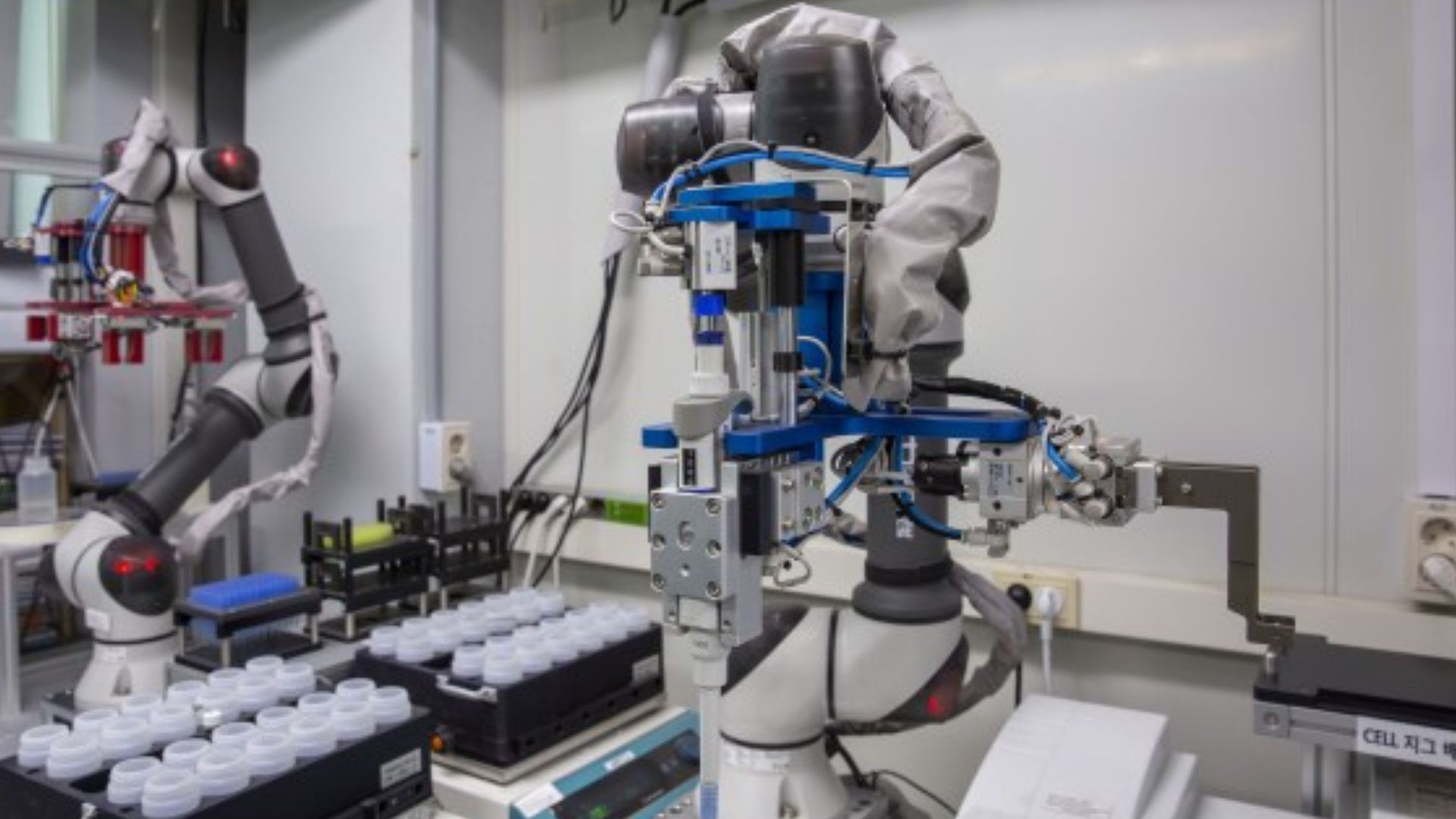
By integrating two coordinated robots into the catalyst evaluation process, the team has automated complex, repetitive experiments that previously required intensive human labor.
READ ALSO: https://modernmechanics24.com/post/china-seedance-2-0-ai-shakes-hollywood/
Catalysts play a crucial role in energy production, hydrogen development, carbon reduction, and chemical manufacturing.
However, developing new catalysts requires extensive repetitive experiments. Researchers must frequently change catalyst compositions, adjust reaction conditions, and conduct continuous measurements over extended periods.
Manual testing is not only time-consuming but also prone to inconsistencies. Even with identical samples, results can vary depending on who performs the experiment. Human fatigue, shift changes, and slight procedural differences can introduce variability that affects data reliability.
Although computational science and artificial intelligence have advanced significantly in predicting catalyst performance, full automation has remained elusive.
Certain tasks, such as precise sample replacement, consumable changes, and overnight monitoring, require delicate manipulation and real-time responsiveness. Until now, these steps kept humans in the loop.
WATCH ALSO: https://modernmechanics24.com/post/ula-atlasv-amazon-leo-success/
How Dual-Robot System Works
The KIER team addressed these challenges by dividing the catalyst evaluation workflow into two coordinated stages, each managed by a dedicated robot.
The first robot focuses on analytical precision. The pre-programmed experimental scenarios include measurement timing, sample sequence, and identification codes. Based on these scenarios, the robot automatically selects the appropriate samples, mounts containers accurately, and performs UV/Vis spectroscopy measurements.
This spectroscopy technique uses ultraviolet and visible light to measure absorbance changes. It enables researchers to monitor reaction progress and evaluate catalyst performance.
By automating sample selection, alignment, measurement initiation, and data recording, the system eliminates delays and reduces variability across operators.
The second robot handles operational continuity. It manages standardized procedures for placing, retrieving, and disposing of samples, as well as for replacing consumables.
These tasks are critical for high-throughput, long-duration experiments. By taking over routine maintenance, the robot ensures uninterrupted operation and continuous data collection without requiring on-site staff.
READ ALSO: https://modernmechanics24.com/post/latam-777-tail-strike-milan-100-ton/
An integrated control logic allows both robots to operate simultaneously, maintaining seamless workflow coordination.
A catalyst performance evaluation that would typically take about 32 days using conventional manual methods was completed in approximately 17 hours using the automated system, resulting in a 45x speedup.
Beyond speed, precision also improved significantly. The research team reported a 32 percent reduction in variability compared to manual experiments. It also demonstrates that stable operation and high-precision data acquisition are achievable even in high-throughput, continuous-testing environments.
“This study demonstrates that we can secure highly reliable data in high-throughput experimental environments, going beyond the full automation of catalyst performance evaluation,” Dr. Ji Chan Park said. “We will expand the application to a broader range of catalytic reactions and materials research, strengthen the linkage between theory and experiments, and ultimately advance toward AI-driven catalyst development.”
The team has secured a Korean-registered patent for the catalyst performance evaluation automation system, reinforcing its technological credibility and opening pathways for commercialization.
The study was supported by KIER’s institutional R&D program and the Ministry of Trade, Industry and Energy (MOTIE). It was published online in Chemical Science, a leading international chemistry journal.
WATCH ALSO: https://modernmechanics24.com/post/explore-raytheons-giant-radar-making-facility/
As global demand for clean fuels and sustainable energy technologies intensifies, faster and more reliable catalyst development could accelerate breakthroughs across hydrogen production, carbon capture, and green chemistry.
With robots now stepping into roles once reserved for human researchers, the laboratory of the future may be defined as operating faster, smarter, and with unprecedented precision.