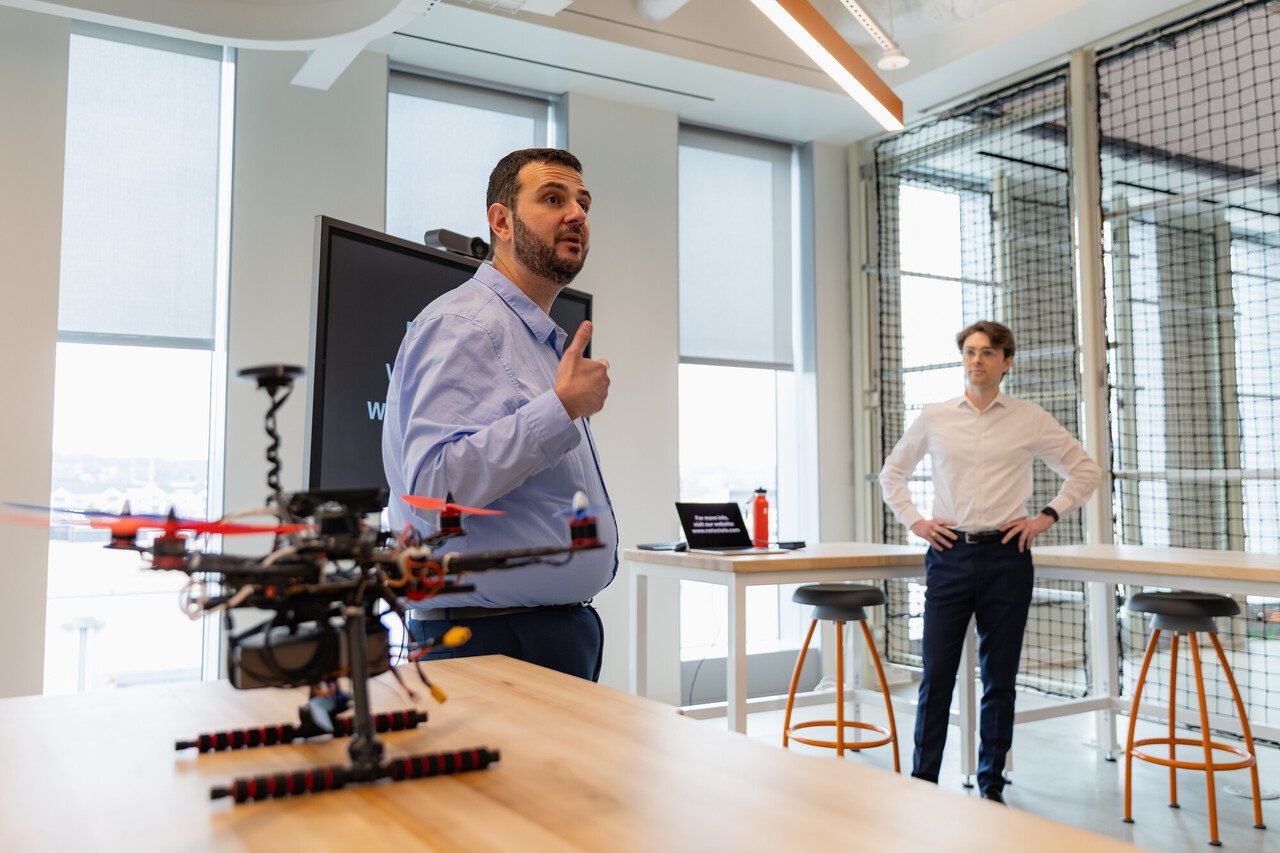
A Virginia Tech doctoral student, Alexander DeRieux, under Professor Walid Saad, has developed a novel framework using quantum entanglement that could enable drones to communicate and coordinate in disaster zones without any wireless signal, marking a potential breakthrough for future emergency response.
The research, conducted at the Institute for Advanced Computing in Alexandria, tackles a critical vulnerability in modern crisis response: the reliance on fragile wireless networks. When wildfires, earthquakes, or other disasters strike, communication infrastructure often fails. Alexander DeRieux, a Ph.D. student and Bradley Fellow in the Bradley Department of Electrical and Computer Engineering, asked a fundamental question: what if devices could share information without transmitting signals through the open air? The answer lies in the strange world of quantum physics.
The team’s solution is a pioneering framework called eQMARL (entangled quantum multi-agent reinforcement learning). It exploits quantum entanglement—the phenomenon where two particles become inextricably linked so that a change to one instantly affects its partner, regardless of distance. “Entanglement effectively leverages the fabric of the physical space around us and how atoms are intrinsically linked with each other,” DeRieux explained. In their model, drones would each hold one half of an entangled pair of quantum bits (qubits). As a drone senses its environment, it encodes that data onto its qubit, causing an instantaneous, correlating change in its partner qubit located on another drone or a command center.
READ ALSO: https://modernmechanics24.com/post/ford-ev-batteries-power-data-centers/
This method offers two revolutionary advantages. First, it provides a communication channel immune to interception or jamming, as no traditional signal is ever broadcast. Second, it operates completely independently of cellular towers or satellite links. Professor Walid Saad, who advised the research, highlighted its transformative potential: “Our research addresses this challenge by exploiting intrinsic quantum properties, such as entanglement, to design learning and communication frameworks that move beyond classical limits.”
The team’s simulations for disaster scenarios, like drone swarms fighting wildfires, showed a marked improvement in performance over both classical computing and non-entangled quantum methods. The drones could coordinate more efficiently because their “knowledge” was shared through this instantaneous quantum link. “We developed the technology and the framework, and then we thought of the application where it can be used,” said DeRieux. The process, he notes, pulls from well-established quantum physics: “We have essentially written an instruction book that says, ‘Yes, this is something you can actually do in entanglement.’”
While a functional fleet of quantum-linked drones is likely 10 to 15 years away, the groundwork is accelerating. The principles demonstrated could extend far beyond disaster relief to any field requiring ultra-secure, infrastructure-independent communication, such as federated learning, medical data sharing, or national security. As quantum hardware shrinks from room-sized mainframes to more portable systems, the Virginia Tech team’s “instruction book” provides a crucial roadmap for integrating this exotic physics into tangible, life-saving technology.
WATCH ALSO: https://modernmechanics24.com/post/explore-raytheons-giant-radar-making-facility/