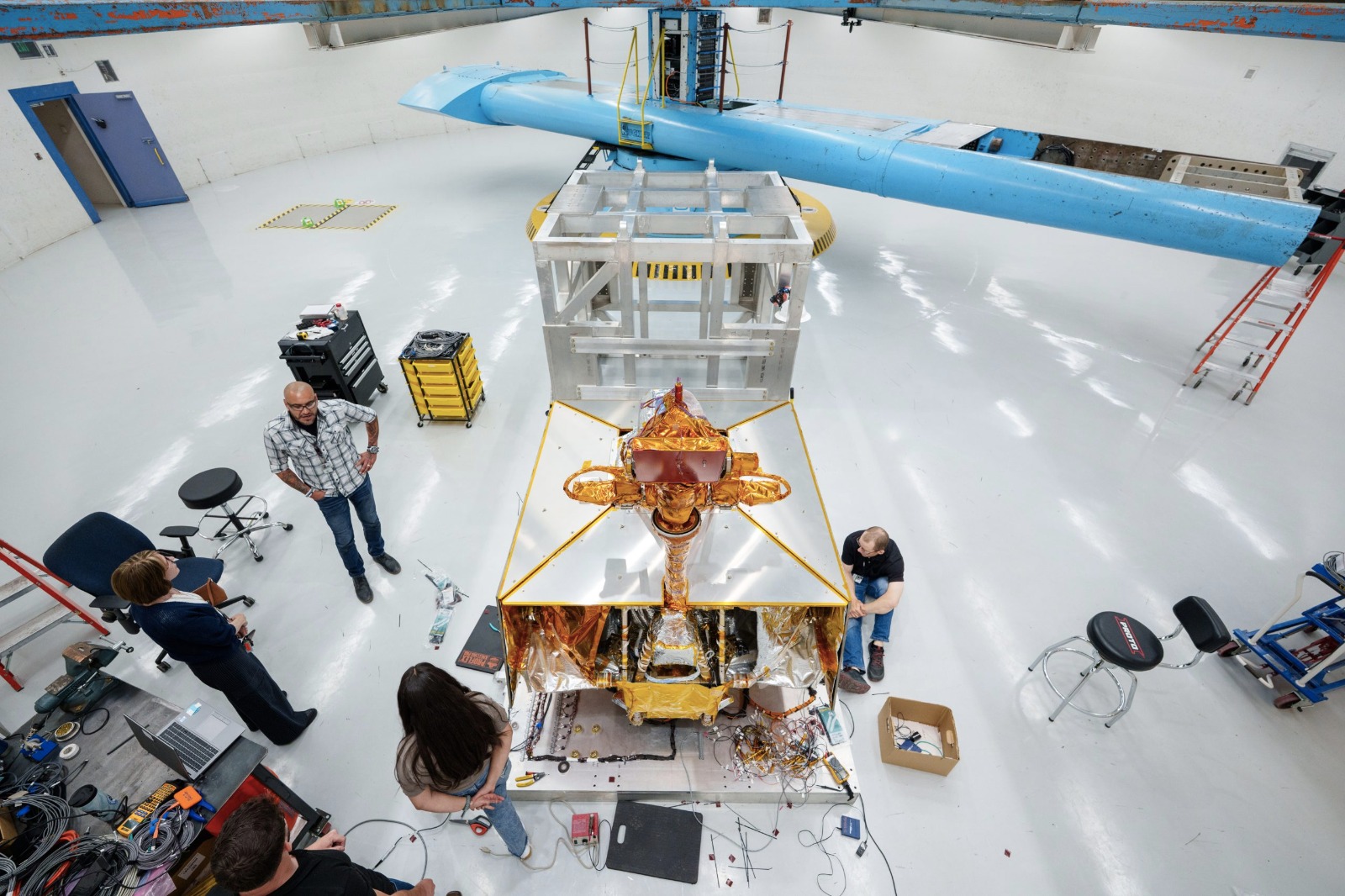
NASA’s VIPER moon rover has survived a critical gauntlet inside the Superfuge, a one-of-a-kind centrifuge at Sandia National Laboratories. The rigorous testing subjected the 1,000-pound rover to forces mimicking a rocket launch, proving its structure can survive the journey to search for water at the lunar South Pole.
Sending a robot to the moon is more than just building it and pointing a rocket skyward. Every bolt, panel, and circuit must be certified to survive the violent shaking and crushing G-forces of launch. For the Volatiles Investigating Polar Exploration Rover (VIPER), that certification process led its team to a unique underground facility in New Mexico. “We need to be sure its structure is properly designed and built to survive the mission, including the launch environment,” said Dave Petri, NASA VIPER system integration and test lead.
The challenge was VIPER’s sophisticated design. Unlike a simple metal box, the rover is covered with delicate solar panels and houses a precision drill in its underbelly. Traditional “push-test” methods, where pistons apply force to specific points, risked damaging these sensitive components. According to the Sandia team, the solution was to test the entire rover assembly dynamically, simulating the actual inertial loads it will face.
READ ALSO: https://modernmechanics24.com/post/worlds-largest-ice-snow-theme-park-china/
That’s where the Superfuge proved indispensable. This 29-foot underground centrifuge is a facility like no other on Earth. It can spin massive payloads, subjecting them to up to 300 times the force of Earth’s gravity (300 Gs). Crucially, it can integrate vibration and thermal environments simultaneously, creating a near-perfect replica of the flight conditions from launch through stage separations. “There is not another machine in the world that has the capabilities we do here,” stated Orlando Abeyta, a Sandia operations engineer at the Superfuge.
For three weeks, the Sandia team, led by test engineer Leticia Mercado, put the rover through its paces. Preparation took months, as engineers meticulously planned how to mount the rover, connect 48 different data points for instrumentation, and determine the precise angles for testing. “You can model anything you want, but until you put it on that arm you don’t know what you are going to get,” Abeyta explained, highlighting the irreplaceable value of real-world testing. Mercado, a mechanical engineer with a concentration in space systems, called leading the rover test a dream come true.
The VIPER mission, now slated for a late 2027 launch aboard a Blue Origin Blue Moon MK1 lander, aims to answer fundamental questions about lunar water. “We know there is water on the moon, but we don’t know the concentrations,” Petri said, comparing the task to prospecting for gold. VIPER will map water ice concentrations at the South Pole using a suite of spectrometers and a one-meter drill, targeting permanently shadowed craters where ice is most likely to persist.
WATCH ALSO: https://modernmechanics24.com/post/argonne-xrays-test-hypersonic-materials/
The successful testing at Sandia marks a major milestone, moving the rover closer to its historic mission. For the engineers who run the Superfuge, it’s another proud chapter in a facility that has tested everything from national security systems to fuel tanks for deep space probes. Their work ensures that when VIPER finally races toward the moon, it will be built not just to get there, but to thrive in the extreme environment where it will make its discoveries.