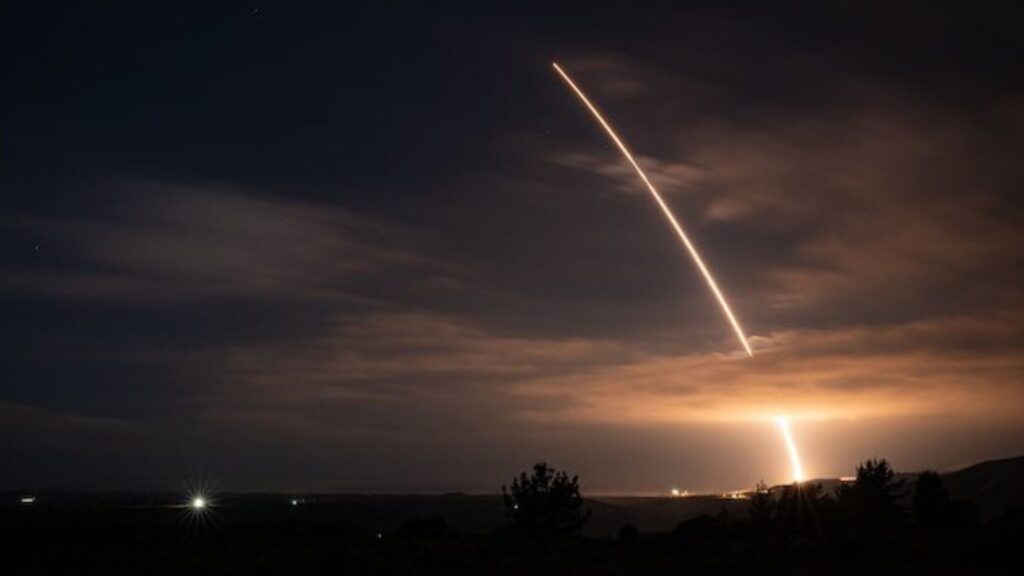
The US Air Force has carried out a test launch of its Minuteman III Intercontinental Ballistic Missile (ICBM), demonstrating the missile’s long-range capabilities and its ability to deploy multiple reentry vehicles.
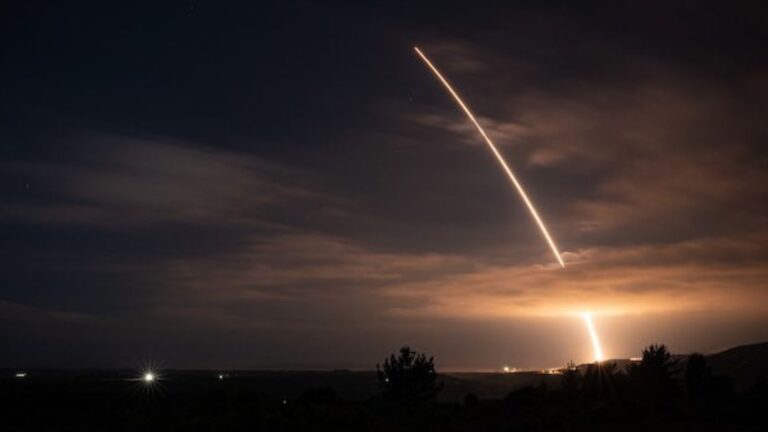
The unarmed missile was launched from Vandenberg Space Force Base in California as part of a scheduled test mission known as Glory Trip 255 (GT-255). The missile traveled thousands of miles across the Pacific Ocean before reaching the test range near Kwajalein Atoll in the Marshall Islands.
US military officials said the test was designed to verify the reliability, accuracy and readiness of one of the most important components of the US’s nuclear deterrence system.
“This test was scheduled years in advance and was not in response to world events,” Air Force officials clarified.
However, the launch comes amid rising global tensions and increased nuclear signaling among major powers.
The Minuteman III remains a central part of the US’s nuclear triad. The triad refers to the three main delivery systems for nuclear weapons: land-based missiles, submarine-launched missiles and strategic bombers.
By testing the missile under real operational conditions, the US military aims to maintain confidence in the land-based leg of that deterrence system.
During the GT-255 mission, the Minuteman III carried two test reentry vehicles. These vehicles simulate the payloads that would separate from the missile during the final phase of its flight.
The reentry vehicles were released after the missile had completed most of its journey and was traveling toward the designated impact area in the Pacific Ocean. Military instrumentation at the Kwajalein test range collected detailed data to assess the system’s accuracy and performance.
Why Multiple Reentry Vehicles Matter
The use of two test reentry vehicles was one of the most important aspects of the mission.
Many routine ICBM tests use only one reentry vehicle. However, GT-255 tested the missile’s ability to deploy more than one payload during the same mission.
WATCH ALSO: https://modernmechanics24.com/post/humanoid-robots-unscripted-conversation/
Military officials say this capability enhances a missile’s effectiveness and makes it harder for enemy defenses to intercept it.
The Minuteman III’s payload system was originally designed to carry multiple independently targeted reentry vehicles. Each vehicle could strike a different target.
Although the operational missile force has been configured with a single warhead in recent years to comply with arms control agreements, testing multiple vehicles helps preserve the technical capability.
Analysts say this capability may become more important after the expiration of the New START nuclear arms control treaty, which had limited the number of deployed strategic weapons for the US and Russia.
How the Minuteman III Missile Works
The Minuteman III is a three-stage intercontinental ballistic missile powered by solid fuel. It is designed for rapid launch from hardened underground silos located across the US.
According to US Air Force data, the missile weighs more than 79,000 pounds and can travel over 6,000 miles. The missile’s powerful rocket motors produce significant thrust during each stage of flight.
READ ALSO: https://modernmechanics24.com/post/ai-war-games-nuclear-escalation/
The first stage generates more than 200,000 pounds of thrust, pushing the missile into space. The second and third stages continue accelerating the missile along its trajectory.
By the time the missile completes its powered flight phase, it can reach speeds of about 15,000 miles per hour.
The missile then follows a high-altitude ballistic trajectory, reaching an altitude of roughly 700 miles above Earth before releasing the reentry vehicles.
Each reentry vehicle must survive extreme heat and pressure as it descends back into the atmosphere toward its target.
Beyond the missile, ICBM launches also test the entire strategic strike system used by the US military.
Minuteman III missiles are operated by crews stationed in underground launch control centers. Each control center is staffed by two officers who remain on alert around the clock. They are responsible for monitoring the missile systems and executing launch orders if required.
These launch crews rely on a network of secure communications systems designed to transmit presidential orders quickly during a crisis.
READ ALSO: https://modernmechanics24.com/post/iran-missile-power-strait-of-hormuz/
The US military also maintains an airborne launch control capability. Aircraft equipped with specialized command systems can control missile launches if ground communications are disrupted.
During the GT-255 mission, personnel from all three US missile wings participated in the launch process. Maintenance teams and technical specialists also supported the test.
Officials said the test collected large amounts of performance data, which will be analyzed by several organizations, including the US Strategic Command and the Department of Energy.
Although officials stressed that the launch was planned long before the current conflicts, the test occurred amid rising geopolitical tensions.
The Middle East has seen a sharp escalation after a war between the US, Israel and Iran began in late February. The conflict has already involved missile attacks, airstrikes and retaliatory actions across the region.
At the same time, European nuclear policy has also entered a new phase. France has recently signaled plans to expand its nuclear deterrent strategy and involve European partners more closely in nuclear defense exercises.
WATCH ALSO: https://modernmechanics24.com/post/ai-platform-powers-research-robot/
These developments have drawn criticism from Russia, which has warned that expanding nuclear cooperation in Europe could increase strategic instability.
Against this backdrop, a US ICBM test carries a strong strategic message. Such tests demonstrate that the US maintains a reliable and ready nuclear deterrent even during periods of global uncertainty.
Aging Missile System
The Minuteman III missile has been in service since the 1970s. Although it has undergone numerous upgrades and life-extension programs, it remains one of the oldest components of the US nuclear arsenal.
Because of its age, the Air Force conducts regular test launches to ensure the missile continues to operate safely and reliably.
The GT-255 mission is part of a long series of “Glory Trip” tests carried out over decades. Each test enables engineers and military planners to gather new data on the missile’s performance and identify potential issues.
The US is currently developing a new missile system, the LGM-35A Sentinel, which will eventually replace the Minuteman III.
The Sentinel program aims to modernize the land-based nuclear deterrent with new missiles, launch systems and command-and-control infrastructure.
According to the Air Force, the program is undergoing restructuring, with major development milestones expected in the coming years.
READ ALSO: https://modernmechanics24.com/post/wsu-3d-printed-heart-surgeons-practice/
Initial operational capability is currently projected for the early 2030s, while the first Sentinel test launch is expected around 2027.
As part of the transition process, the Air Force will gradually deactivate older Minuteman infrastructure and prepare missile bases for the new system.
Until the Sentinel missile becomes operational, the reliability of the Minuteman III remains essential for US national security.
Military officials say routine testing, such as the GT-255 mission, helps ensure the system continues to function as expected. These tests provide real-world performance data and demonstrate that the US can execute complex long-range strike operations if necessary.
Maintaining a credible nuclear deterrent requires constant verification of the technology, personnel, and command systems that support it. The GT-255 test represents a carefully planned demonstration that the US still has the capability to carry out long-range strategic missile operations with precision and reliability.