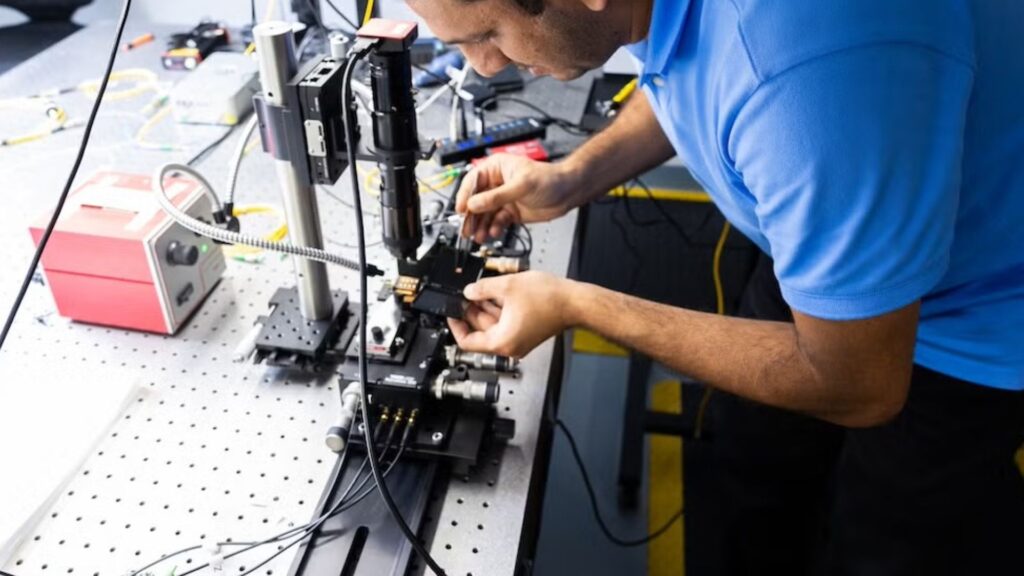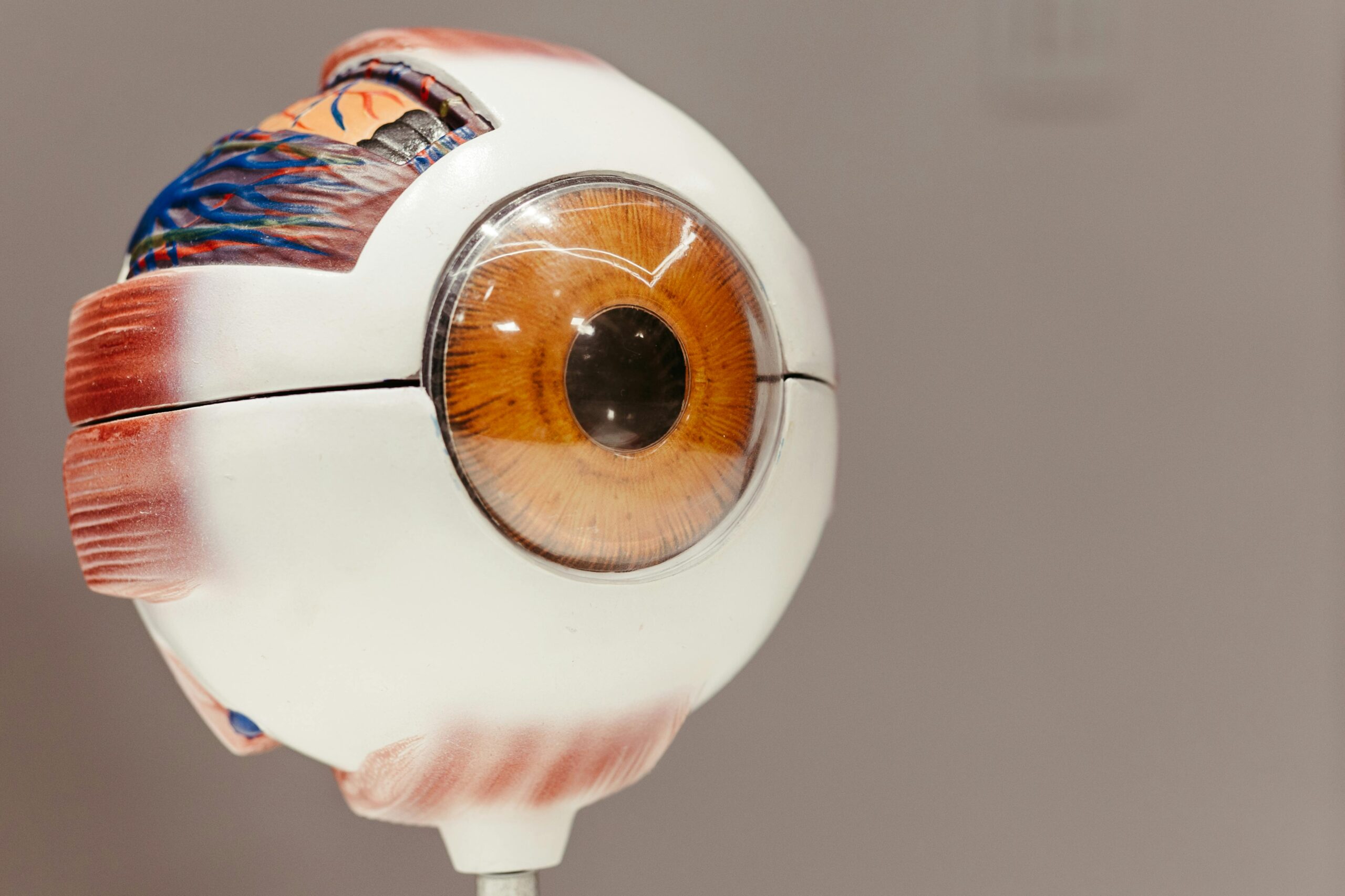
An international research team led by China’s Beihang University has developed a synaptic transistor array that enables machines to detect moving objects four times faster than current state-of-the-art systems—and even faster than the human brain. Led by Associate Professor Gao Shuo, the hardware plug-in reduces autonomous vehicle braking distance by 4.4 metres at highway speed, a margin that separates collision from near miss.
There is a number that keeps safety engineers awake at night. At 80 kilometres per hour, a human driver needs 0.15 seconds to react to a hazard. An autonomous vehicle, burdened by high-definition image processing, takes half a second. In that gap, the car travels another 13 metres.
Machines, for all their sensors and silicon, have been slower than flesh and blood. Now, a team spanning Beihang University, the University of Cambridge, Hong Kong, Saudi Arabia, and the United States has closed that gap—not by replacing cameras, but by giving them a hardware-level reflex.
READ ALSO: https://modernmechanics24.com/post/porsche-cayenne-electric-production-starts/
The product solves a fundamental bottleneck in computer vision. Conventional systems attempt to process entire high-definition frames before identifying motion. This is computationally expensive and slow. The researchers’ approach mimics the human visual system, which does not analyse every pixel; it detects change and flags what moves.
What it actually does for users is filter before processing. At the heart of the system is a two-dimensional synaptic transistor array, a chip engineered to detect image changes in just 100 microseconds—orders of magnitude faster than biological perception. Once it registers motion, it retains that information for over 10,000 seconds and can operate through more than 8,000 cycles without degradation. Only then does it pass the relevant data to standard vision algorithms for detailed analysis.
There is, of course, a limitation. The hardware is a plug-in, not a replacement. It accelerates existing computer vision pipelines rather than reinventing them, which makes it practical for immediate deployment. But the team acknowledges that real-world conditions—variable lighting, weather interference, sensor noise—reduce the efficiency gains slightly compared to ideal laboratory tests. The 213.5 percent improvement in hazard detection and 740.9 percent boost in robotic arm grasping were measured under controlled conditions. In vehicles, the system still delivers a meaningful 0.2-second reaction cut, translating to 4.4 metres of braking distance saved.
WATCH ALSO: https://modernmechanics24.com/post/china-sets-maglev-700kmh-record/
The summary value is stark. At highway speeds, four metres determine whether a child runs home or is airlifted to a hospital. As Associate Professor Gao Shuo of Beihang University’s School of Instrumentation and Optoelectronic Engineering put it: “In a traffic accident, these 4 metres often determine whether a collision occurs or it’s just a close call.”
The innovator behind the architecture is Gao Shuo, who co-corresponded the study published in Nature Communications. The engineering was executed by a multidisciplinary cohort of researchers across five countries, including collaborators from the University of Cambridge and King Abdullah University of Science and Technology. Their approach does not overthrow existing camera infrastructure. It inserts a reflex arc between the lens and the processor. “We do not completely overthrow the existing camera system,” Gao explained. “Instead, by using hardware plug-ins, we enable existing computer vision algorithms to run four times faster than before, which holds greater practical value for engineering applications.”
The team tested the system across autonomous driving, drone navigation, and robotic manipulation. For small unmanned aerial vehicles, reaction time improved by at least one third, directly extending endurance and manoeuvrability. Gao confirmed that discussions are already underway with Chinese automotive and drone manufacturers. “We hope to equip autonomous vehicles with this ‘hardware-level reflex’ system, enabling them to respond more sensitively than humans when handling sudden road conditions, thereby fundamentally enhancing the safety of unmanned systems.”
READ ALSO: https://modernmechanics24.com/post/drdo-akhash-ng-missile-trials-success/
The research, published in Nature Communications, represents one of the few documented cases of machine sensory latency falling below that of humans. It is not artificial general intelligence. It is not consciousness. It is something arguably more urgent: a chip that sees a child step into the road and tells the brakes to stop before the driver even blinks.