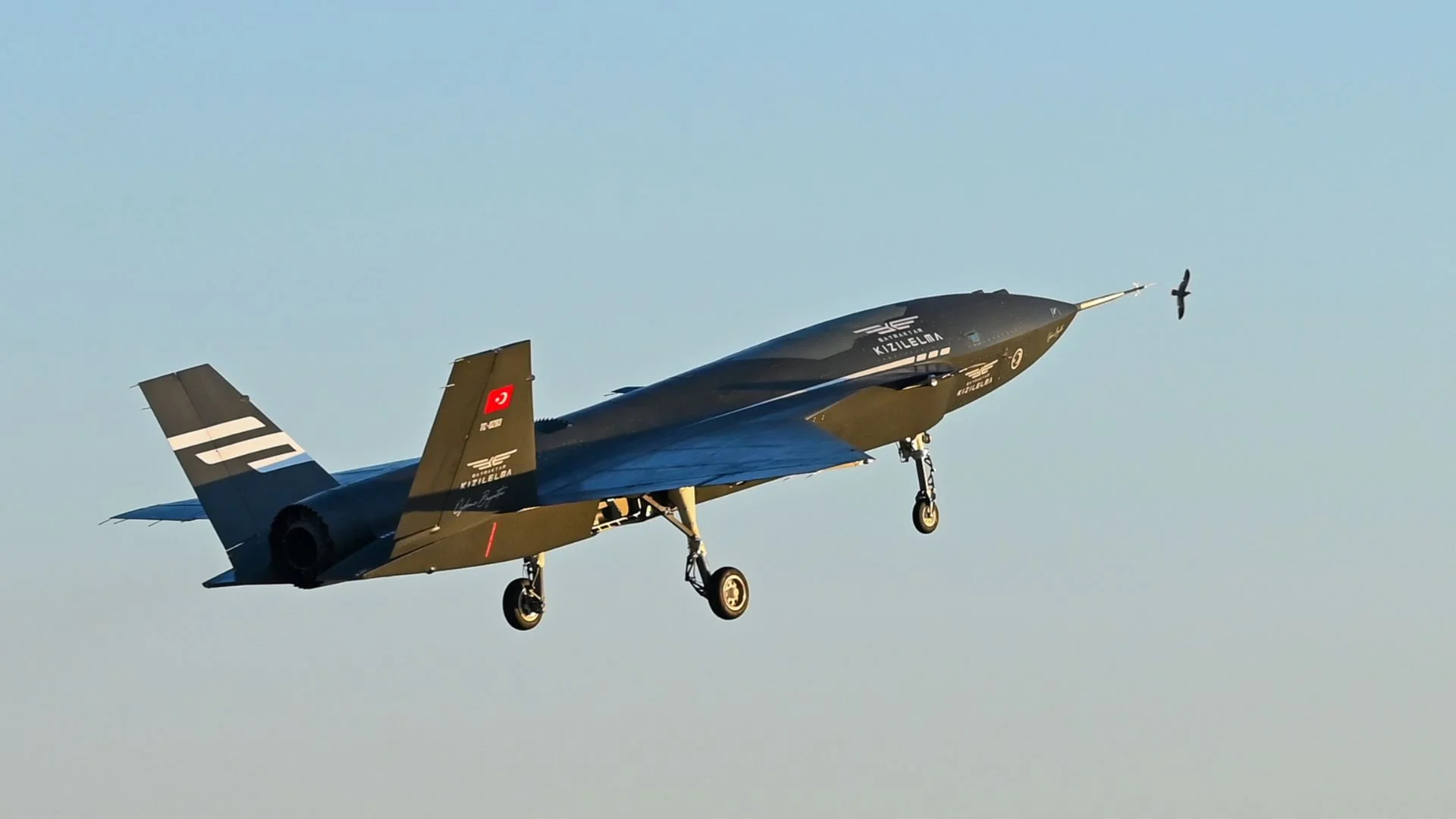
Turkey has successfully completed a new series of flight trials involving its Kizilelma unmanned combat aircraft and Leonardo’s M-346 fighter-trainer jet.
The tests marked an important step toward future air combat systems that combine crewed aircraft with autonomous drones. The project was carried out jointly by Turkish drone maker Baykar and Italian aerospace company Leonardo.
The demonstrations took place in May at Baykar’s flight test center in Çorlu, Turkey. The tests formed the first live phase of the company’s K-SWARM program. The initiative focuses on enabling fighter pilots to work directly with combat drones during missions.
During the trials, the Kizilelma completed taxiing and takeoff without direct human control. The drone then autonomously joined the M-346 Fighter Attack aircraft in formation. After the formation was established, the two pilots aboard the M-346 assumed command of the unmanned aircraft.
The Kizilelma relied on Baykar’s Smart Fleet Autonomy software during the exercise. These algorithms were developed and tested extensively before the live demonstrations. The technology allows the drone to understand commands and perform assigned actions independently.
Once connected to the M-346, the drone responded to commands issued from the fighter jet. The aircraft crew instructed the Kizilelma to perform various formation changes and tactical maneuvers. These included position adjustments, separation movements, and rejoining the formation.
The drone carried out these tasks autonomously after receiving the initial commands. The pilots did not need to manually control every movement. This approach reduces workload while allowing crews to manage multiple assets during a mission.
An advanced radio-frequency data exchange system linked the aircraft throughout the test. This communication network allowed information to move between the platforms in real time. Reliable data sharing is considered essential for future crewed-uncrewed operations.
A Leonardo-owned M-346 Fighter Attack aircraft participated directly in the tests. An Italian Air Force T-346A trainer aircraft also supported the mission as a chase plane. The additional aircraft monitored operations and collected valuable flight data.
Before conducting live flights, the companies carried out extensive virtual testing. Simulated missions were performed using an M-346 full-mission simulator in Italy. Engineers also used Leonardo’s Product Capability and Concept Laboratory in Turin to evaluate tactics and software performance.
These simulations allowed teams to refine procedures before moving into real-world conditions. Potential issues were identified and corrected during the virtual phase. This reduced risk and accelerated progress toward flight testing.
The K-SWARM program represents part of a larger global effort to develop collaborative combat aircraft. These systems pair fighter pilots with autonomous drones that can support missions in several ways. Such drones can gather intelligence, conduct surveillance, carry weapons, jam enemy systems, or act as decoys.
Military planners view these systems as a way to increase combat power without relying solely on expensive crewed aircraft. Drones can perform dangerous tasks while pilots remain at a safer distance. This concept is becoming a major focus for air forces worldwide.
The Kizilelma has emerged as one of the most advanced fighter-style drones currently flying. Development began in 2013, though Baykar publicly revealed the project in 2021. The aircraft completed its first brief flight in December 2022.
Unlike many experimental concepts, the Kizilelma has already progressed to an active flight-test program. It was developed to perform missions traditionally assigned to fighter aircraft. Its design includes features intended to reduce detection by enemy radar systems.
Future versions are expected to reach supersonic speeds. The aircraft is powered by a Ukrainian-made Ivchenko-Progress AI-322F turbofan engine. With the afterburner engaged, the engine produces close to 10,000 pounds of thrust.
Turkey plans to have the Kizilelma operate alongside the country’s next-generation TF Kaan fighter aircraft. The drone is also being discussed as a potential companion to the Hürjet light combat aircraft. Together, these systems could form a layered air combat network.
The Kizilelma has already achieved several notable milestones. In late 2025, the drone successfully launched a Turkish-made Gökdoğan air-to-air missile against a target drone. The event marked one of the first known cases of a combat drone using a radar-guided air-to-air weapon.
The aircraft is also equipped to support advanced sensors. Previous testing has included the Toygun electro-optical targeting system. Trials have also involved an active electronically scanned array (AESA) radar.
READ ALSO: Battleship-Trained AI Learns Smarter Questions, Lifting Win Rates From 8% to 82%
Baykar and Leonardo plan to expand testing in the coming months. Future exercises will introduce more complex scenarios and greater levels of autonomy. The goal is to improve coordination among multiple platforms operating together.
One long-term objective is to move beyond simple remote control. Engineers want drones to make more decisions independently while still operating under human supervision. Human crews would remain responsible for final decisions involving mission execution and weapons use.
This balance between autonomy and human control is considered critical. Military organizations want faster decision-making without removing human oversight. Advanced artificial intelligence is expected to play an increasingly important role in achieving that goal.
Turkey’s latest achievement places it among a small number of nations pursuing advanced crewed-uncrewed air combat operations. The US has conducted several similar experiments involving fighter aircraft and autonomous drones. China is also investing heavily in comparable technologies.
M-346 Commands Kizilelma Autonomously
Russia has reported tests involving the S-70 Okhotnik drone and the Su-57 fighter. However, public information about the level of cooperation achieved remains limited. In contrast, the United States has openly demonstrated drones being controlled from aircraft such as the F-22 Raptor.
The timing of the K-SWARM tests is significant. Many countries are accelerating efforts to field collaborative combat aircraft before the end of the decade. Germany, for example, has identified operational drone wingmen as a future requirement.
Turkey also enjoys an export advantage in the growing drone market. Many of its defense products are not subject to the US International Traffic in Arms Regulations (ITAR). This gives Ankara greater flexibility when offering military systems to international customers.
WATCH ALSO: World’s first motorbike backflip between two moving trucks successfully completed
The combination of the Kizilelma drone, TF Kaan fighter, and Hürjet aircraft could create a unique export package. Customers would gain access to aircraft, drones, and integrated weapons from a single supplier. Such an approach could attract interest from countries seeking affordable advanced air combat capabilities.
For Leonardo, the successful tests also strengthen the M-346 platform’s position. The aircraft already serves as a trainer and light combat jet for several operators. Adding drone-command capabilities could further expand its appeal in the global defense market.
The recent demonstrations represent more than a technology test. They show how future air forces are preparing for a battlefield where pilots and autonomous systems operate side by side.