

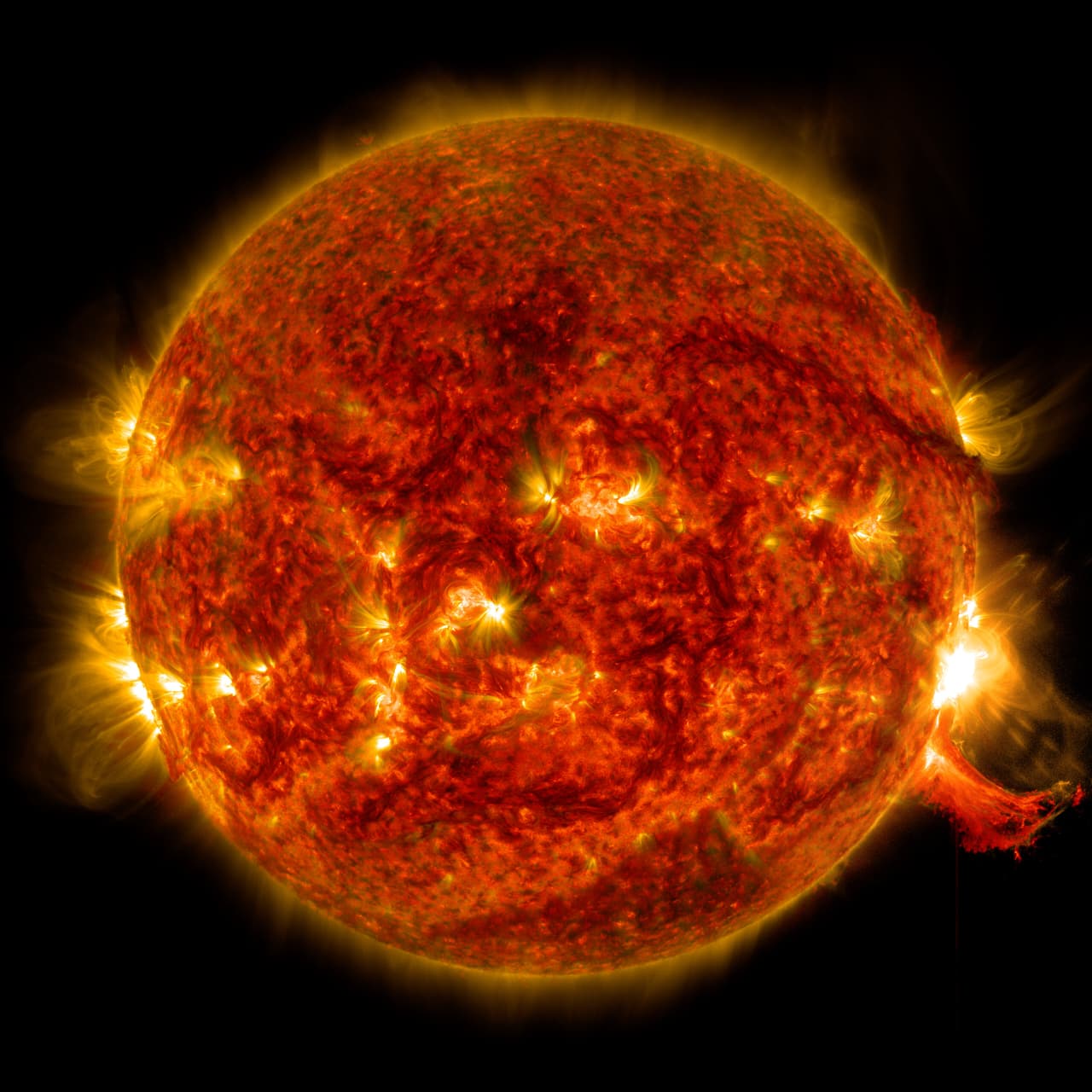
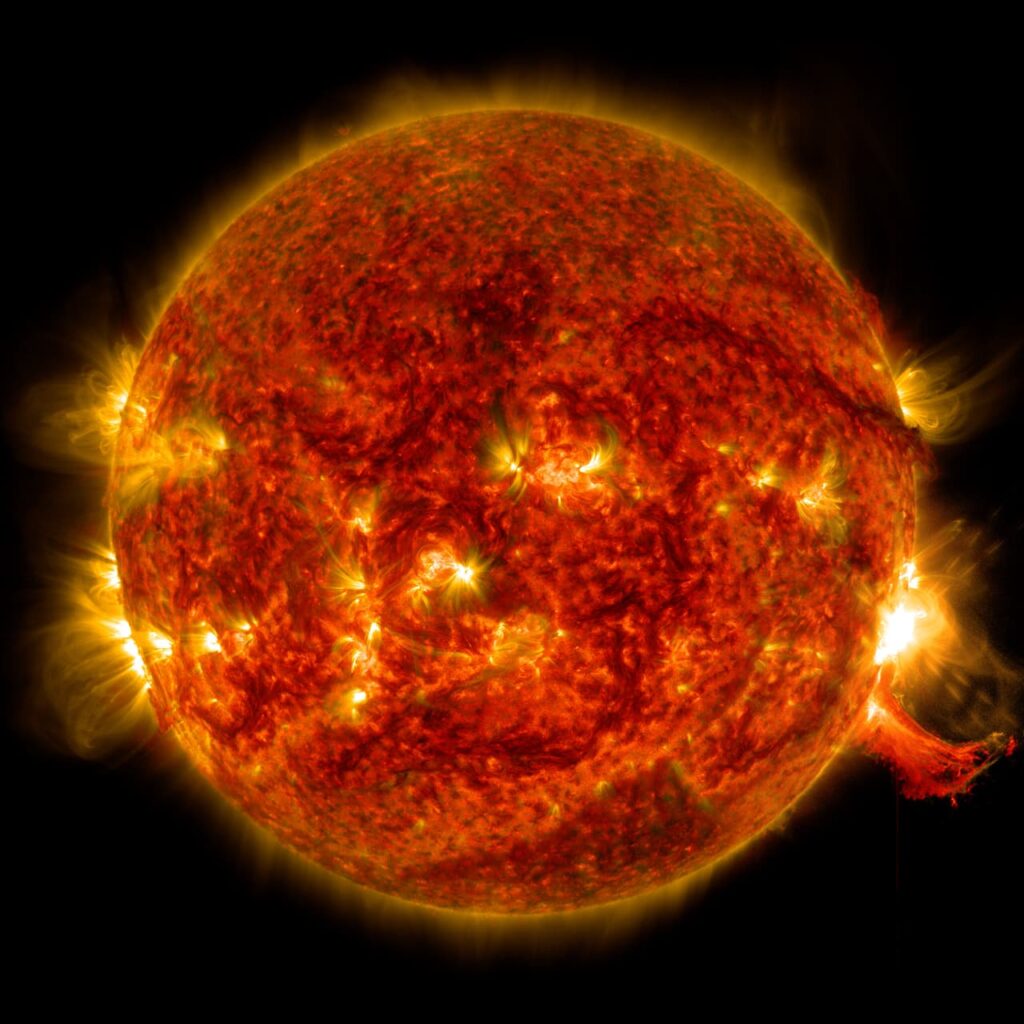
New research has found that the Sun has the physical potential to produce a superflare, an extreme solar eruption far stronger than the flares normally observed from our star.
Scientists reached the conclusion after studying hundreds of solar flares and comparing their energy with the size of the active regions that produced them.
The finding does not show that a superflare is imminent, or establish how often one might occur, but it provides new evidence that the Sun is capable of such an event. The study was led by Natalie Krivova of the Max Planck Institute for Solar System Research in Germany.
The researchers examined observations collected by NASA’s Solar Dynamics Observatory between 2010 and 2016 and selected the 300 strongest flares recorded during that period. They then compared the energy released by each flare with the size of the active region on the Sun where it originated.
READ ALSO: https://modernmechanics24.com/post/bae-design-space-force-meo-satellites/#google_vignette
Active regions are parts of the solar surface where magnetic fields are especially strong and complex. They are often associated with sunspots, which appear as darker areas on the visible surface of the Sun. When magnetic fields in these regions become unstable, they can release large amounts of energy as solar flares.
The researchers knew that none of the flares in their 2010-2016 dataset reached superflare levels. Their analysis showed, however, that flare energy followed a statistical relationship with the size of the active region. The team used that relationship to estimate what larger active regions might be capable of producing.
Giant Sunspots Hold Clues
The next stage of the study focused on the largest sunspots recorded during centuries of solar observations.
Sunspots have been systematically observed for about 400 years, giving researchers a long record of unusually large magnetic structures on the Sun. The team used the size of these historical sunspots to estimate the size of their associated active regions and the energy of flares they might have produced.
One important example came from April 1947, when an exceptionally large sunspot appeared on the Sun. It covered about 0.6 percent of the visible solar disk and had a diameter roughly 40 times that of Earth. No superflare was recorded from that sunspot, but the researchers found that a region of that scale had enough potential to produce one in a statistically rare event.
That distinction is important because the study does not claim that the 1947 sunspot produced a superflare. Instead, the result shows that the Sun can create magnetic regions large enough to reach the physical conditions associated with such an extreme flare. Krivova said the Sun therefore has ‘superflare potential’ and can produce massive sunspots that may serve as starting points for extreme radiation bursts.
What Counts As Superflare
A superflare is an exceptionally powerful stellar flare that releases vastly more energy than ordinary solar flares.
Studies of other stars with properties similar to the Sun have found that such events occur roughly once per century when averaged across large populations of Sun-like stars. That figure is a statistical rate across many stars, rather than a timetable predicting when the Sun itself will produce one.
Scientists have also found clues that the Sun has produced unusually intense particle events in the past. Radioactive isotope changes preserved in natural archives such as tree material and ice cores indicate that Earth has experienced episodes of exceptionally strong solar particle radiation.
Researchers have not established that these events were accompanied by superflares, because a flare itself does not leave a lasting physical record.
Extreme particle events and powerful flares are often associated, but they do not always occur together. This means the historical isotope evidence provides useful information about past solar activity, but it cannot by itself confirm that the Sun has previously produced a superflare.
WATCH ALSO: https://modernmechanics24.com/post/us-forces-floating-refueling-station/
Why Solar Weather Matters
The potential significance of a superflare comes from the modern dependence on space and ground-based technology.
Strong solar activity can interfere with radio communications, navigation systems and satellites, while powerful geomagnetic storms can also affect electrical infrastructure. The effects would depend on the strength and direction of the event and on how much material and radiation reached Earth.
The Sun has already demonstrated its ability to disrupt technology on a much smaller scale. The Carrington event of 1859 produced one of the most severe geomagnetic storms recorded in modern history, while the associated flare is estimated to have released only about one-hundredth of the energy of a superflare. Today, satellites and other space-based systems add another layer of infrastructure that can be exposed to severe solar activity.
A major solar eruption does not automatically mean that every system on Earth would fail. Its effects would depend on factors such as the direction of the eruption, the particles reaching Earth, the strength of the resulting geomagnetic storm and the resilience of affected infrastructure.
The new study, therefore, adds another piece to the scientific assessment of extreme space weather. It shows that the Sun’s largest known sunspots can reach a scale associated with superflare-level energy, even though no such event has been directly observed from the Sun.
Watching The Sun Ahead
The researchers stress that their work does not determine how frequently the Sun produces superflares. It also does not establish that the Sun has produced one during recorded history. Instead, the study places a physical limit on what the largest solar magnetic regions may be able to generate.
Future observations will help scientists better understand how magnetic fields build up and release energy on the Sun. Better monitoring also matters for space-weather forecasting, since early warnings can give satellite operators and other infrastructure managers time to take protective measures.
The European Space Agency’s Vigil mission, planned for launch in the 2030s, is designed to provide earlier views of solar activity from a position away from the direct Sun-Earth line.
For now, the new evidence changes one part of the scientific picture: the absence of a directly observed solar superflare does not mean the Sun lacks the ability to produce one. The challenge ahead is to determine how often such extreme events occur and how much warning future generations may have before the Sun unleashes its most powerful eruptions.









One Response