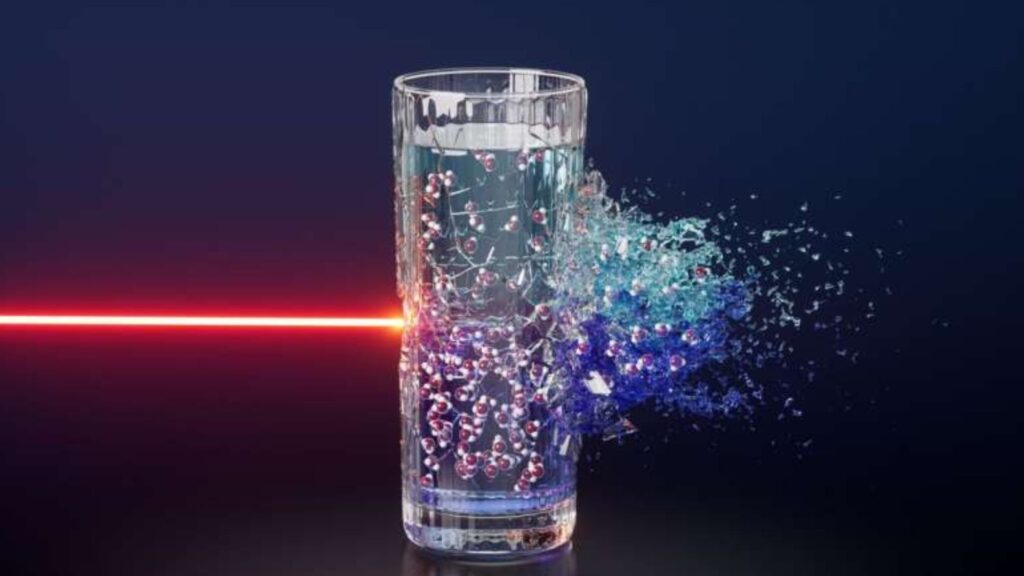
In a striking discovery, researchers at Drexel University have found that liquids can behave like solids and break under extreme stress.
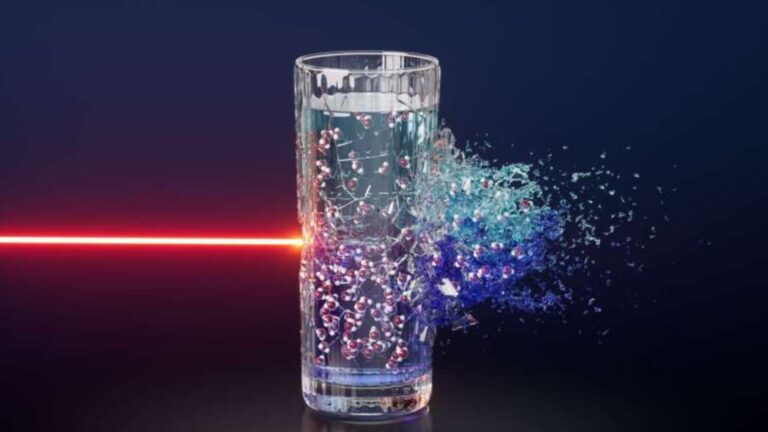
The study, published in Physical Review Letters, shows that simple liquids such as water or oil can fracture when stretched beyond a certain limit.
This finding challenges a basic idea in physics: that liquids flow only under force and do not break like solids. By identifying a clear breaking point in liquids, the research opens a new way of understanding how fluids behave under extreme conditions.
READ ALSO: YouTuber Built a 3D-Printed Fiberglass Dive Helmet and It Actually Works
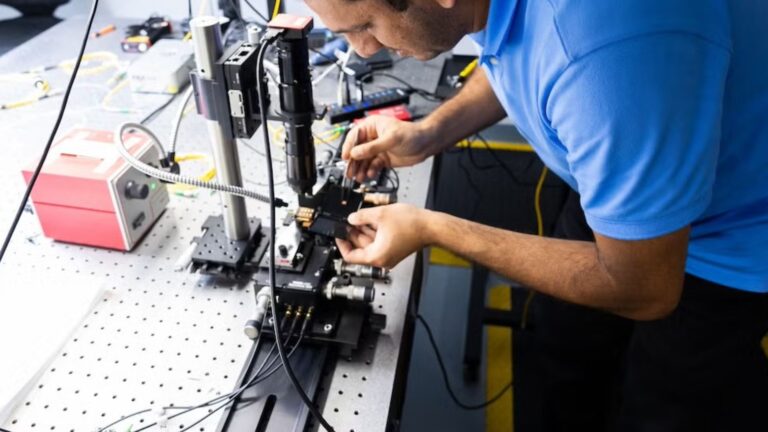
The discovery emerged during experiments designed to measure how viscous liquids respond to stretching. Instead of gradually thinning, the liquid suddenly snapped apart, producing a sharp sound similar to a solid breaking.
The team repeated the tests multiple times and used high-speed cameras to capture the process. What they observed closely resembled brittle fracture, a type of break typically seen in solids such as glass or metal.
Researcher Thamires Lima explained that when a liquid is pulled with enough force per area, it reaches a critical stress point and fractures instantly. This behavior, she noted, appears to apply broadly to simple liquids, not just specific chemical types.
WATCH ALSO: YouTuber captures lightning in a bottle during stunning experiment
The study highlights viscosity, the resistance of a liquid to flow, as the key factor behind this unexpected behavior. Traditionally, fracture has been linked to elasticity, which allows materials to store energy when stretched.
Liquids, however, are not known for storing such energy. They typically deform continuously instead of breaking. But the Drexel University team found that, even without strong elastic properties, viscous liquids can reach a point at which they abruptly fail.
In their experiments, different liquids with similar viscosity fractured at nearly the same stress level, around 2 megaPascals, indicating a consistent threshold.
To confirm their findings, the researchers tested multiple liquids, including hydrocarbon blends and styrene-based fluids. They also changed temperatures to alter viscosity and observed how the liquids responded.
READ ALSO: Chinese Scientists Use Gene-Edited Pig Liver to Treat Liver Failure Patient
Each variation showed a predictable pattern: as viscosity changed, the stretching rate required to cause fracture also shifted, while the critical stress remained nearly constant. At very low viscosity levels, the available equipment could not stretch the liquid fast enough to trigger a break, reinforcing the idea that both viscosity and strain rate are crucial factors.
The results suggest that this fracture behavior may be universal and independent of the liquid’s chemical composition.
The findings raise important questions about the nature of fluids and their behavior under stress. For decades, scientists believed that liquids could only fracture after transitioning into a solid-like state, such as below the glass transition temperature.
However, the Drexel University study shows that a fracture can occur even when the liquid remains fully in its fluid state. This suggests that the phenomenon is not limited to elastic materials and may be more common than previously thought.
Researchers are now exploring possible explanations, including cavitation, where tiny vapor bubbles form and collapse under stress, potentially triggering the fracture.
WATCH ALSO: United Launch Alliance’s Atlas V rocket delivers success for Amazon Leo
Beyond theory, the discovery could have practical implications across several industries. Understanding how liquids break may improve processes like fiber spinning, 3D printing, and fluid transport systems. It could also offer insights into biological systems, such as how fluids behave inside blood vessels under stress.
The research team plans to expand their work to study other liquids and uncover the exact mechanisms behind this behavior. As Lima noted, the next step is to understand why this happens and how widely it applies.
What began as an unexpected observation may now reshape the foundations of fluid mechanics and influence technologies that rely on controlling liquid behavior.