

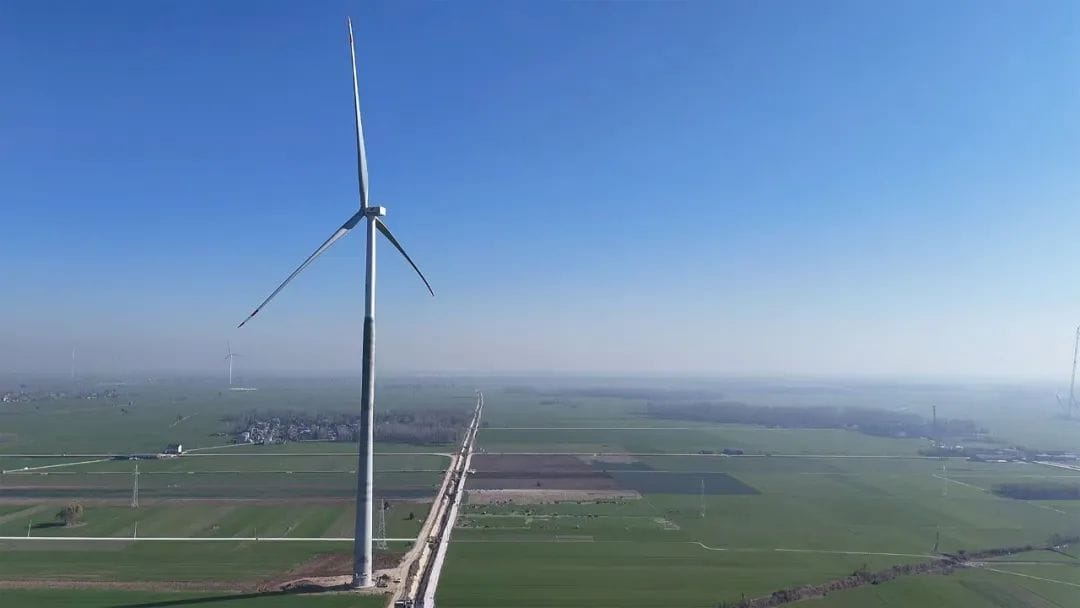
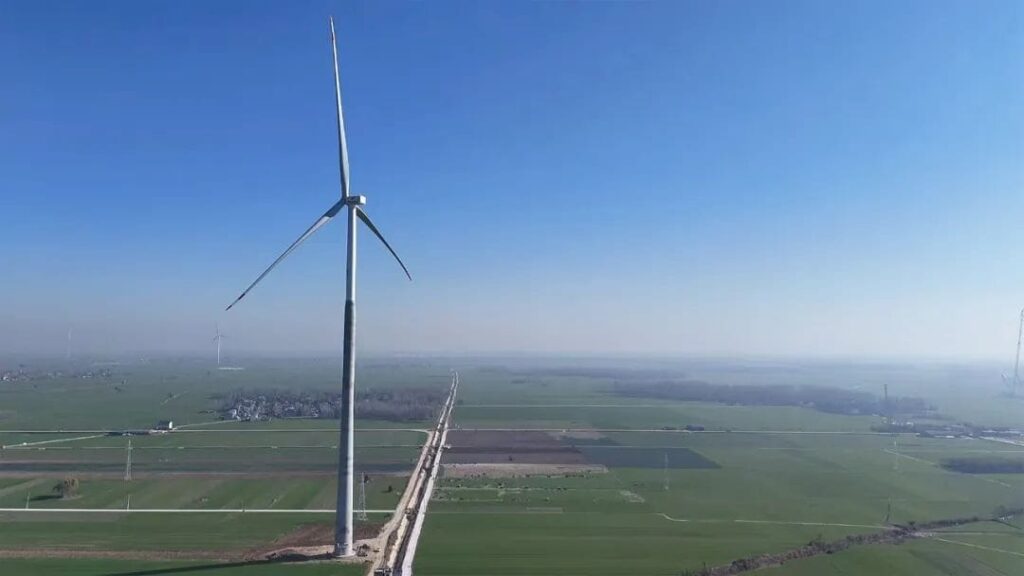
China has completed a 360-metre wind measurement tower at an experimental wind farm in the northwestern region of Xinjiang, expanding efforts to study wind conditions at high altitudes and improve large-scale wind power technology.
The tower has been put into operation at an 800,000-kilowatt experimental wind farm in Mulei county, in the Changji Hui autonomous prefecture, according to the Science and Technology Daily. The publication described it as the tallest wind measurement tower in the global wind power industry.
The facility is designed to collect detailed information on wind conditions at different heights. Researchers will measure wind speed, wind direction, wind shear, turbulence intensity and atmospheric stability.
Wind conditions can change significantly with altitude. Data from different levels of the tower will help researchers understand how airflow behaves above the ground and how those conditions affect wind turbines.
Zhang Ziping, executive deputy general manager of Xinjiang Guochuang Wind Power Technology Co, said the measurements would support research into high-altitude wind energy. He said the data would also help validate the design of larger wind turbines and support the development of new power systems.
READ ALSO: https://modernmechanics24.com/post/mq20-avenger-us-navy-autonomous-mission/
Wind shear refers to changes in wind speed or direction with height. Turbulence describes irregular changes in airflow, while atmospheric stability provides information about how air moves through different layers of the atmosphere.
The measurements are particularly relevant as wind turbines have grown in size and height. Larger turbines can operate at elevations where wind conditions differ from those measured by conventional monitoring equipment.
The Mulei facility is intended to provide data for testing and validating wind power technologies before they are applied more widely. It will also support research into wind measurement equipment, models and methods.
Research Platform For Industry
The operator plans to use the experimental base as an open research platform for wind power technology. Government departments, universities, research institutes and companies are expected to take part in research and testing activities.
The platform will support the standardisation of wind resource observations and the validation of theories and models used in wind energy research. It is also expected to provide a testing ground for new equipment used to measure wind conditions.
Accurate wind measurements are important when developing large renewable energy projects. Developers use such information to assess wind resources, select suitable turbine designs and plan electricity generation.
The new tower adds a research function to a region that is already a major centre for renewable energy production. It will allow scientists and engineers to collect data at heights that are relevant to the operation of increasingly large wind turbines.
Xinjiang Expands Renewable Capacity
Mulei county is located in an area containing 10 major wind zones and five major solar energy zones in Xinjiang. The county has expanded its renewable energy industry in recent years, with wind and solar projects forming a growing part of its power infrastructure.
In 2025, Mulei completed Xinjiang’s first county-level new energy base with both wind and photovoltaic power capacity exceeding 10 million kilowatts. The development strengthened the county’s role in the region’s renewable energy sector.
Xinjiang has expanded renewable generation as part of China’s wider development of wind and solar power. By the end of 2025, the region had six renewable energy bases with installed capacity of at least 10 gigawatts each.
Total installed renewable energy capacity in Xinjiang reached 169 million kilowatts by the end of 2025, accounting for 64% of the region’s total power capacity, according to Xinhua News Agency.
The region’s renewable electricity output is also linked to China’s west-to-east power transmission network. Xinjiang sends electricity to other parts of the country through long-distance transmission lines.
WATCH ALSO: https://modernmechanics24.com/post/xpeng-second-gen-iron-humanoid-robot/
Role In China’s Energy Network
As of March 18, Xinjiang had transmitted 304.36 billion kilowatt-hours of renewable electricity to other regions, according to the local branch of State Grid. Renewable electricity accounted for about 30% of the region’s total outbound power supply.
The growing volume of electricity generated in remote areas such as Xinjiang places greater importance on accurate resource assessment and reliable power-system planning. Wind measurement facilities can provide data needed to improve the design and operation of projects before they are connected to the wider grid.
The research at Mulei is also linked to China’s climate targets. Beijing aims to peak carbon emissions before 2030 and achieve carbon neutrality before 2060.
For Xinjiang, the 360-metre tower represents another step in building research capacity alongside its expanding renewable generation infrastructure. Its long-term value will depend on how the data is used to test turbine designs, improve wind measurement standards and support future wind power projects.






One Response