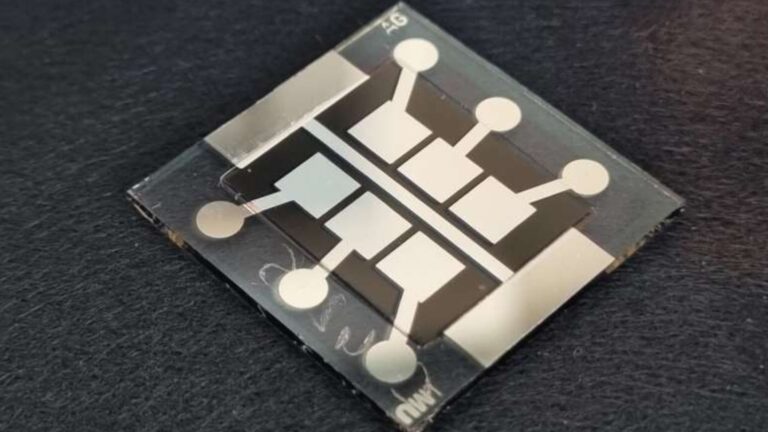
Peking University researchers led by Professor Sun Zhong have supercharged a next-generation analogue AI chip, achieving 12 times the speed and more than 200 times the energy efficiency of state-of-the-art digital processors when handling complex, real-world tasks like personalized recommendations and image compression, according to their new study in Nature Communications.
Remember the bulky, dial-covered computers from mid-century sci-fi movies? The core idea behind them—analogue computing—is making a dramatic comeback. Scientists at Peking University have just turbocharged this old-school concept, creating a chip that could sever artificial intelligence’s draining reliance on power-hungry digital hardware. The breakthrough, reported by Science Daily, moves this technology from solving simple equations to tackling practical AI workloads, marking a potential paradigm shift in how we process data.
So, what’s the big difference? Digital chips, like those from Nvidia, process all information as binary 1s and 0s. Analogue chips, however, use continuous physical signals—like varying electrical voltages—to perform calculations. This allows them to execute many operations simultaneously right where the data is stored, slashing the massive energy cost of shuffling information between separate memory and processor units. “Our study opened a new path for solving complex data problems in real time and highlighted the huge potential of analogue computing for practical applications,” Professor Sun Zhong told Science Daily.
READ ALSO: https://modernmechanics24.com/post/samsung-odyssey-6k-3d-gaming-monitors/
The team’s latest work, building on a landmark paper from October, focused on a powerful data-crunching technique called non-negative matrix factorisation (NMF). This method is brilliant for distilling useful patterns from massive, messy datasets—think figuring out your Netflix preferences from millions of viewing records or compressing a high-resolution image. But as data scales up, digital systems choke on the computational complexity. The Peking University team engineered their analogue chip, built with resistive memory arrays, to perform the most demanding part of the NMF algorithm in a single, lightning-fast step.
The results are staggering. When training recommendation systems on datasets comparable to those of Netflix and Yahoo, their prototype smashed digital rivals. It wasn’t just a modest gain; it delivered a 12-fold speed boost while sipping just 1/200th of the energy. In image compression tests, it reconstructed pictures with nearly identical quality to digital methods while halving storage needs. A peer reviewer of the Nature Communications paper highlighted these “orders-of-magnitude improvements” as clear evidence of the technology’s industrial potential.
WATCH ALSO: https://modernmechanics24.com/post/humanoid-robots-no-human-control/
Professor Sun holds a particular fondness for the NMF technique, noting in a social media post that he has “loved” it since its proposal in 1999. “It’s deeply rewarding to see it now brought into the realm of in-memory analogue computing, 27 years later,” he wrote. This passion project addresses perhaps the most pressing bottleneck in modern computing: the AI energy crunch. As models grow exponentially, so does the power appetite of the vast server farms that train and run them. A switch to ultra-efficient analogue hardware could dramatically reduce this footprint.
The journey isn’t over. While the chip has proven itself on specific, complex tasks, the broader challenge is making analogue systems as versatile and fault-tolerant as digital ones. Yet, this research decisively proves that analogue computing is no longer a relic. It’s a viable, powerful contender for the future of AI, offering a path to intelligent systems that are not only smarter but also sustainably faster and infinitely more efficient.
READ ALSO: https://modernmechanics24.com/post/microsoft-rho-alpha-robot-dexterity/