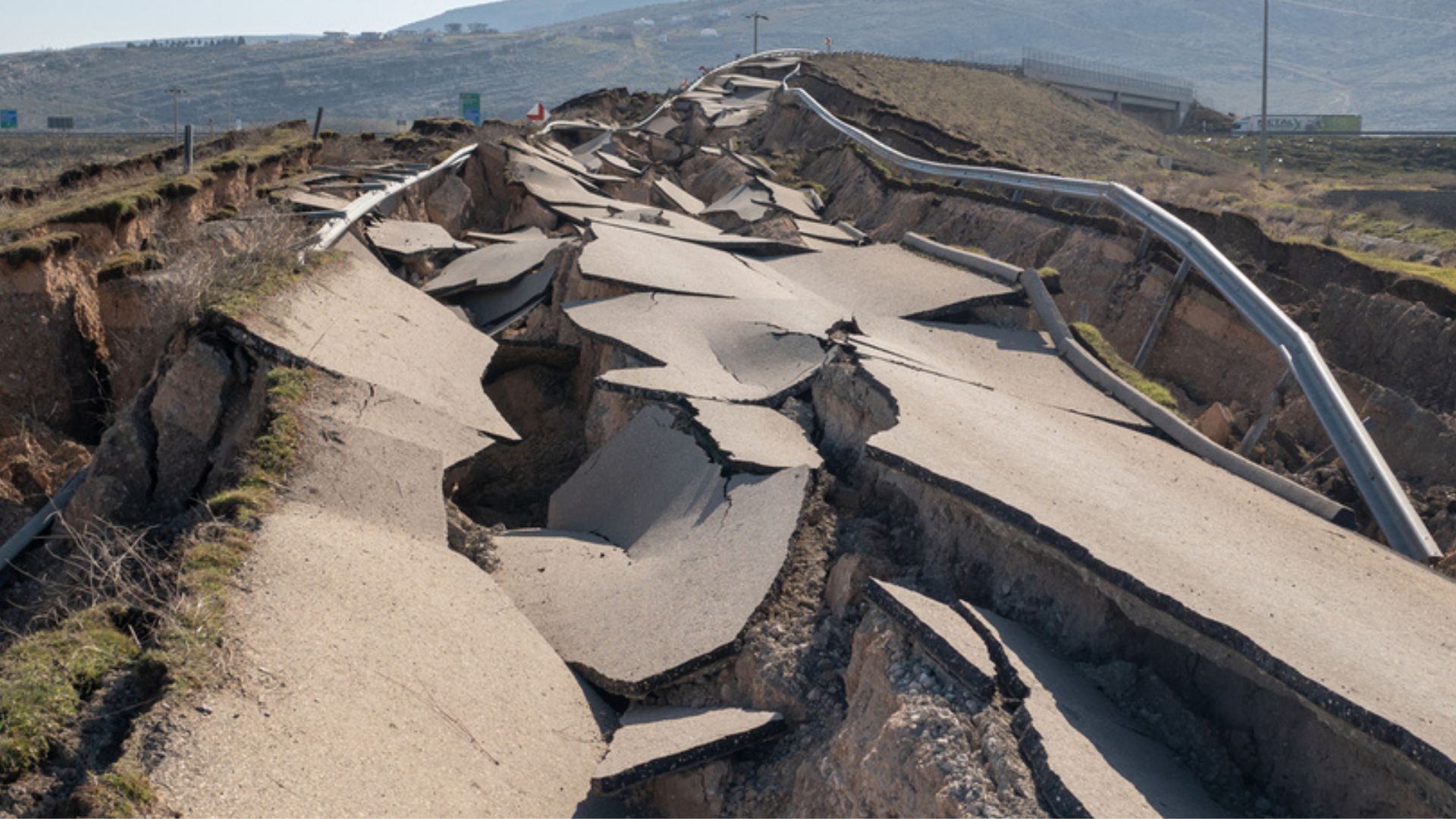
New research from the Massachusetts Institute of Technology suggests that these unusual “boomerang” earthquakes may not be as rare or dependent on complex fault systems as previously believed.
Earthquakes are widely understood to rupture outward from their underground origin, sending seismic waves in one or two directions along a fault.
But scientists have long been researching rare events in which a quake appears to reverse course, shaking the ground it had already passed through just seconds earlier.
In a study published in AGU Advances, researchers report that rupture reversals can occur even along a single, straight fault under specific but surprisingly common conditions.
The findings could reshape how scientists assess seismic hazards in regions once considered structurally simple.
READ ALSO: https://modernmechanics24.com/post/china-2d-semiconductor-wafer-production/
Traditionally, seismologists assumed that back-propagating ruptures were largely confined to complex fault networks. These are the regions with intersecting or branching fractures where seismic energy could ricochet unpredictably. But the new study challenges that assumption.
According to lead author Yudong Sun, a researcher in MIT’s Department of Earth, Atmospheric and Planetary Sciences, these reversal events may have gone undetected more often than scientists realized.
“Our work suggests that these boomerang quakes may have been undetected in a number of cases,” Sun says. “We do think this behavior may be more common than we have seen so far in the seismic data.”
Co-author Camilla Cattania, the Cecil and Ida Green Career Development Professor of Geophysics at MIT, explains that identifying a rupture reversal from ground shaking alone is extremely difficult.
“In most cases, it would be impossible for a person to tell that an earthquake has propagated back just from the ground shaking, because ground motion is complex and affected by many factors,” Cattania says. “However, we know that shaking is amplified in the direction of rupture, and buildings would shake more in response. So there is a real effect on the damage that results. That’s why understanding where these boomerang events could occur matters.”
WATCH ALSO: https://modernmechanics24.com/post/china-6-ton-tiltrotor-first-flight/
What Is Boomerang Earthquake?
In a typical earthquake, stress builds along a fault, a crack in Earth’s crust, until rocks suddenly slip past one another. This release of energy travels outward along the fault in a rupture front, generating seismic waves that can reach the surface.
In a boomerang event, part of that rupture turns around. Instead of continuing in one direction, the quake splits. One portion proceeds forward, while another travels backward along the same path.
This back-propagating front effectively causes parts of the fault to rupture twice in quick succession.
Scientists have observed hints of such behavior before. In 2016, a mid-Atlantic earthquake appeared to move eastward before reversing westward moments later. Similar rupture reversals may have occurred during the devastating 2011 Tohoku earthquake in Japan and the powerful 2023 Turkey-Syria earthquake.
But those events occurred in regions with complicated geological structures, leaving one question: Could a simple fault also produce this behavior?
READ ALSO: https://modernmechanics24.com/post/titanic-sized-electric-ferry-set-record/
Testing Theory
To find out, MIT researchers built a computer model simulating earthquake physics along a straight, single fault embedded in an elastic crust.
They varied key factors: the length of the fault, the location of the quake, and whether the rupture spread in one direction (unilateral) or two directions (bilateral).
Their simulations revealed a striking pattern. Only unilateral earthquakes produced boomerang behavior.
But that alone wasn’t enough. The researchers discovered that rupture reversals depended heavily on how friction changed along the fault during the quake.
“When you see this boomerang-like behavior, it is tempting to explain this in terms of some complexity in the Earth,” Cattania says. “For instance, there may be many faults that interact, with earthquakes jumping between fault segments, or fault surfaces with prominent kinks and bends. In many cases, this could explain back-propagating behavior. But what we found was, you could have a very simple fault and still get this complex behavior.”
WATCH ALSO: https://modernmechanics24.com/post/happy-new-year-2026-from-iss/
Fault Friction
In standard earthquake theory, stress builds along a fault until friction weakens, allowing rocks to slide. This reduction in friction encourages further sliding, a positive feedback that sustains the rupture.
But in MIT’s simulations, friction didn’t simply drop and stay low. Instead, it fluctuated.
“When the quake propagates in one direction, it produces a ‘breaking’ effect that reduces the sliding velocity, increases friction, and allows only a narrow section of the fault to slide at a time,” Cattania explains. “The region behind the quake, which stops sliding, can then rupture again, because it has accumulated more stress to slide again.”
In other words, friction first decreases to initiate sliding, then increases enough to momentarily halt movement, and then decreases again. It triggers a second rupture in the opposite direction.
The team also found that boomerang effects are more likely in larger earthquakes that travel long distances along a fault.
“This implies that large earthquakes are not simply ‘scaled-up’ versions of small earthquakes, but instead they have their own unique rupture behavior,” Sun says.
READ ALSO: https://modernmechanics24.com/post/giant-virus-hijacks-cell-protein/
Why This Matters for Seismic Risk
The implications extend beyond theoretical modeling.
Many simple faults, such as certain stretches of the San Andreas Fault in California, were previously thought less likely to exhibit complex rupture behavior. But if even straight faults can produce back-propagating events, hazard assessments may need to evolve.
Rupture direction influences how seismic energy focuses. Areas in the direction of rupture often experience stronger shaking due to a phenomenon known as directivity. If a rupture reverses, zones behind the initial rupture could experience unexpected intensification.
For infrastructure, that difference can matter.
While individuals on the ground might not distinguish a reversal from normal shaking, the amplified ground motion could alter damage patterns across cities.
Another key finding is methodological. Many current seismic detection techniques may not be sensitive enough to capture subtle back-propagating fronts.
“You shouldn’t only expect this complex behavior on a young, complex fault system. You can also see it on mature, simple faults,” Cattania says. “The key open question now is how often rupture reversals, or ‘boomerang’ earthquakes, occur in nature. Many observational studies so far have used methods that can’t detect back-propagating fronts. Our work motivates us to actively look for them to further advance our understanding of earthquake physics and ultimately mitigate seismic risk.”
WATCH ALSO: https://modernmechanics24.com/post/us-hits-isis-terrorists-nigeria/
As scientists refine detection tools and re-examine past seismic data, the number of recognized boomerang earthquakes may grow.
For now, the study shows that Earth’s crust may behave in more dynamic, less predictable ways than previously assumed. Though simple faults can make earthquakes strike twice, understanding the physics behind that reversal could prove critical in preparing for the next major seismic event.