China has revealed that its space-based solar power program may go beyond clean energy, with the same technology capable of supporting military communication, control, and surveillance.
This revelation comes from Duan Baoyan, a leading scientist behind China’s ‘Zhuri’ or ‘sun-chasing’ space solar program.
In a recent research paper, he explained that the design of the country’s orbital solar power system has been upgraded to handle multiple tasks. These go well beyond energy transmission.
READ ALSO: Plasma Rotation Solves Tokamak Exhaust Mystery, Boosting Fusion Reactor Reliability
Duan, a professor at Xidian University and an academician of the Chinese Academy of Engineering, stated that the system is now expected to support communication, navigation, reconnaissance, interference, and remote control. He emphasized that these features are not separate add-ons but integrated into the system’s design.
One of the most important elements of this technology is the use of highly focused microwave beams. These beams are designed to transmit energy from space to Earth with great precision. While this improves the efficiency of electricity delivery, it also opens up other possibilities.
With such accuracy, the beams can be directed toward specific targets. In theory, this means they could be used to protect sensitive communication channels or disrupt enemy signals. This dual-use capability has drawn attention, as it blends civilian energy goals with strategic military applications.
Space-based solar power has long been seen as a solution to the limits of ground-based solar panels. On Earth, solar energy depends on weather conditions, seasonal changes, and the day-night cycle. In space, however, sunlight is almost constant.
WATCH ALSO: 6-ton tiltrotor aircraft completes first flight in China
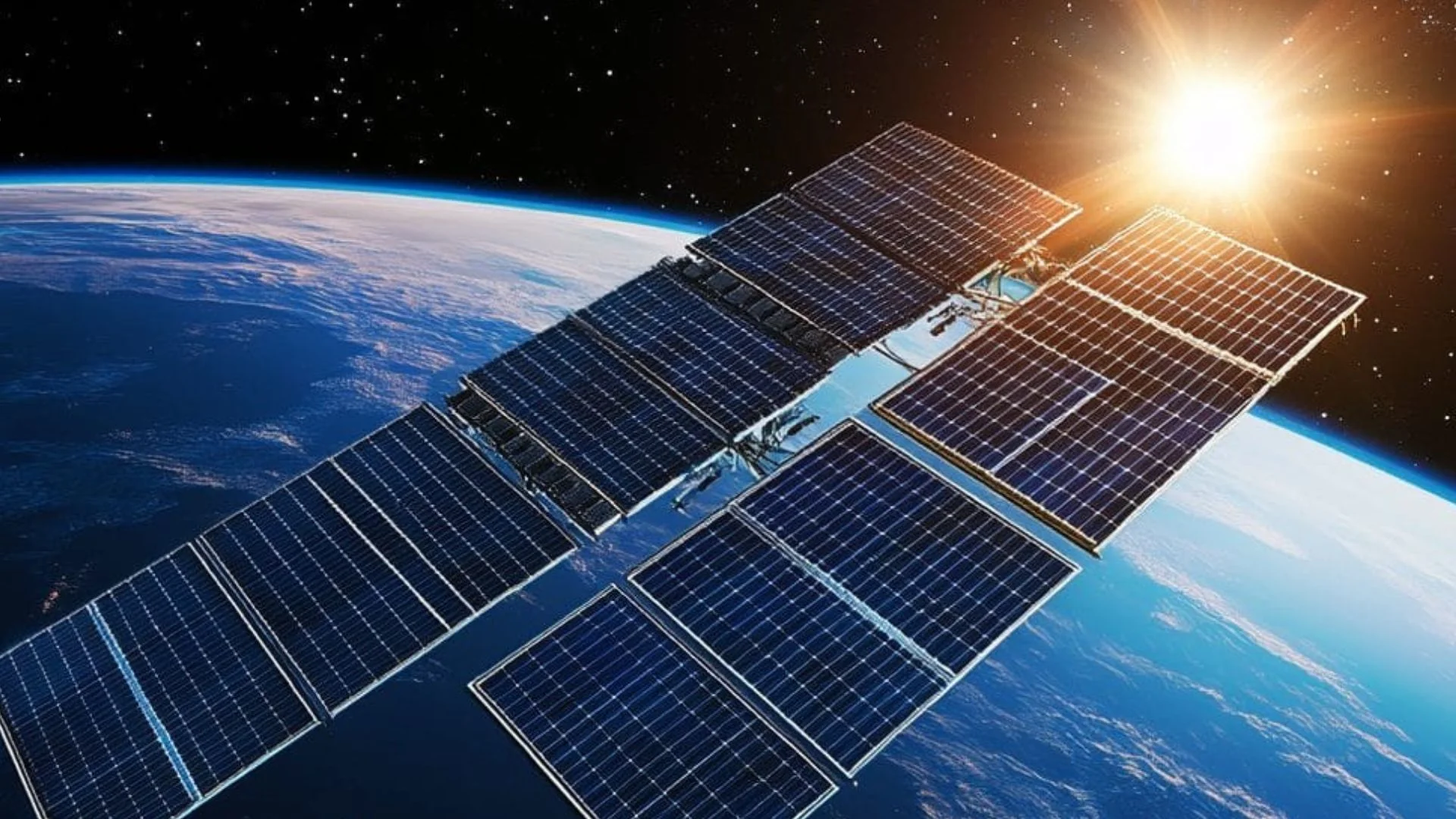
The process works in three steps. First, solar panels in orbit collect sunlight and convert it into electricity. Next, this energy is turned into microwave signals. Finally, these signals are sent to Earth, where receiving stations convert them back into usable power.
China has been working on this idea for more than a decade. Earlier, Duan and his team proposed the Orbit M-shaped Exploration and Gigawatt Application(OMEGA) design. This design served as the foundation for China’s approach to building a large-scale space solar power station.
In 2022, the team completed a 75-meter-long ground-testing facility. This setup successfully demonstrated the full process, including tracking the sun, concentrating solar energy, wirelessly transmitting it, and receiving it at a distance.
In his latest work, Duan has proposed a major shift in design. Instead of building one massive structure in space, the system would now use a modular approach. This means many smaller units would work together as a network.
This change offers several advantages. If one unit fails, the rest can continue operating. It also reduces the difficulty of managing extremely high energy levels in a single structure. Overall, the modular system is seen as more practical and easier to build.
READ ALSO: MIT Engineers Create Soft Gel That Boosts Conductivity 400-Fold with Light
China is not alone in exploring this technology. In the early 2010s, NASA introduced its own concept called SPS-ALPHA. This design also relies on a large number of smaller units working together to collect and transmit solar energy.
Duan noted that China’s OMEGA design may have certain advantages over the American concept. He pointed to a simpler structure, better energy collection efficiency, and improved heat management as key strengths.
Meanwhile, researchers at the California Institute of Technology demonstrated microwave power transmission in orbit in 2023. This marked an important step in proving that the concept can work outside laboratory conditions.
The idea of space-based solar power is not new. Scientists first proposed it in the 1960s. Since then, it has been seen as a way to provide continuous and large-scale clean energy. However, high costs and technical challenges have slowed its progress.
WATCH ALSO: China’s military showcases modern battlefield capabilities in new exercise
China’s latest developments show that the technology is evolving quickly. At the same time, the addition of military capabilities raises new questions about its future use.
As nations expand their investments in space technology, such systems are set to shape not just future energy supply but also global security dynamics.