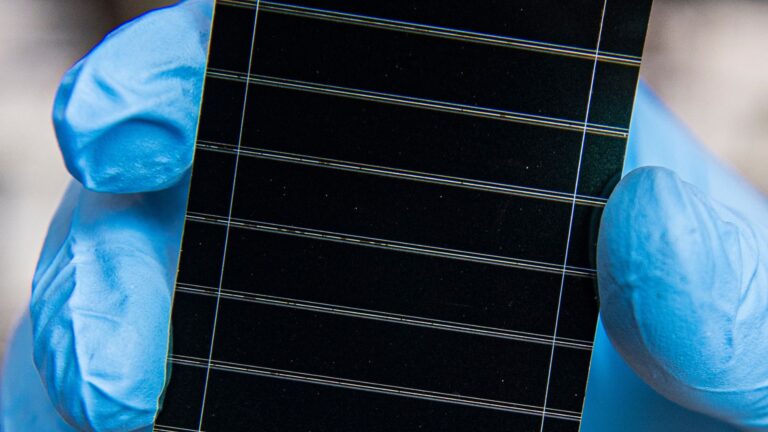
In a surprising twist, scientists at Saarland University in Germany have developed a promising lithium-ion battery anode using iron oxide—common rust—housed inside unique hollow carbon spherogels from the University of Salzburg. This collaboration has yielded a battery material with a progressively increasing storage capacity, offering a more abundant and environmentally benign alternative to problematic cobalt and nickel.
What if one of the most common signs of decay could become a cornerstone of energy storage? While rust is typically a nuisance, materials scientists in Germany and Austria are repurposing it as a key ingredient for the next generation of greener batteries. Their work addresses a pressing issue in our tech-dependent world.
About the product is straightforward: it tackles the environmental and supply chain problems of conventional lithium-ion batteries by replacing toxic, scarce metals like cobalt and nickel with abundant, non-toxic iron. The research, published in Chemistry of Materials, is a transdisciplinary effort. The novel battery anode material was created by introducing iron oxide into ingenious nano-sized carriers developed in Austria.
READ ALSO: https://modernmechanics24.com/post/humanoid-robot-100km-walk-across-china/
The secret lies in the unique structure of these carriers. Professor Michael Elsaesser and his team at the University of Salzburg created porous, hollow carbon spherogels. To visualize them, think of a microscopic, ultra-porous Mozartkugel—the famous Salzburg chocolate. These nanometer-sized spheres provide a vast surface area and a cavity just waiting to be filled. The basic function of the final material is to use these spheres as a robust, conductive scaffold that houses iron oxide nanoparticles, which then store and release lithium ions efficiently.
“The challenge for us is to use chemical synthesis to fill the cavity inside these spheres with suitable metal oxides,” explained Dr. Stefanie Arnold, the postdoctoral researcher at Saarland University who led the experimental work under Professor Volker Presser. After testing other materials, the team focused on iron. “Iron has a number of advantages: it is abundant worldwide, it offers—in theory at least—a high storage capacity, and it’s easy to recycle,” Arnold added.
The synthesis process, based on iron lactate, allowed the team to evenly distribute iron nanoparticles within the carbon framework. But the most fascinating behavior emerged during testing. Unlike typical batteries that degrade, this anode’s capacity increased with use. It took about 300 charge-discharge cycles to reach its peak performance. This is due to a gradual activation process where the embedded metallic iron slowly converts to its higher-capacity oxide form within the carbon matrix.
WATCH ALSO: https://modernmechanics24.com/post/baes-cv90120-tank-modern-warfare/
This collaborative dynamic between the innovator and engineer teams was crucial. The University of Salzburg provided the fundamental carbon spherogel platform—the innovation. The Saarland University team, led by Professor Volker Presser and executed by Dr. Stefanie Arnold, engineered the functional battery material by perfecting the iron oxide integration and electrochemistry.
The summary of its value is significant for a sustainable future. It represents a major step toward eco-friendly energy storage, using harmless, plentiful materials. Professor Presser, who also heads the Energy Materials department at the INM–Leibniz Institute, is optimistic: “We are confident that our approach will facilitate the development of environmentally friendly buffer storage systems for renewable energy.”
However, the path to commercialization isn’t without hurdles. A key limitation is the slow activation time; 300 cycles to reach full capacity is impractical for consumer devices. Future work must accelerate this process. Furthermore, this anode is just one half of a battery; developing a complementary, equally sustainable cathode to create a full cell is the next major challenge.
READ ALSO: https://modernmechanics24.com/post/rolls-royce-smr-skanska-uk-aseismic-demo/
The research, supported by the EnFoSaar project, looks beyond just new materials. The team is also investigating efficient battery recycling methods to close the material loop. “We need efficient recycling methods and closed-loop material systems to minimize resource consumption,” Arnold emphasized. The platform is also being tested for sodium-ion batteries, showing its versatile potential.
By transforming rust from a symbol of waste into a component of high-tech storage, this German-Austrian collaboration is charging toward a more sustainable energy future. It proves that sometimes, the best solutions aren’t found in rare earths, but in reimagining the most common elements around us.