Researchers from the Dalian Institute of Chemical Physics have developed a novel two-electron transfer system for bromine-based flow batteries, dramatically reducing corrosion and enabling stable operation for over 700 cycles. The breakthrough, published in Nature Energy, solves a major bottleneck for scalable, high-energy-density energy storage.
Finding a battery that’s both high-performance and long-lasting for grid-scale energy storage is a holy grail for renewable energy. Bromine-based flow batteries have long been a promising candidate due to their potentially high energy density and abundant materials, but they’ve been held back by a corrosive flaw. Now, a team from the Chinese Academy of Sciences (CAS) has engineered an elegant chemical solution that could finally unlock their potential.
The core problem is simple: during charging, these batteries produce highly corrosive elemental bromine (Br2), which attacks and degrades components, shortening lifespan and hiking costs. While additives can help, they often create new issues like phase separation. The team led by Professor LI Xianfeng from the Dalian Institute of Chemical Physics (DICP) took a fundamentally different approach. They didn’t just try to manage the bromine; they changed the reaction itself.
READ ALSO: https://modernmechanics24.com/post/optical-ai-chip-china-100x-nvidia/
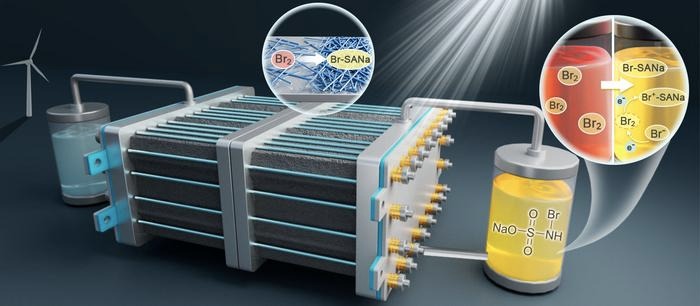
As reported in the prestigious journal Nature Energy, the researchers introduced specific amine compounds into the electrolyte to act as “bromine scavengers.” This clever trick transforms the entire electrochemistry. Instead of the standard one-electron transfer that produces troublesome free Br2, the new system enables a two-electron transfer from bromide ions directly to stable brominated amine compounds.
The result is game-changing. The concentration of free, corrosive Br2 in the electrolyte plummets to an ultra-low level of approximately 7 mM. “This new reaction enables a two-electron transfer from bromide ions to brominated amine compounds, increasing the battery’s energy density,” the team stated, according to the Dalian Institute of Chemical Physics. “Simultaneously, the ultra-low Br2 concentration substantially reduces electrolyte corrosivity, extending battery life.”
They applied this novel chemistry to a zinc-bromine flow battery. With the corrosive threat virtually eliminated, the team could use a low-cost, non-fluorinated ion exchange membrane (SPEEK), slashing system expenses. The performance data is compelling. In a scaled-up 5 kW system test, the battery operated stably for over 700 cycles at a current density of 40 mA cm⁻², maintaining an energy efficiency above 78%. Critically, post-cycle inspection showed no corrosion on key components like electrodes and current collectors.
This move from a lab-scale proof-of-concept to a robust, multi-kilowatt system is a critical step toward commercialization. It tackles the twin challenges of longevity and cost head-on. “Our study provides a novel approach to the design of long-life bromine-based flow batteries and lays the foundation for the further application and promotion of zinc-bromine flow batteries,” explained Professor LI.
READ ALSO: https://modernmechanics24.com/post/china-drone-swarm-refuel-test-us-range/
For the renewable energy sector, this innovation is significant. Flow batteries are ideal for storing energy from intermittent sources like solar and wind for hours on end. By solving the corrosion puzzle that plagued bromine-based systems, the DICP team has opened a clearer path to safer, cheaper, and more durable large-scale energy storage, bringing us closer to a resilient, clean-powered grid.