Researchers in the US have demonstrated a new type of antenna that uses laser-ionized air instead of a conventional metal structure.
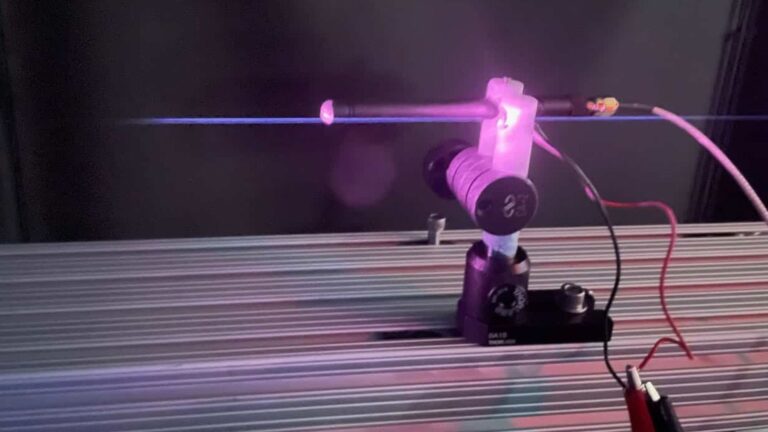
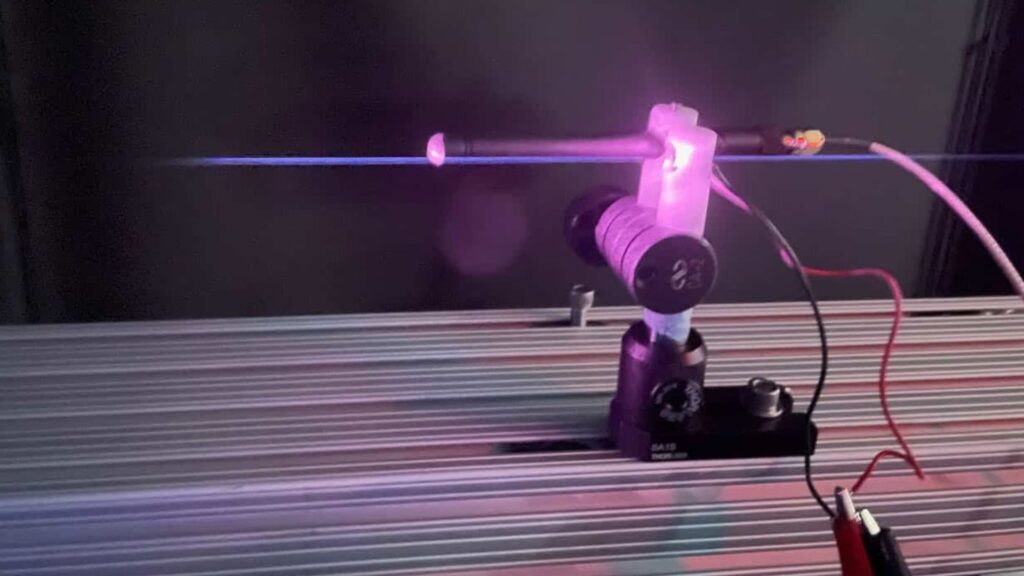
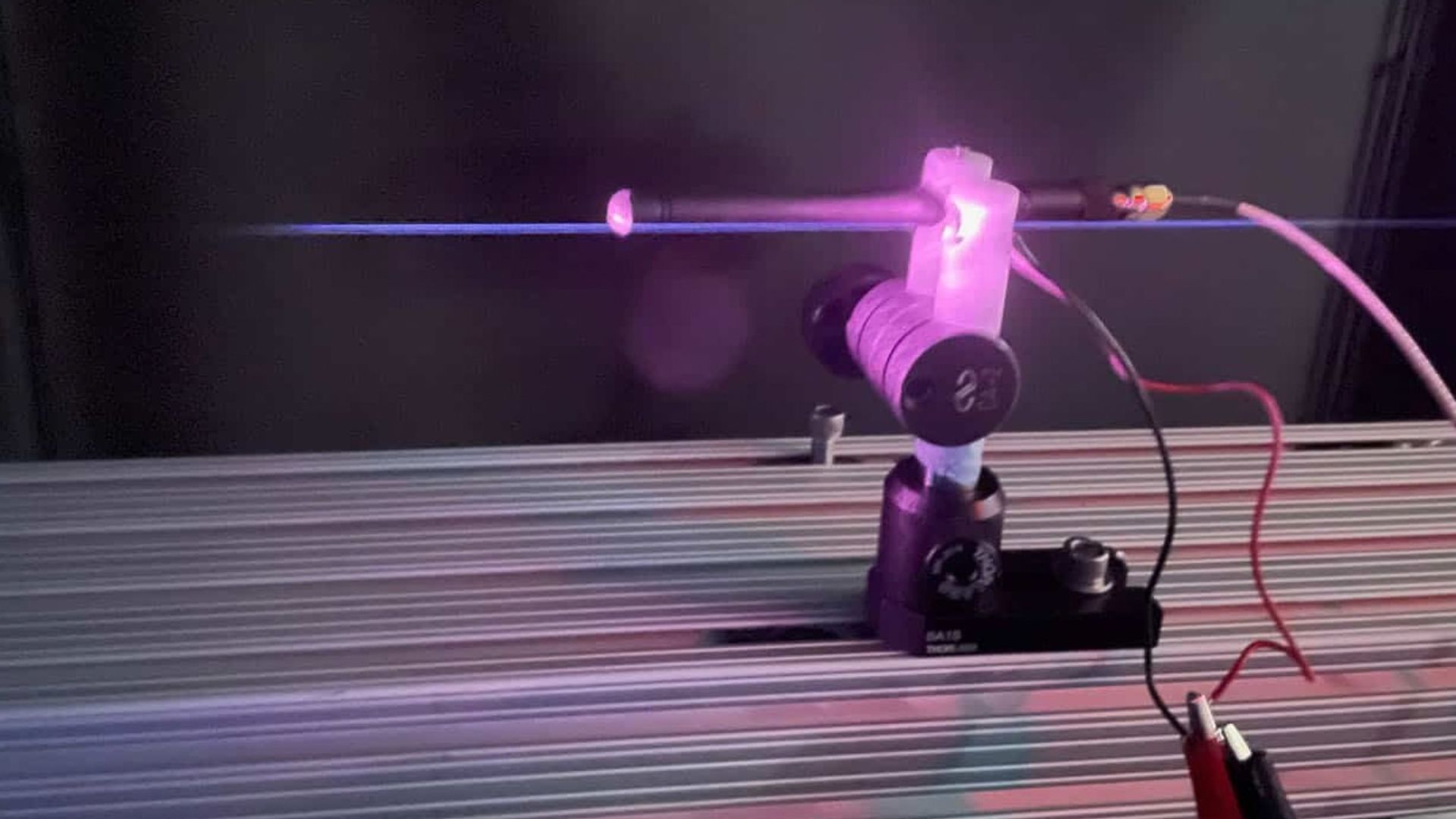
The system creates a narrow plasma filament that resembles a glowing lightsaber and uses it to transmit radio waves at 30 MHz. The work offers a way to change antenna length and direction by adjusting the laser beam.
Researchers at North Carolina State University demonstrated the technique, with measurements supported by researchers at Texas A&M University and Princeton University.
Their study, titled “Laser-Induced-Plasma-Filament Antenna Transmitting 30 MHz VHF,” was published in the IEEE Journal of Microwaves. The research team included Priya Darshni and Paul Franzon from NC State, along with Arthur Dogariu.
A conventional antenna normally relies on a physical conductor to transmit or receive radio signals. Its size and shape affect the frequencies it works at, which can make frequency changes difficult when an antenna must cover a wide range. The new approach replaces part of that fixed structure with a temporary column of ionized air.
The researchers create the plasma by firing a laser through the air at a selected power and diameter. The laser removes electrons from air molecules and produces a thin, defined channel of electrically charged gas called a plasma filament. The length of this filament can then be adjusted by changing the laser parameters.
The plasma filament acts as the antenna’s radiating element. Because the laser controls its length, researchers can change the antenna without physically moving or replacing its components. This gives the system a different approach to frequency tuning compared with conventional antennas.
Contactless Radio Connection
Creating the plasma filament was only one part of the research. The team also needed a way to transfer a radio-frequency signal into the temporary antenna without making direct physical contact with the plasma. This led to the development of a contactless antenna feed based on a metal ring.
The metal ring works as a capacitor around the point where the laser creates the plasma filament. A radio-frequency generator sends a signal into the capacitor, which produces an electromagnetic field around the plasma. That field interacts with the ionized air, allowing the filament to transmit the radio signal.
This arrangement avoids the need for a conventional electrical connection directly attached to the plasma. The laser passes through the metal ring while creating the filament inside it. The researchers demonstrated the system transmitting a signal at 30 MHz in the very-high-frequency (VHF) band.
READ ALSO: https://modernmechanics24.com/post/blue-pigments-platinum-hydrogen-fuel/
The approach also separates the laser system from the radio-frequency signal path. This makes it possible to change the antenna’s physical characteristics with the laser while keeping the radio-frequency source in place. The result is a temporary antenna whose dimensions are controlled through light.
Steering Signals With Lasers
The researchers say the laser offers control beyond antenna length. By changing the direction of the laser beam, they can also change the plasma filament’s angle. This provides a way to steer the antenna without using mechanical systems to move a physical antenna.
A steerable antenna has applications in systems that need to change the direction of a transmitted or received signal. Radar systems, for example, often need to scan different areas without constantly repositioning large mechanical structures. A laser-controlled plasma filament provides a possible alternative for some such applications.
The technique also has potential for frequency scanning. Since antenna length affects its operating frequency, changing the plasma filament’s length gives researchers a way to tune the antenna. Darshni said the method may be useful in applications that require an antenna to sweep across different frequencies.
The present demonstration focuses on transmission. The team has not yet demonstrated the same plasma filament functioning as a receiver for incoming radio signals. Darshni said there is no apparent reason the concept would not also work for receiving signals, but that capability still requires experimental testing.
Space Applications Under Study
Space systems are one area the researchers are examining for the technology. Antennas used on spacecraft must fit within strict limits on mass, size and deployment hardware. A laser-generated antenna offers a different way to create and adjust an antenna after a spacecraft is operating.
The researchers are particularly interested in low Earth orbit. Although space is generally associated with a vacuum, the upper atmosphere in low Earth orbit contains enough residual air for the team to consider forming plasma filaments. Franzon said the air at these altitudes is sufficient to create plasma.
A system based on this concept may reduce the need for complex mechanical antenna deployment mechanisms.
Instead of carrying a large antenna that unfolds into a fixed shape, a spacecraft may use a laser to create a temporary antenna with the required dimensions. This approach remains in early research and needs further testing before operational space use.
The team describes the present experiment as an initial demonstration of the concept. Future work will focus on improving the antenna’s performance and understanding how its properties change with different laser settings and operating conditions. Researchers will also need to test wider frequency ranges and investigate its ability to receive signals.
The study establishes that a laser-generated plasma filament can transmit radio waves when combined with a contactless radio-frequency feed. Its ability to change length and direction through laser control gives researchers a new way to design adaptable antennas.
Further development will determine whether the concept can move from a laboratory demonstration to practical systems for communications, radar, and space technology.