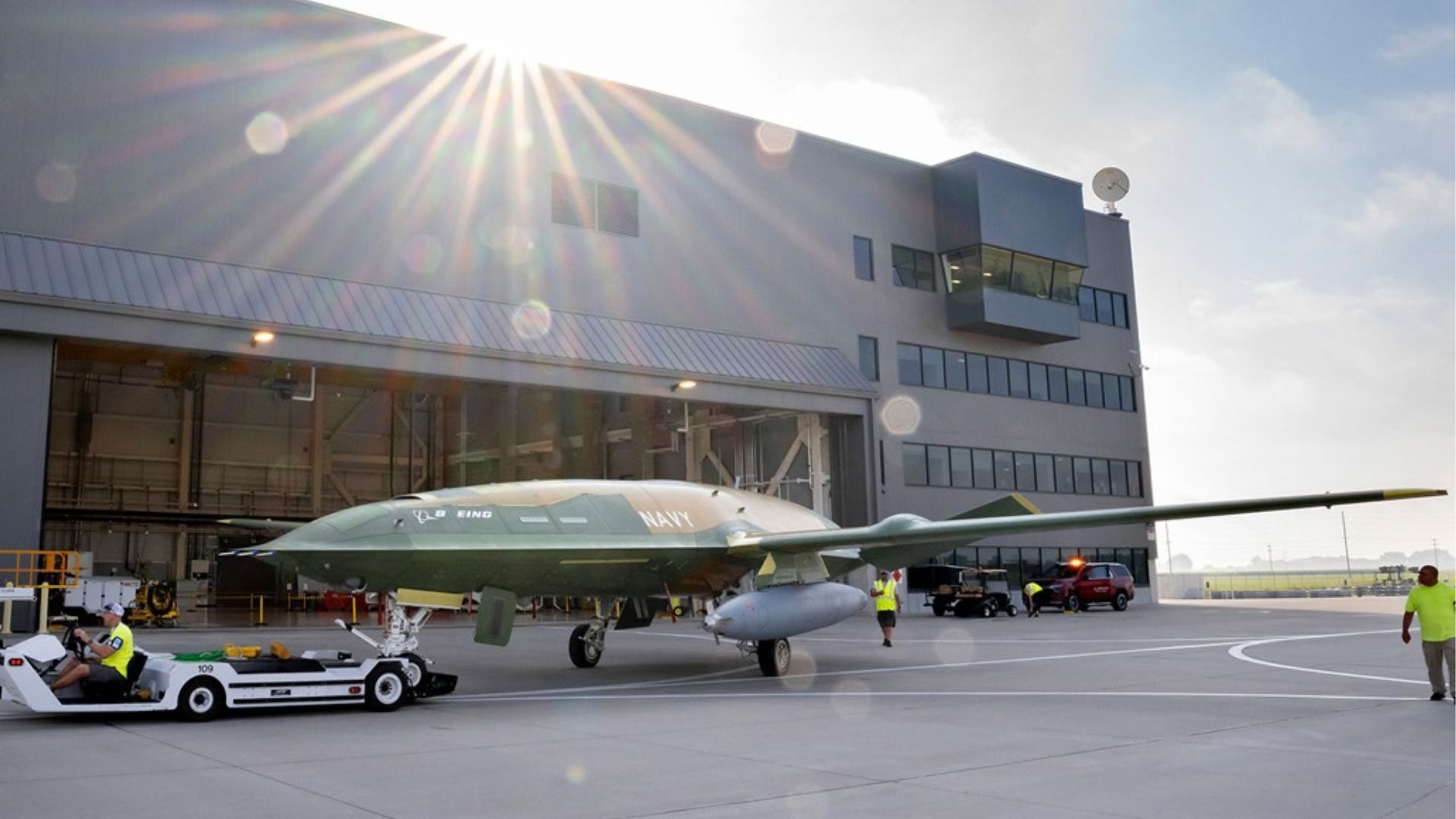
Boeing has tested software that lets crewed aircraft control the unmanned MQ-25A Stingray tanker through the US military’s Link 16 network.
The test moves the US Navy closer to allowing F/A-18 Super Hornet crews to coordinate the Stingray during aerial refueling missions. The capability is intended to make tanker operations more responsive while extending the range of carrier-based aircraft.
The software was tested during the Emerald Flag military exercise at Eglin Air Force Base in Florida. Boeing engineers installed the system on a Beechcraft 1900D, and an E90 King Air used as test aircraft. Test pilots then demonstrated exchanging commands and information between crewed aircraft while flying.
The system is based on Manned Unmanned Teaming (MUM-T) technology.
In simple terms, it allows a crewed aircraft to communicate with and direct an uncrewed aircraft during a mission. Boeing is using open-architecture messaging over Link 16, allowing the software to exchange information through a network already used by US military aircraft.
Link 16 Connects Crews
Link 16 is a secure military communications network that shares information between aircraft, ships, and ground units. It gives participating platforms a common way to exchange tactical data and coordinate operations. Boeing’s approach uses that existing network instead of requiring a separate communications system for every aircraft.
READ ALSO: https://modernmechanics24.com/post/northrop-talon-blue-autonomous-flight/
The Emerald Flag test focused on the communications and command functions before installing them on the MQ-25A. Boeing said the flight testing provided an opportunity to check how the software performs between crewed platforms in an airborne environment. More testing is now planned before the system enters operational aircraft.
“Integrating this software into the MQ-25A will give manned platforms control of aircraft, turning the tanker into a force-multiplier that streamlines refueling operations and expands mission reach,” said Kayla Stice, Boeing’s MQ-25 Advanced Design program manager.
The planned setup gives Super Hornet crews a direct way to coordinate with an unmanned tanker. Instead of treating the tanker as a separate asset that operates independently, the crewed aircraft can manage parts of its mission through the network. This can help align tanker movements with the changing needs of aircraft operating farther from a carrier.
MQ-25 Moves Toward Fleet
Boeing developed the MQ-25A for the US Navy as an uncrewed carrier-based refueling aircraft. Its main role is to refuel carrier aircraft in flight, allowing fighters and other aircraft to spend more time on missions instead of returning to the carrier for fuel. The aircraft is also designed to extend the distance a carrier air wing can operate.
The MQ-25 program has already demonstrated the potential of unmanned tankers. Boeing’s MQ-25 T1 test aircraft became the first unmanned aircraft to refuel another aircraft during testing. The operational Stingray is intended to bring that capability to US Navy carrier air wings.
The tanker matters because it can take some refueling workload away from manned aircraft. That allows more F/A-18E/F Super Hornets to focus on strike and other operational tasks. It also reduces the need to use fighter aircraft for tanker duties, helping preserve their flight hours for combat missions.
The US Navy has also started moving the program toward production. In September, the service awarded the first low-rate initial production contract for three MQ-25A aircraft, along with advance procurement for three more. The first aircraft from that production lot are expected to be delivered in 2029.
Software Expands Future Options
Boeing developed the MUM-T software with the US Navy. Personnel from Boeing’s Phantom Works, MQ-25, F/A-18 and F-22 programs worked together on the system, which the company designed to work across different aircraft types.
The platform-agnostic design gives the software a wider potential role. It may eventually support other Navy and Air Force aircraft that need to coordinate with unmanned systems. This approach matters as US military aviation increases its use of autonomous and remotely coordinated aircraft.
Mark Dunn, Boeing’s MQ-25 Avionics Integrated Product Team lead, said the software will enable the Stingray to coordinate autonomously with crewed platforms. He said the aim is to improve tanker responsiveness, reduce logistical demands and increase the operational tempo of carrier strike groups.
Further flight tests are underway to validate the system. Boeing plans to add the capability to the operational MQ-25A software after the testing and evaluation phase is complete.
The company plans to introduce the capability first on the MQ-25A and F/A-18 Super Hornet. If testing supports wider adoption, the same basic approach may provide a common way for crewed aircraft to coordinate with unmanned platforms across different missions.
READ ALSO: https://modernmechanics24.com/post/mit-muscle-powered-robot-swims-water/
Boeing is developing this capability as it expands its work on future US combat aircraft. The company won the Air Force’s F-47 sixth-generation fighter program in 2025 and was selected for the Navy’s F/A-XX program on September 29, 2026. The F/A-XX is intended to replace the F/A-18 Super Hornet and become part of the Navy’s next-generation carrier air wing.
The MQ-25A and its new control software therefore represent one part of a broader shift toward mixed-crewed and unmanned operations. The next stage will depend on flight testing, software validation, and Navy evaluation.
However, Super Hornet crews will gain a new way to manage unmanned tankers and coordinate refueling while operating farther from the carrier.