The ATLAS Collaboration has observed a new feature of nuclear structure at the Large Hadron Collider (LHC).
Researchers found that nucleons near the edge of a lead nucleus have different internal parton distributions than nucleons closer to its center. The result provides new evidence about how the nuclear environment changes the quarks and gluons inside protons and neutrons.
Atomic nuclei contain protons and neutrons, but these particles have their own internal structure.
Inside each nucleon, quarks and gluons carry different fractions of its momentum, and physicists describe these distributions using parton distribution functions (PDFs). When a nucleon becomes part of a nucleus, its parton distribution changes, an effect first observed by the European Muon Collaboration in 1982.
The finding became known as the EMC effect and has remained an open question in nuclear physics. Nuclear PDFs, often shortened to nPDFs, describe these changes and account for how the nuclear environment modifies the behavior of quarks and gluons. The puzzle is difficult because the energy that binds a nucleon to a nucleus is far smaller than the energy needed to probe its internal partons.
The new ATLAS result adds a spatial dimension to this problem. It indicates that the modification depends on where a nucleon sits inside the nucleus. Nucleons near the nuclear surface appear to have different parton distributions from those deeper inside.
Lead Ions Provide Clues
The ATLAS team studied ultra-peripheral lead-lead collisions at the LHC. In these encounters, the two lead nuclei pass close to each other without directly colliding, while their powerful electromagnetic fields interact. These fields allow one nucleus to emit a photon that strikes the other nucleus in a photonuclear interaction.
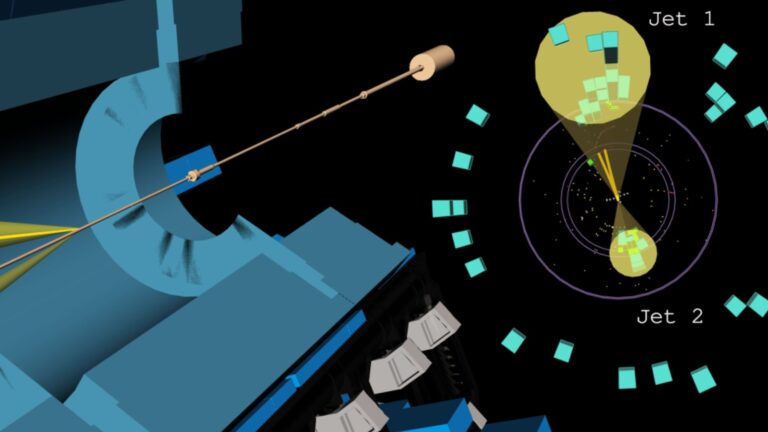
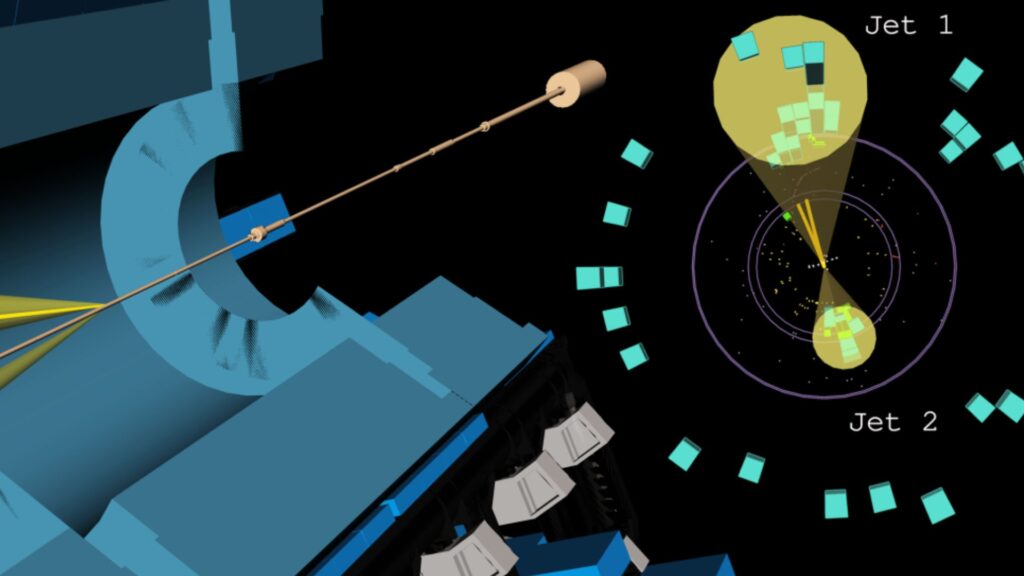
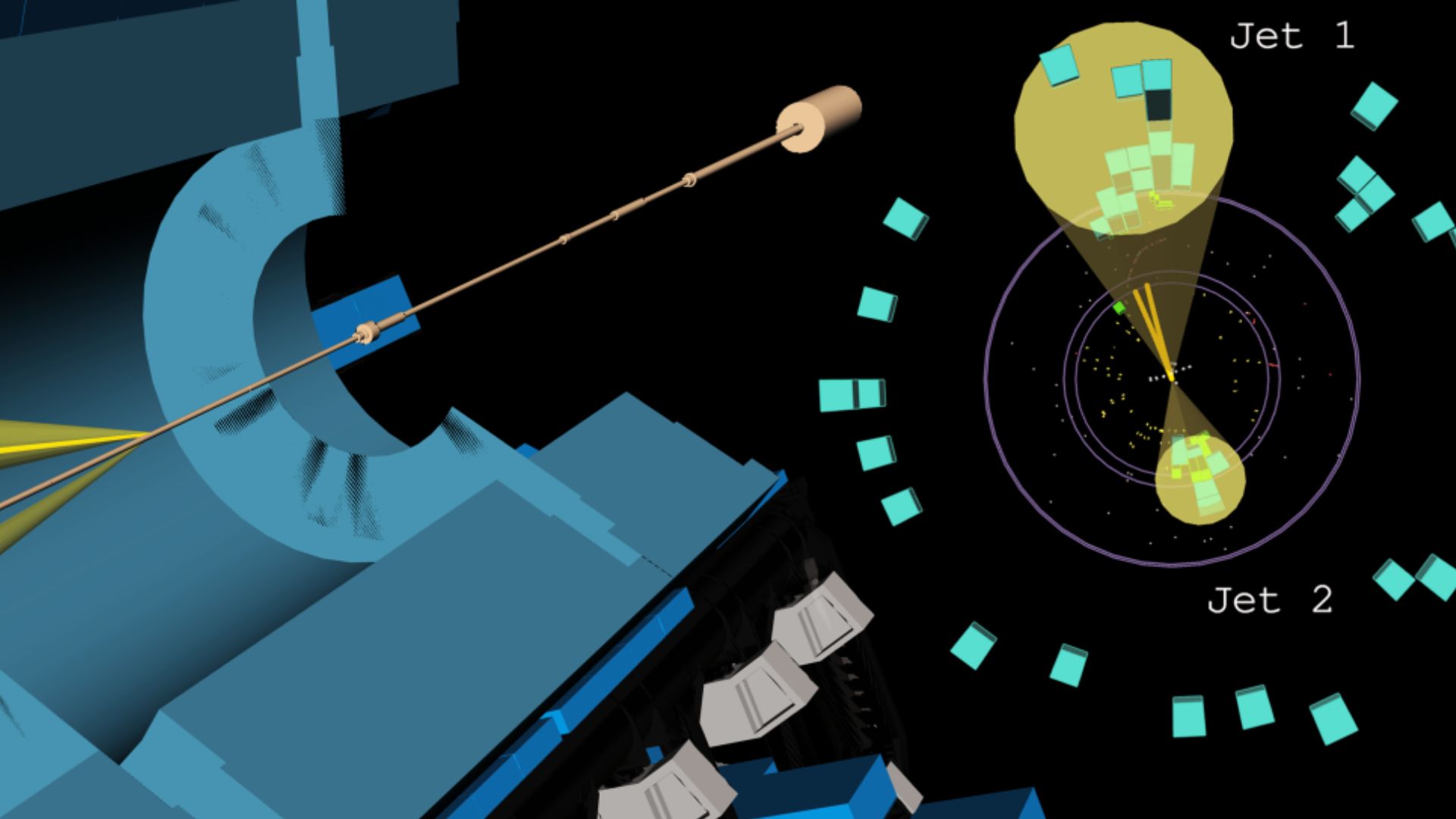
Such interactions can produce narrow streams of particles known as jets. The properties of these jets contain information about the partons involved in the interaction. This gives physicists a way to study the internal structure of nucleons while they remain bound inside a heavy nucleus.
The ATLAS detector also helps identify where the struck nucleon was located. Photonuclear interactions generally disturb the nucleus and produce neutrons that travel close to the beam direction. ATLAS detects these forward neutrons with zero-degree calorimeters (ZDCs) positioned about 140 metres from the collision point.
Surface Nucleons Stand Apart
In most photonuclear interactions, the lead nucleus breaks up and produces forward neutrons. These events are classified as 0nXn, where the side of the struck nucleus produces neutrons. In these events, the struck nucleon may have been located deeper inside the nucleus.
READ ALSO: https://modernmechanics24.com/post/rheinmetall-argotec-surveillance-sat/
A much smaller group of events behaves differently. In about 4% of photonuclear interactions, the photon hits a single nucleon and leaves the rest of the nucleus intact. The absence of forward neutrons from the struck side identifies these events as 0n0n and points to an interaction involving a nucleon near the nuclear edge.
The ATLAS Collaboration used this difference to compare nucleons in different nuclear environments. Researchers analysed lead-lead collision data collected in 2018, with a total integrated luminosity of 1.72 nb⁻¹. They selected events with at least two jets and limited additional detector activity, characteristic of photon-induced interactions.
Jet Data Reveals Structure
The selected events were separated into the 0nXn and 0n0n categories. Physicists then used measured jet properties to construct proxy variables that describe the kinematics of the partons involved. One of these variables, called x₊, estimates the fraction of the nucleon’s momentum carried by the struck parton.
Researchers compared the shape of the x₊ distributions between the two event categories. The ratio of the peripheral and inclusive cross-sections showed a clear slope rather than a flat distribution. This difference indicates that nuclear PDF modifications vary with the nucleon’s position inside the lead nucleus.
The measured result also matched theoretical predictions in which peripheral nucleons retain parton distributions closer to those of free nucleons.
A statistical analysis placed the significance of the observed difference at 6.0 standard deviations. In particle physics, that level of statistical significance provides strong evidence for the observed separation between the two nuclear environments.
Implications For Nuclear Physics
The observation gives physicists new information about the long-running EMC effect. It shows that nuclear PDF modifications are not simply a property shared equally by every nucleon in a nucleus. Instead, the internal distribution of quarks and gluons changes with the nucleon’s location.
This distinction matters for experiments that use heavy nuclei to study high-energy particle interactions. Many measurements involving nuclear collisions rely on nuclear PDFs to interpret their results. If those distributions depend on position inside the nucleus, analysts must account for that dependence when interpreting such measurements.
READ ALSO: https://modernmechanics24.com/post/mit-muscle-powered-robot-swims-water/
The result also provides a new way to test models of nuclear structure. The comparison between surface and interior nucleons links the large-scale geometry of a nucleus with the much smaller-scale structure of its constituent particles. Future measurements can test whether the same behavior appears across different collision conditions and nuclear systems.
Larger Datasets Ahead
The ATLAS result is based on the lead-lead data collected during the LHC’s 2018 run. The experiment now has access to a substantially larger lead-lead dataset from Run 3. This expanded sample will allow researchers to examine nuclear PDF effects with greater statistical precision.
The future High-Luminosity LHC programme will provide another major increase in the available collision data. More precise measurements will help physicists determine how parton distributions change from the nuclear surface toward its interior. They will also help refine models describing quarks and gluons inside atomic nuclei.
The ATLAS observation therefore adds a measurable link between a nucleon’s position inside a nucleus and its internal parton structure. Further LHC data will let researchers test this relationship in greater detail and improve understanding of nuclear PDFs used across high-energy nuclear physics.