

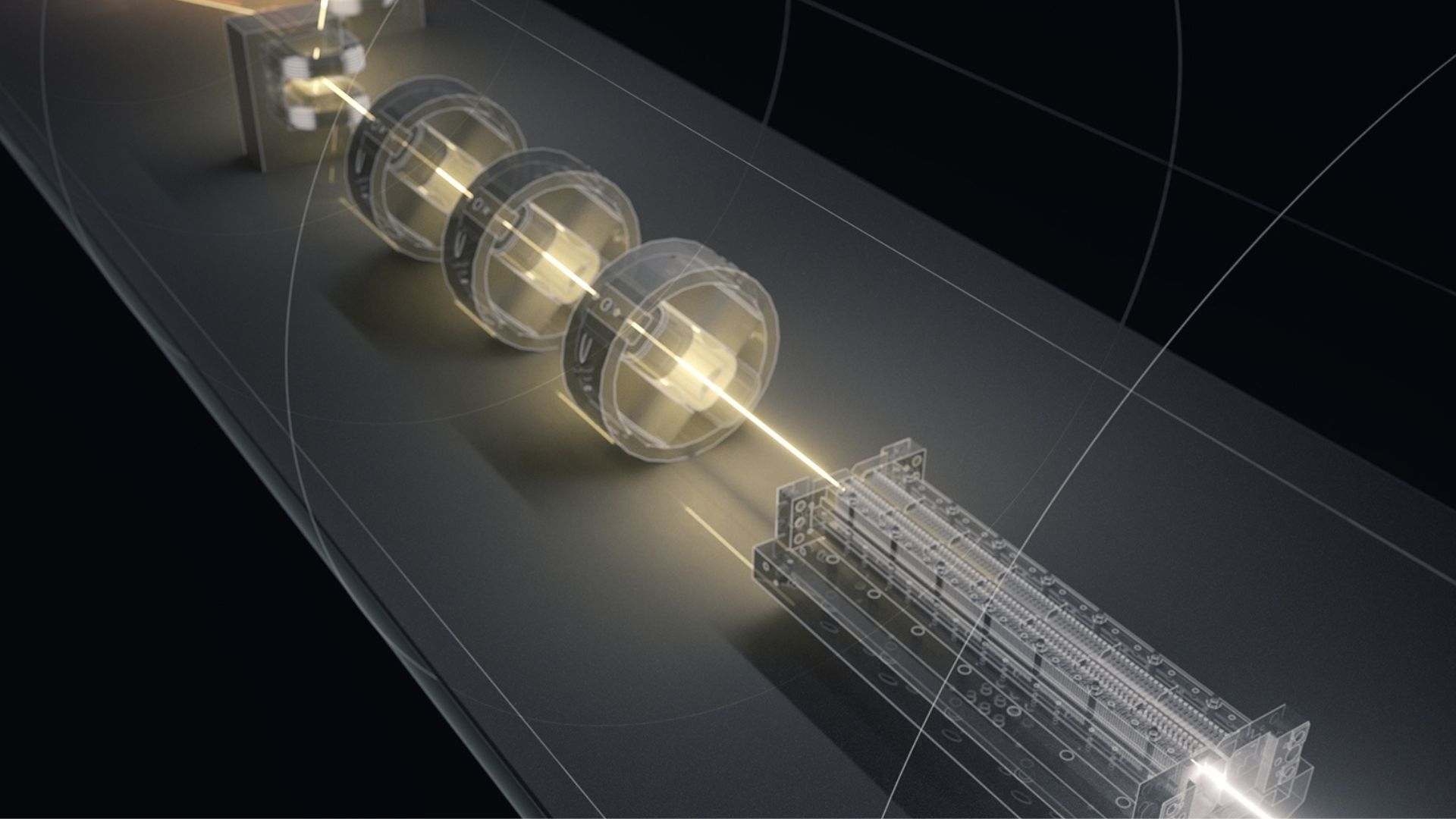
Researchers at Heinrich Heine University Düsseldorf (HHU) are developing a compact approach to X-ray laser technology that may reduce the size and cost of facilities needed to produce high-intensity X-rays.
The project, called Next-Generation X-Ray Laser Light (NEXLIGHT) sources, has received a Proof of Concept Grant from the European Research Council (ERC). The funding will support efforts to turn the research into a commercially viable technology for research, medicine and industry.
X-ray free-electron lasers (XFELs) allow scientists to study matter at extremely small spatial and temporal scales. They generate intense X-ray radiation by sending high-energy electron beams through specialised accelerator systems. The resulting light allows researchers to examine processes and structures at the scale of atoms and molecules.
Current XFEL facilities depend on conventional particle accelerators. These machines can stretch for kilometers and require investment in the billions of euros. Only a small number of such facilities operate worldwide, limiting access to X-ray laser experiments for many research groups and industrial users.
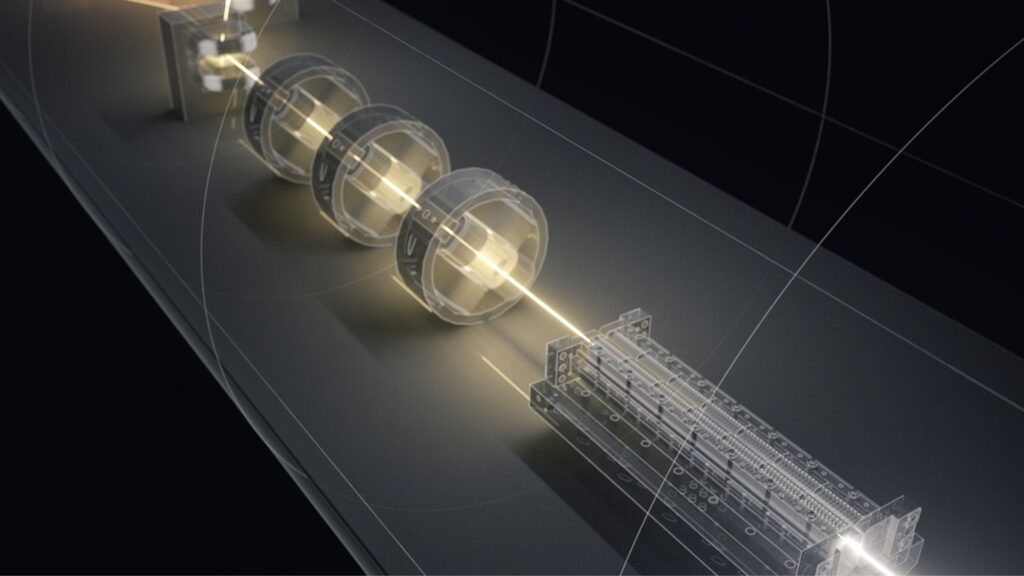
HHU researcher Professor Bernhard Hidding is pursuing a different method. His team uses powerful laser pulses to create plasma and accelerate particles across very short distances. The approach is based on laser-plasma acceleration, which replaces much of the physical length required by conventional accelerator systems.
Accelerating Particles With Lasers
In a conventional accelerator, electric fields accelerate electrons through long structures. Laser-plasma acceleration uses a different process: an intense laser pulse passes through plasma and creates strong electric fields. These fields can accelerate electrons over distances far shorter than those used in conventional machines.
Hidding’s research group says its approach can produce particle accelerators about 1,000 times more compact.
The team also reports electron beams with brightness up to 100,000 times higher than those produced by conventional approaches in relevant contexts. These characteristics form the technical basis for the compact XFEL concept being developed through NEXLIGHT.
The research builds on results from Hidding’s earlier ERC-funded NeXource project. That project demonstrated how XFEL systems based on laser-plasma accelerators can be developed on a much smaller scale and at a lower cost than existing facilities. NEXLIGHT now focuses on moving that research toward practical applications and commercial development.
From Research To Applications
The new ERC Proof of Concept Grant helps researchers assess how results from frontier research can be translated into usable products or services.
NEXLIGHT will use the funding to examine the technology’s commercial potential and develop possible routes toward industrial deployment. The project also aims to identify applications where compact XFEL systems can provide capabilities that are difficult to access through large centralised facilities.
READ ALSO: https://modernmechanics24.com/post/ndbi-nuclear-perpetual-sensor-lorawan/
One proposed model involves regional centres equipped with their own compact XFEL systems. Such facilities would place X-ray laser capabilities closer to universities, laboratories, hospitals and companies. Researchers and industrial teams would therefore have access to the technology without depending entirely on a small number of large international accelerator sites.
Potential applications span several technical fields. These include biomedicine and drug discovery, materials research, semiconductor development, energy research and fusion science. Compact systems may also support technology development where frequent access to intense, short-wavelength X-rays is useful.
Building A Commercial Path
The NEXLIGHT project also supports intellectual property and business development. HHU’s Centre for Entrepreneurship Düsseldorf (CEDUS) and the Gateway Factory will work with the research team on potential applications and commercialization strategies. Their role includes examining business models, protecting intellectual property and supporting the possible creation of a start-up company.
The ERC Proof of Concept programme is available to researchers who have already received ERC funding for frontier research.
In NEXLIGHT’s case, the earlier NeXource project provided the scientific foundation required for the follow-up grant. The new funding will support work that was not part of the original research program but is needed to explore its commercial and societal value.
The project is being developed at HHU’s ARCTURUS Laser-Plasma Facility, where researchers work on laser-driven particle acceleration.
Hidding said compact XFEL systems based on the technology would expand access to X-ray laser radiation. He also described the project as an opportunity for North Rhine-Westphalia to strengthen its position in science and deep-tech development.
Expanding Access To XFELs
The main difference between the proposed system and existing XFEL facilities is infrastructure scale.
Conventional XFELs require large accelerator complexes, while laser-plasma acceleration aims to achieve comparable particle acceleration over much shorter distances. If the technology reaches practical and commercial maturity, this difference may change how X-ray laser facilities are designed and located.
The technology is still moving from advanced research toward commercial development. The NEXLIGHT grant does not itself establish that compact XFELs are ready for widespread deployment. Instead, it funds investigations into applications, protects intellectual property, and determines how the underlying research can be developed into a marketable system.
The longer-term objective is to make powerful X-ray laser tools available in more locations. For scientists, that may mean easier access to experiments involving atomic-scale structures and fast physical processes. For industry, regional compact XFEL facilities may provide another tool for research and development in areas ranging from semiconductors and materials to medicine and energy.
NEXLIGHT therefore represents the next stage of HHU’s work on laser-plasma-based X-ray sources. Its progress will depend on technical development, application testing and the ability to translate the accelerator concept into a reliable commercial system. However, compact XFEL technology may expand the number of places where advanced X-ray research can be carried out.










One Response