Researchers turned blue pigments used in dyes and inks into catalysts for a type of hydrogen fuel cell, delivering more than 900 milliwatts of power per square centimeter without platinum.
A research team from Tohoku University, Technion, Hokkaido University and AZUL Energy developed the catalysts by changing the molecular structure of iron-based phthalocyanine pigments.
In tests at 80 degrees Celsius, the stronger formulation reached 902 milliwatts per square centimeter and operated under a high constant load for 35 hours.
The work addresses one of the main cost and materials challenges facing fuel-cell technology.
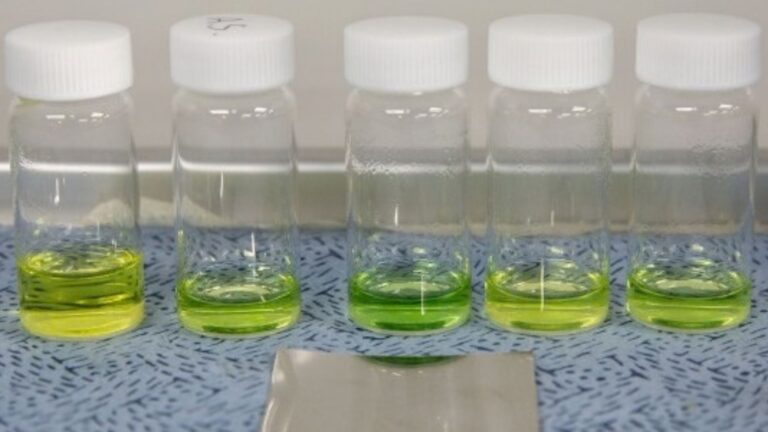
Platinum is widely used at fuel-cell cathodes because it is highly effective at driving the oxygen reduction reaction, but the metal is expensive and subject to resource constraints. The researchers instead used metal phthalocyanines, a class of synthetic pigments whose molecular structures can be modified for catalytic applications.
Why This Result Matters
The study focuses on anion-exchange membrane fuel cells (AEMFCs). These fuel cells operate under relatively mild alkaline conditions, which makes it easier to use catalysts that do not contain platinum. The technology still faces challenges in achieving high power output and maintaining performance over time, particularly with platinum-free cathode catalysts.
The researchers designed two iron tetra-azaphthalocyanines for the cathode. In these molecules, nitrogen-containing ring structures replace the peripheral benzene rings found in conventional iron phthalocyanine. The first material, FeAzPc-4N, was placed on conductive Ketjen Black carbon and named AZ-FT-30, while the more nitrogen-rich FeAzPc-8N8Me became AZ-FO-30.
Electron microscopy and elemental analysis showed that the iron-containing molecules were spread across the carbon support at the atomic and molecular levels. The measurements did not show the formation of larger iron-containing particles. This dispersion gives the catalyst access to a large carbon-supported surface while keeping the active molecular structures separated.
How Blue Pigments Work
The two catalysts had almost identical electrochemical surface areas. AZ-FT-30 measured 155.8 square metres per gram, while AZ-FO-30 measured 157.5 square metres per gram. This similarity allowed the researchers to examine the role of the molecular structure rather than simply attributing the performance difference to a larger available surface.
READ ALSO: https://modernmechanics24.com/post/argonne-passive-cooling-reactors-safe/
The difference became clear during complete AEMFC testing. At 80 degrees Celsius, AZ-FT-30 produced a peak power density of 744 milliwatts per square centimetre, while AZ-FO-30 reached 902 milliwatts per square centimetre. The study reports the latter as the highest power density recorded for an AEMFC cathode based on a metal phthalocyanine.
Power density describes how much electrical power a fuel cell produces per unit area of its active surface. A higher value lets a smaller active area produce the same power, although practical systems also depend on factors such as durability, operating conditions, system design, and cost.
The 902 milliwatt result, therefore, provides a performance measurement for this particular catalyst under the reported laboratory conditions rather than a complete assessment of a commercial fuel-cell system.
Testing The New Catalysts
The stronger AZ-FO-30 catalyst also underwent a constant-load durability test. It operated for 35 hours at a current density of 400 milliamperes per square centimetre, with an average voltage decay of 2.4 millivolts per hour. The test shows the catalyst can operate under a sustained electrical load, while also indicating that longer-term durability remains an important area for further evaluation.
The researchers used density functional theory calculations to investigate why the more nitrogen-rich molecule performed better. Professor Maytal Caspary Toroker and her team at Technion carried out these calculations and focused on how oxygen-related species interact with the catalyst’s iron center. The calculations linked the experimental performance to changes in molecular-scale oxygen binding.
For an adsorbed hydroxyl group, the iron-oxygen distance became shorter in the sequence from conventional iron phthalocyanine to AZ-FT-30 and then AZ-FO-30.
The shortest distance was found for AZ-FO-30, indicating the strongest interaction at the iron active site among the three structures studied. The same pattern held when the calculations included an explicit water molecule, further supporting the link between molecular design and catalytic activity.
Molecular Design Drives Performance
The researchers say the findings show how changing the chemical structure around an active metal centre can alter fuel-cell performance.
Professor Hiroshi Yabu of Tohoku University said careful molecular design helped narrow the performance difference between platinum catalysts and platinum-free alternatives. The study, therefore, focuses on controlling the catalyst’s chemistry rather than relying only on increasing the amount of active material.
The international collaboration brought together researchers in Japan and Israel, along with AZUL Energy. Hiroshi Yabu led the work at Tohoku University’s Advanced Institute for Materials Research, with Dario R. Dekel at Technion, Yasutaka Matsuo at Hokkaido University, and researchers from AZUL Energy also involved.
READ ALSO: https://modernmechanics24.com/post/nel-asa-wins-collins-order-submarine/
The findings were published in ACS Catalysis on September 26, 2026, in a paper titled Advanced Metal-Phthalocyanine-Based Catalysts with Enhanced Oxygen Reduction Reaction Activity for High-Performance Anion-Exchange Membrane Fuel Cells. The paper is identified by DOI 10.1021/acscatal.6c03312.
The results show that blue pigment chemistry can be adapted for a demanding electrochemical role traditionally associated with platinum.
The next step for this class of catalysts will involve establishing how their performance holds up over longer operating periods and under conditions closer to practical fuel-cell systems. If those tests confirm the laboratory results, molecularly engineered phthalocyanines may offer another route to reduce platinum use in future AEM fuel cells.