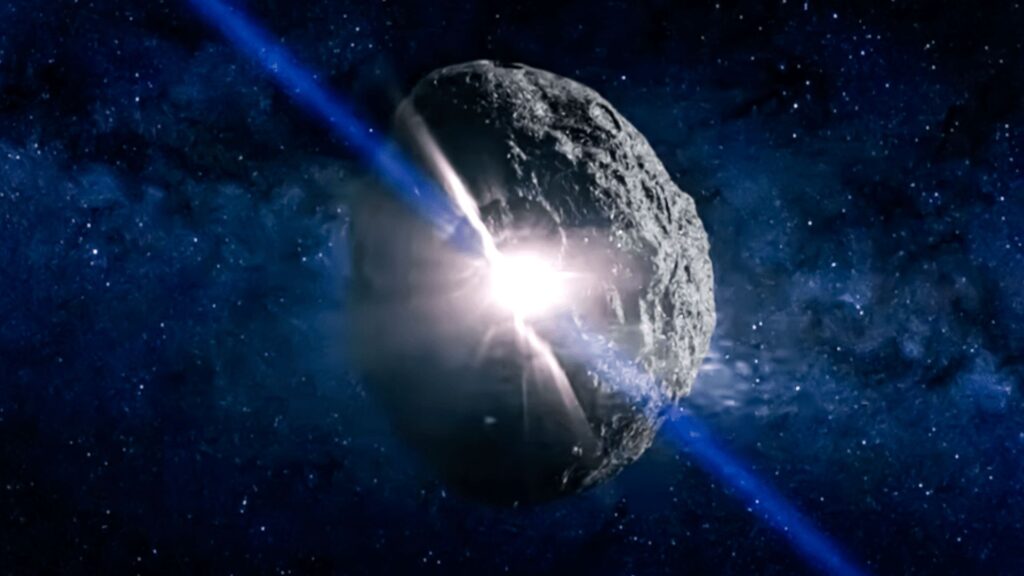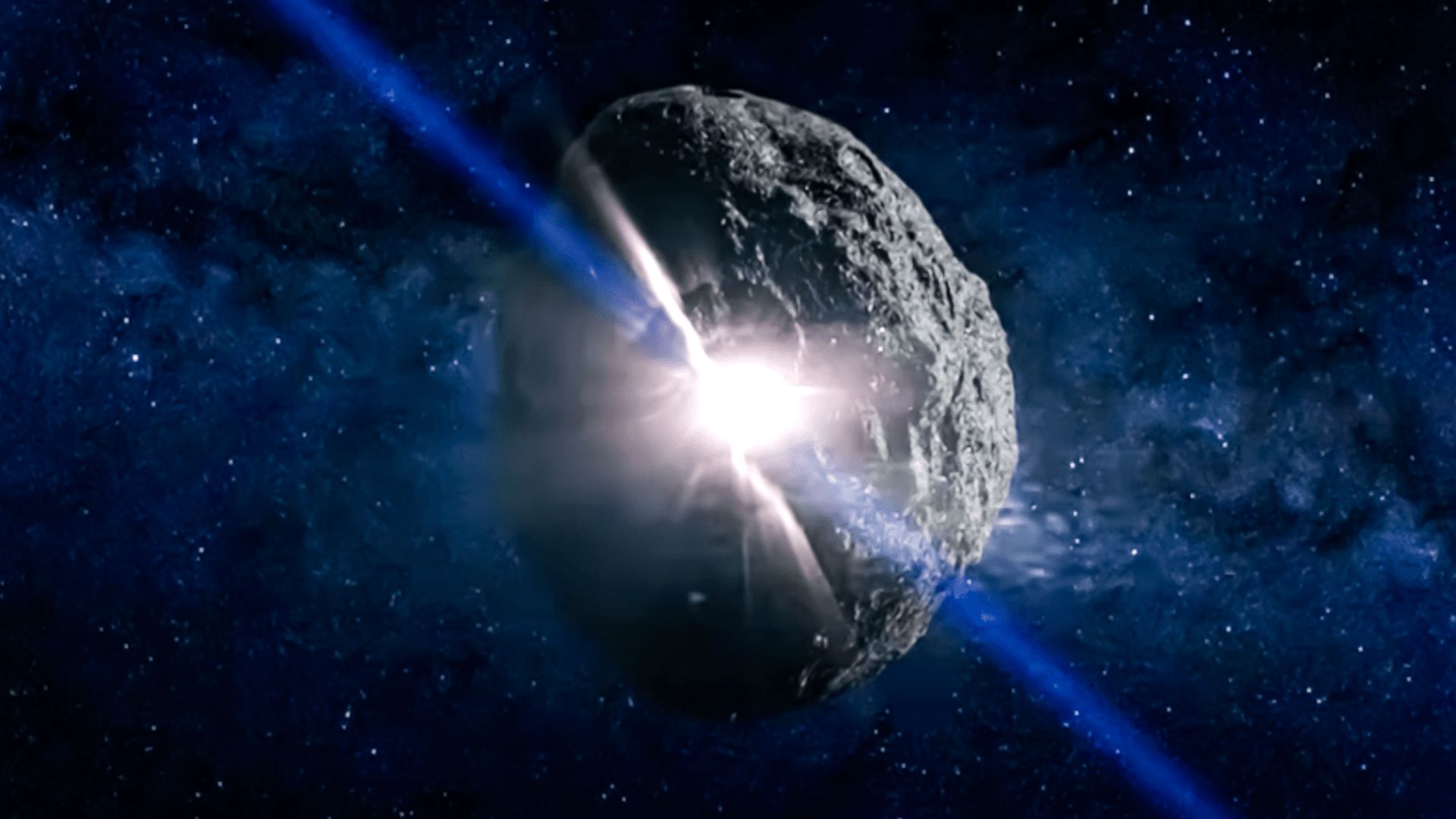
Samples collected from asteroid Bennu by NASA’s OSIRIS-REx mission provide new evidence about how the early solar system assembled.
Researchers found that Bennu formed from a mixture of fine dust, water-bearing material, and ingredients from both warmer and colder regions of the young planetary disk.
The findings place Bennu near the boundary between the hot inner solar system and the colder region beyond the solar system’s ancient snow line.
Bennu is a near-Earth asteroid that NASA studied in detail between 2018 and 2021 through the OSIRIS-REx mission. The spacecraft collected material from the asteroid and returned a sample capsule to Earth on September 23, 2023, carrying about 120 grams of Bennu’s surface material. Scientists worldwide later received portions of the sample for detailed laboratory analysis.
One of the researchers involved is Maria Schönbächler, a professor of isotope geochemistry at ETH Zurich in Switzerland. Her team received about half a gram of material from Bennu for analysis. Their study examined isotopes of iron, titanium and chromium to determine where the asteroid’s building material came from and how it was assembled.
Isotopes Trace Bennu’s Ingredients
Isotopes are different forms of the same element that contain different numbers of neutrons. Scientists use their proportions in rocks and minerals as chemical fingerprints because they can preserve information about where material formed and how it moved through the early solar system.
The researchers found that the iron and titanium isotopes in Bennu were unusually well mixed. That pattern indicates the asteroid’s parent material came largely from fine dust rather than larger, more irregular pieces that remained separated from one another.
The composition also resembles that of asteroid Ryugu, which Japan’s Hayabusa2 mission visited and sampled. Bennu and Ryugu also share important similarities with CI chondrites, a rare class of meteorites that contains material with a composition close to the early solar system.
READ ALSO: https://modernmechanics24.com/post/cape-canaveral-lasers-drone-threats/
These similarities point toward a possible common source for the three types of material. Bennu and Ryugu themselves are fragments of larger parent bodies that were later broken apart, leaving smaller objects that eventually entered near-Earth space.
Asteroid Formed Near Snow Line
Earlier models had placed the parent bodies of Bennu and Ryugu much farther from the Sun. One possibility was that they formed in the outer solar system near the region where comets developed, where lower temperatures and slower processes would have shaped their evolution.
The new isotope results point to a different setting. The researchers propose that Bennu’s parent body formed near the solar system’s snow line, where temperatures changed enough for water to exist as vapor on one side and ice on the other.
The snow line is believed to have existed roughly around the region now occupied by Jupiter. Inside it, temperatures were high enough for water ice to melt or turn into vapor. In contrast, farther out, water remained frozen and became part of the solid material available to build larger bodies.
Material from both sides of this boundary appears to have contributed to Bennu’s parent body. Ice may have acted as a binding agent, helping fine dust particles stick together as the larger object developed.
Water-bearing minerals found in the Bennu sample provide additional evidence for this process. Water that existed as ice beyond the snow line could have turned into vapor closer to the Sun and then moved into regions where Bennu’s parent material was accumulating.
Jupiter Shaped Material Flow
Jupiter also appears to have influenced how material moved through this early planetary environment. The giant planet formed relatively soon after the Sun, within about one million years, and its growing gravitational influence affected material movement around its orbit.
As Jupiter grew, it acted as a barrier to some heavier, coarser dust clumps. Finer particles could move around this obstacle more easily and reach regions where the parent bodies of Bennu, Ryugu, and related objects were forming.
This process helps explain the unusually uniform isotope distribution found in Bennu. It also indicates that Bennu’s parent body probably formed relatively soon after Jupiter itself began developing.
Schönbächler described Bennu as a hybrid because its material does not fit neatly into either the inner or outer solar system. Its composition instead shows characteristics of both environments, providing evidence that material crossed the boundary between them during the solar system’s earliest stages.
The fine-grained material in Bennu also resembles material associated with the presolar nebula. That nebula was the cloud of gas and dust from which the Sun and planets formed, meaning Bennu preserves material that existed before the planets reached their present forms.
Bennu Mirrors Solar Ingredients
The researchers say Bennu’s material may represent the average elemental composition of the planet-forming disk. That makes the asteroid useful for studying the basic ingredients that eventually became Earth and the other terrestrial planets.
Schönbächler said Bennu may provide one of the best views of the original chemical mixture from which the terrestrial planets were built. Because the sample was collected directly from an asteroid and returned to Earth under controlled conditions, researchers can examine its minerals and isotopes in laboratories using instruments that are not available on spacecraft.
READ ALSO: https://modernmechanics24.com/post/hii-odyssey-warships-unmanned-fleets/
The similarity between Bennu and Ryugu adds another question about the population of near-Earth asteroids. Successful sample-return missions visited both objects, yet their materials show strong similarities despite coming from separate missions and different asteroids.
Researchers now want to determine whether other asteroids carry the same isotope signature. Finding similar patterns in additional objects would help establish whether Bennu and Ryugu represent a wider population or have unusually similar histories.
More sample-return missions are already expanding the opportunity to make that comparison. China’s Tianwen-2 mission reached the near-Earth asteroid Kamo’oalewa in the summer of 2026 and is planned to return a sample to Earth in 2027.
Japan is also preparing the Martian Moons eXploration mission (MMX). The mission is designed to collect material from Phobos and return it to Earth in 2031. The moon’s origin remains an important scientific question because some models suggest Phobos may be a captured asteroid.
If Phobos is confirmed to have an asteroid origin, its isotopic composition may provide another useful comparison with Bennu and Ryugu. These samples can help researchers trace how material moved through the young solar system and how the raw ingredients for planets were distributed.
The latest Bennu findings were published in Science Advances on September 23.
The results add another piece to the history preserved inside Bennu’s returned material and give scientists a way to study how hot and cold regions of the early planetary disk supplied the ingredients that eventually formed worlds such as Earth.