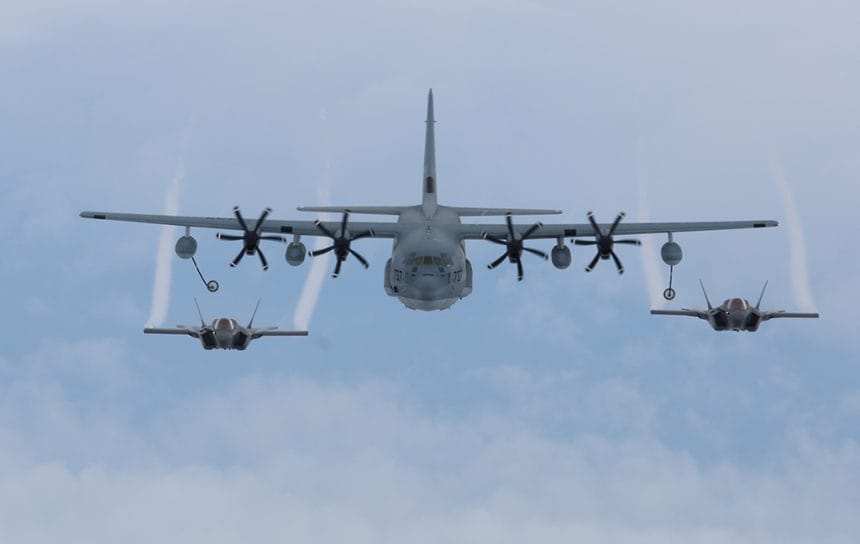
The US Marine Corps has demonstrated a new way to move and support F-35B Lightning II fighters across the widely dispersed Indo-Pacific.
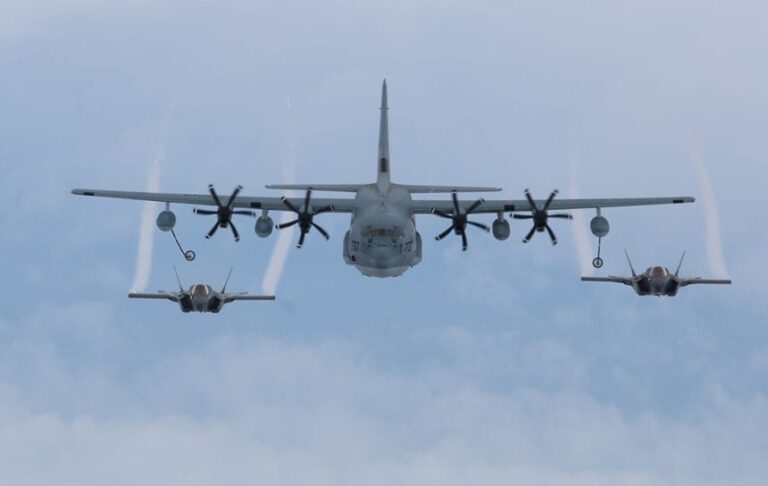
Operation Slingshot used KC-130J aircraft as mobile logistics hubs during a 4,000-nautical-mile movement from northern Australia to Hawaii.
The mission showed how Marines can carry fuel, maintenance equipment and personnel forward to support fighter operations from remote airfields.
Operation Slingshot involved personnel and aircraft from the 3rd Marine Aircraft Wing (3rd MAW). The movement began at Royal Australian Air Force Base Tindal and continued through Cairns, Pohnpei, Kwajalein Atoll and Wake Island before reaching Hawaii. Marines used MV-22B Ospreys and other wing assets to secure locations along the route and prepare them for aviation operations.
The KC-130J played a central role in the movement. Instead of serving only as a transport or aerial refueling aircraft, it operated as a forward logistics node that moved with the force. It carried Marines, fuel, maintenance equipment and other supplies ahead of the F-35Bs.
READ ALSO: https://modernmechanics24.com/post/f35-gets-25-percent-more-cooling-power/
This arrangement allowed the fighter aircraft to move farther from established bases. The KC-130J delivered the support needed to keep the F-35Bs operating as they moved between widely separated locations. The model also reduced the need to depend on large, permanent bases or external strategic tanker aircraft along the route.
The mission covered roughly 4,000 nautical miles across the Indo-Pacific. That distance is significant because many locations in the region are separated by large stretches of ocean and have limited aviation infrastructure. The operation tested whether Marine aviation units could move their own support network alongside combat aircraft.
Remote Airfields Become Support Points
A major part of the demonstration involved operating from remote and undeveloped airfields. The KC-130J landed at austere locations and helped establish Aviation-Delivered Ground Refueling and rearming points. These forward sites provide places where aircraft can receive fuel and other support without depending on a fully developed military air base.
The concept is closely linked to the Marine Corps’ expeditionary aviation model. F-35Bs are designed to operate from shorter runways and expeditionary locations, while the KC-130J can transport the people and equipment required to support them. Together, the aircraft create a mobile system that can move between locations as operational needs change.
The KC-130J also brings a large cargo capacity to the mission. The aircraft involved in the operation weighed about 135,000 pounds and was flown through long over-water routes before landing on austere strips. Its crews therefore had to manage navigation, aircraft performance, cargo weight and ground operations throughout the movement.
Loadmasters had an important role once the aircraft reached each location. They managed the weight and balance of the aircraft while also supporting ground-refueling activities. This allowed the KC-130J to function as more than a transport aircraft during the operation.
WATCH ALSO: https://modernmechanics24.com/post/gen-1-5-robots-one-shot-learning-ai/
A Long Marine Aviation Legacy
The concept demonstrated during Operation Slingshot builds on decades of C-130 operations. The aircraft family first emerged during the early Cold War, with the first C-130 flight taking place in 1954 and production beginning at the Lockheed-Georgia facility in Marietta, Georgia. The platform was developed to move troops, equipment and supplies into areas where conventional transport options were limited.
The C-130 later played a major role during the Vietnam War. During the 1968 siege of Khe Sanh, C-130 aircraft delivered more than 12,000 tons of supplies to the surrounding 26th Marine Regiment after overland supply routes were cut. Crews used a combination of airdrops, landings and other delivery methods to maintain the flow of supplies.
Marine KC-130 aircraft later took on an expanded role during Operation Desert Storm in 1991. They provided aerial refueling for strike aircraft operating deep into the northern Persian Gulf. Refueling allowed those aircraft to remain in the air longer and operate farther from their bases.
The KC-130J retains these transport and refueling functions while adding modern avionics and multi-mission capabilities. Its design allows one aircraft to move cargo and personnel, support ground refueling and provide aerial refueling when required. This combination gives Marine aviation commanders another way to move support with combat units.
What Slingshot Shows
Operation Slingshot applies the Marine Corps’ historic island-hopping approach to a modern aviation environment. Instead of relying on a small number of major bases, the concept uses a network of smaller locations that can support aircraft for shorter periods. The KC-130J provides the transport and logistics link between those locations.
The approach is particularly relevant to the Indo-Pacific. The region contains thousands of islands, long distances and many airfields with limited infrastructure. Moving fuel, maintenance teams and equipment by air gives Marine units a way to establish temporary support points without waiting for major infrastructure to be available.
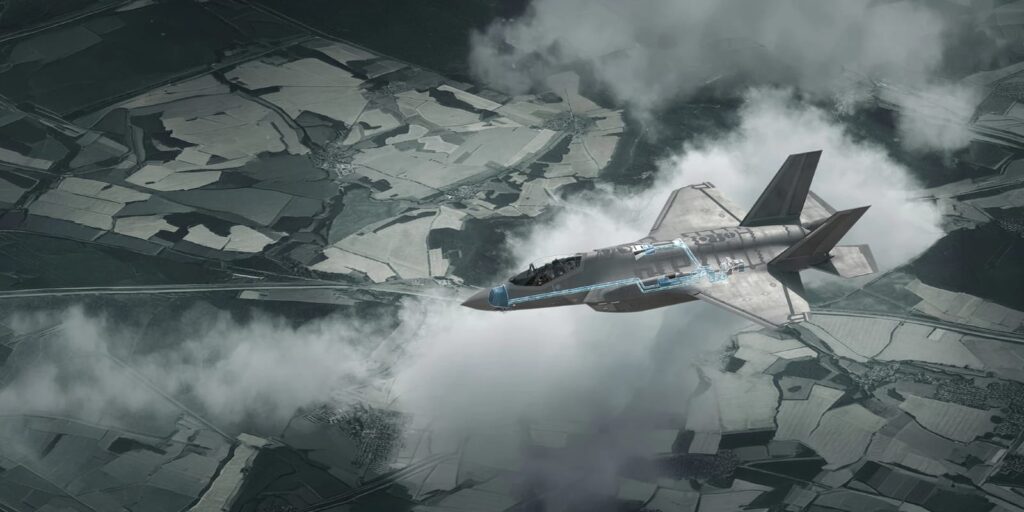
The F-35B adds another element to the model. The short-takeoff and vertical-landing fighter is designed to operate from locations that are less suitable for conventional fighter aircraft. Its ability to use expeditionary airfields becomes more useful when aircraft such as the KC-130J can bring the people, fuel and equipment required to sustain operations.
The operation also shows why logistics remains central to expeditionary aviation. A fighter aircraft can travel quickly, but its operations still depend on fuel, maintenance personnel, spare equipment and other supplies. By moving those resources forward, the KC-130J helps create the conditions needed for the F-35B to continue operating.
The Marine Corps described the KC-130J as the workhorse supporting the fighters behind the tactical mission. First Lt. Christian Schwien, a KC-130J co-pilot, said the aircraft carries maintainers, maintenance equipment and fuel needed to extend the reach of the jets. His description reflects the aircraft’s supporting role during the operation rather than its role as a fighter platform.
READ ALSO: https://modernmechanics24.com/post/ukraine-zorelit-v5-ai-drone-interceptor/
The demonstration also required close coordination among the KC-130J crew. Pilots handled long-range navigation over open water and austere-field operations, while loadmasters managed cargo distribution and ground-refueling requirements. Each part of the process had to work together for the mobile logistics model to function.
For the 3rd Marine Aircraft Wing, the exercise provided a practical test of how aviation forces can move through the Indo-Pacific with their own support structure. The route from Australia to Hawaii showed that the concept can connect distant locations while using relatively limited infrastructure. The operation therefore placed logistics at the center of the Marine Corps’ effort to maintain mobile F-35B operations.
Operation Slingshot does not represent a replacement for established bases or larger tanker aircraft. Instead, it demonstrates another method for distributing aviation support across a region where distance and infrastructure remain major planning factors. The KC-130J’s ability to carry fuel, equipment and personnel gives Marine aviation units an additional tool for operating from dispersed locations.
The demonstration also points to how expeditionary aviation may be organized in future Indo-Pacific operations. F-35B fighters can provide the combat capability, while KC-130J aircraft move the support needed to keep those fighters active.