

Researchers in South Korea have developed a new approach to extend the operating life of anode-free batteries, a design that removes the conventional graphite anode to save space and weight.
The team from the Korea Advanced Institute of Science and Technology (KAIST) combined microscopic structures on a copper foil with an ultrathin MXene coating. The method helps control lithium growth and supports a more stable protective layer during repeated battery operation.
The work addresses one of the main technical problems facing anode-free battery designs. These batteries have attracted interest because removing the separate anode material leaves more room for active battery materials within the same package.
However, unstable lithium deposition has made it difficult to maintain performance over many charging and discharging cycles.
READ ALSO: https://modernmechanics24.com/post/giant-sunspots-superflare-potential/
Why Anode-Free Batteries Matter
Most lithium-ion batteries use graphite or another anode material to hold lithium when the battery charges.
An anode-free cell starts without this separate lithium-storage material and instead deposits lithium directly onto a thin copper current collector. This design reduces the amount of inactive material inside the cell and can increase the energy stored within a given battery size.
The approach is especially relevant to electric vehicles, where battery weight and volume affect vehicle design and energy use. A smaller battery with the same usable energy can provide more flexibility for vehicle packaging. A lighter battery can also reduce the amount of mass that the vehicle has to carry.
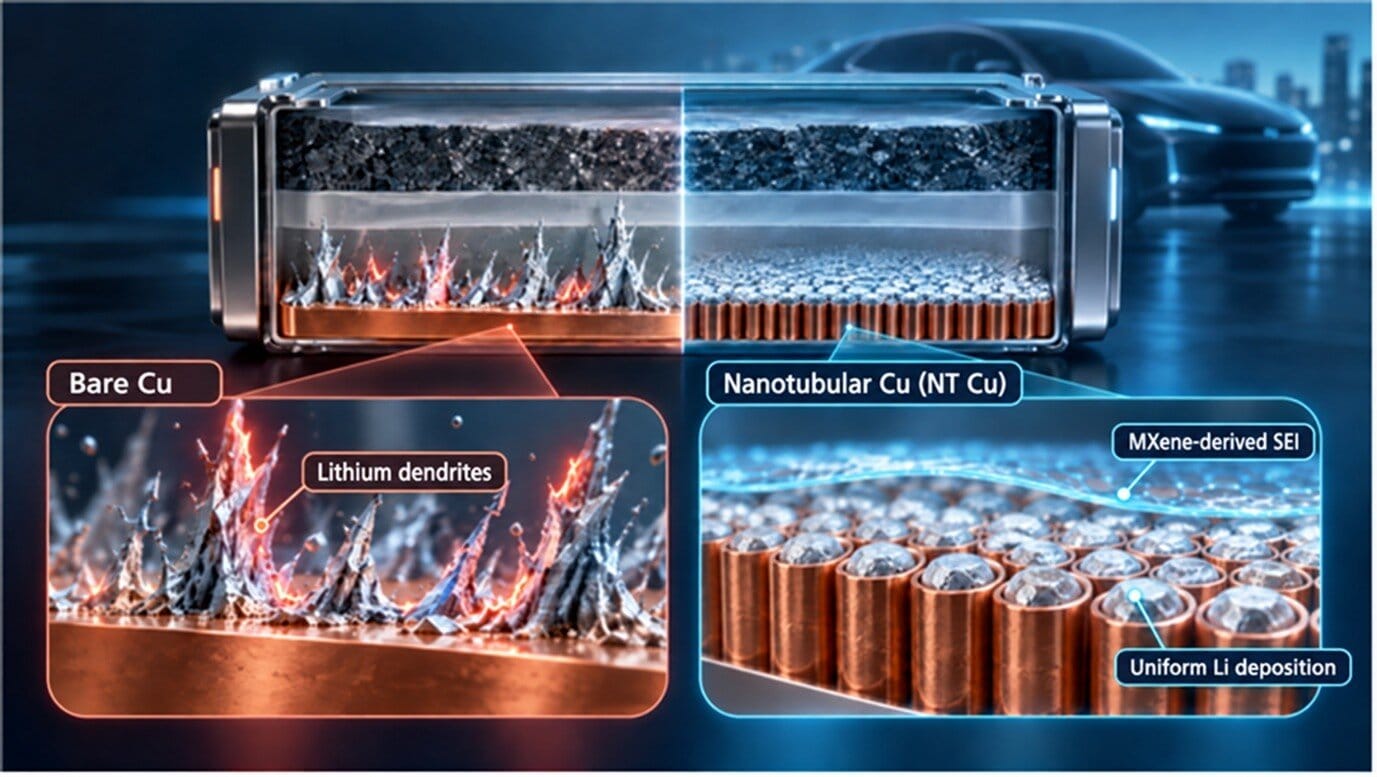
The main problem appears during repeated cycling. Lithium does not always spread evenly across the copper surface, and some areas can develop branch-like or needle-shaped structures known as dendrites. These structures can consume active lithium, increase unwanted reactions and contribute to faster battery degradation.
The protective layer that forms around lithium can also become unstable during operation. Once that layer repeatedly breaks down and reforms, more lithium and electrolyte can be consumed. These processes reduce the amount of lithium available for normal battery operation and shorten cell life.
Microscopic Copper Guides Lithium
The KAIST-led team addressed the problem by changing the surface of the copper foil rather than adding a thick new battery component. Researchers created an array of microscopic tube-shaped structures across the copper surface. The structures provide more controlled locations for lithium to accumulate during charging.
The team used a semiconductor manufacturing technique known as secondary sputtering lithography (SSL) to fabricate the structures. Each microscopic tube measured about 300 nanometers in diameter and 150 nanometers in height. The modified surface provided about four times the area available on flat copper foil for lithium deposition.
The larger and more structured surface helps distribute lithium instead of allowing large amounts to collect in isolated areas. The design therefore reduces the conditions that encourage uneven, spike-like growth. This approach also avoids the need to add a large amount of extra material to the battery.
The concept is similar to dividing a large open surface into many controlled deposition sites. Instead of allowing lithium to accumulate wherever conditions happen to favor growth, the structured copper provides defined areas for deposition. This gives the researchers greater control over how lithium develops during charging.
WATCH ALSO: https://modernmechanics24.com/post/space-force-gps-ground-system-upgrade/
MXene Helps Build Protection
The researchers added another layer of control by coating the structured copper with MXene. MXenes are two-dimensional materials with properties that make them useful for advanced electronic and energy-storage applications. In this study, the MXene coating was only about 10 nanometers thick.
The coating does not function simply as a conventional protective shield. Instead, it helps guide the chemical reactions that create a protective layer around the deposited lithium. The researchers found that the MXene surface promotes the formation of a layer rich in lithium fluoride (LiF) when used with a lithium hexafluorophosphate (LiPF6) electrolyte.
This protective layer limits direct reactions between lithium and the surrounding electrolyte. It also helps reduce the uneven lithium growth associated with battery degradation. Because the MXene film is extremely thin, the approach adds little material compared with thicker protective coatings.
The researchers studied the modified electrode surfaces and their internal structures while limiting exposure to air. They used several analytical methods to understand how the protective layer developed. These included X-ray photoelectron spectroscopy, time-of-flight secondary ion mass spectrometry and transmission electron microscopy.
Path Toward Longer Battery Life
The research team was led by Professors Jinwoo Lee and Hee-Tae Jung of KAIST’s Department of Chemical and Biomolecular Engineering. Researchers from Kyungpook National University and the National NanoFab Center also contributed to the study. The findings were published in the journal Advanced Functional Materials.
Lee said the research demonstrates how fabrication methods developed for semiconductor manufacturing can be applied to battery electrodes. According to the researcher, the process creates controlled lithium deposition sites while supporting a stable protective layer without changing the main electrolyte formulation or adding excess lithium.
That point is important because some earlier methods relied on additional lithium to compensate for material lost during battery cycling. Other approaches used thicker protective coatings to limit reactions at the lithium surface. Both strategies add material and can reduce some of the size and weight advantages associated with anode-free cells.
READ ALSO: https://modernmechanics24.com/post/china-super-microscope-100x-brighter/
The KAIST approach instead focuses on controlling the electrode surface at a microscopic scale. The copper structure manages where lithium is deposited, while the MXene layer helps regulate the chemistry at the lithium-electrolyte interface. The two features address separate parts of the same battery-life problem.
The researchers see the technology as a potential foundation for improving the durability of high-energy anode-free batteries. Further development will be needed to determine how the technique performs in larger cells and under the demanding operating conditions of commercial vehicles.
If the process can be transferred from laboratory-scale electrodes to practical battery manufacturing, it may help reduce some of the technical barriers facing lighter and more compact EV battery designs.











2 Responses