

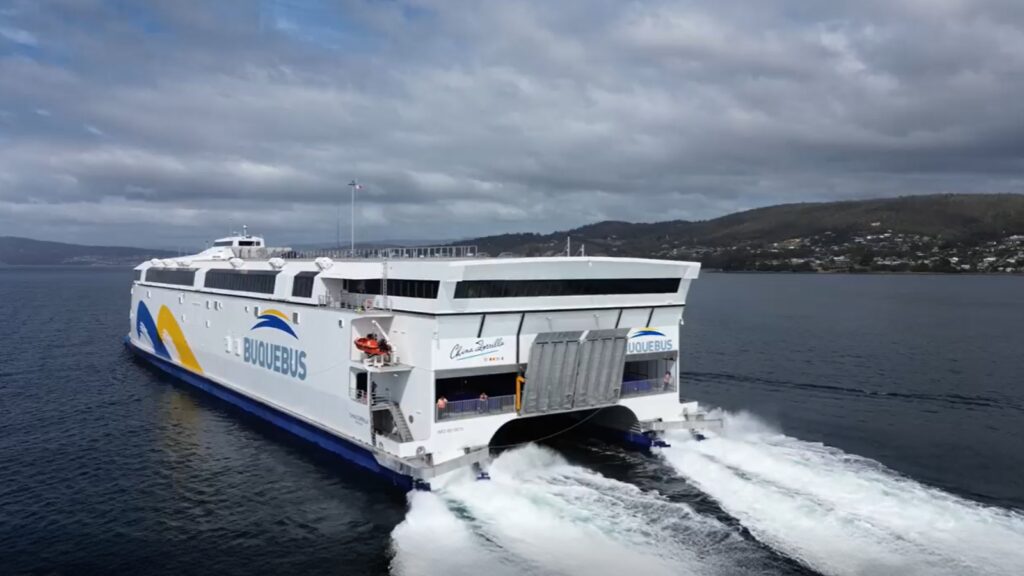
The world’s largest battery-electric ship has reached South America after travelling thousands of kilometres from Tasmania aboard a heavy-lift transport vessel.
Incat’s 130-metre Hull 096 arrived in Uruguay after crossing the Pacific and rounding Cape Horn before being unloaded into South American waters. The ferry will now be towed to Colonia del Sacramento, where its owner Buquebus will begin testing and commissioning the vessel.
Hull 096 left Hobart in early August after a complex operation to load it onto the MV Black Marlin on the River Derwent.
The huge transport ship carried the ferry north past New Zealand and across the Pacific Ocean before sailing around the southern tip of South America. The vessel reached South America last Friday and was officially welcomed at a ceremony in Nueva Palmira, Uruguay.
READ ALSO: https://modernmechanics24.com/post/organic-catalyst-solar-hydrogen-produce/
Over the weekend, Hull 096 was floated off the Black Marlin and placed back into the water. Tugboats are now towing the ferry towards Colonia del Sacramento, where Buquebus will start the commissioning process. The company will test the vessel’s systems and prepare it for regular passenger operations.
The arrival marks the next stage of a project that began several years ago. Buquebus first commissioned the ferry in 2019, but production was paused during the COVID-19 pandemic. The design was later changed from a diesel-powered vessel to a fully battery-electric ferry.
Built For Rio Route
Hull 096 was built by Tasmanian shipbuilder Incat for Buquebus, a South American transport company.
The ferry is designed to operate on a route of about 30 nautical miles across the Rio de la Plata between Colonia del Sacramento and Buenos Aires, Argentina. The crossing takes roughly one hour and links Uruguay with the Argentine capital.
The ferry can carry up to 2,100 passengers and 225 vehicles. It will enter service under the name China Zorrilla, after the Uruguayan film and theatre star who died in 2014. Its size and passenger capacity make it a major addition to the regional ferry network.
The vessel measures 130 metres in length and uses more than 5,000 battery modules for propulsion. Its battery system provides enough energy for about 90 minutes of operation. This range is suited to its planned short-distance service across the Rio de la Plata.
Hull 096 also uses aluminium for its structure instead of conventional steel. Aluminium weighs less than steel, which helps reduce the energy required to move the vessel. The combination of a lighter hull and electric propulsion is designed to reduce emissions during ferry operations.
WATCH ALSO: https://modernmechanics24.com/post/china-five-destroyers-firepower-drill/
Testing Before Service
The commissioning phase will be an important step before the ferry begins carrying passengers. Buquebus will check the propulsion system, batteries and other onboard equipment under operating conditions. The company will then prepare the vessel for service on its planned Uruguay-Argentina route.
The ship’s long delivery journey also involved a major marine transport operation. Incat had to load the completed ferry onto the Black Marlin at Hobart before sending both vessels on a voyage of thousands of kilometres. The operation required the ferry to remain securely supported throughout the journey and was described by Incat as a significant milestone for the company.
Hundreds of Tasmanian shipbuilders worked on Hull 096 over several years. Incat said the vessel represents a step towards cleaner maritime transport as ferry operators examine alternatives to conventional fossil-fuel propulsion. The project also gives the shipbuilder experience with large battery-powered commercial vessels.
Electric Ferries Expand
Interest in large electric ferries extends beyond South America. Danish ferry operator Molslinjen has ordered three Incat vessels that are now under construction in Hobart. Known as Hull 102, Hull 103 and Hull 104, they are planned for service on one of northern Europe’s busiest ferry corridors.
Those vessels are expected to become the largest electric ferries in Europe when completed. Their construction shows how the technology used for Hull 096 is being adapted for other passenger routes. The projects also give shipbuilders and operators more experience with large battery systems and electric propulsion.
Hull 096’s arrival therefore moves the project from shipbuilding into the final stages before commercial operation.
READ ALSO: https://modernmechanics24.com/post/ukraine-sargan-3000-sinks-russian-naval/
Once commissioning is complete, the ferry is expected to provide a lower-emission option for the busy connection between Uruguay and Argentina. Its service will also provide a real-world test of large-scale battery-electric ferry operations on an international passenger route.










One Response