MIT engineers have developed a recyclable elastic yarn that offers the stretch and durability of traditional spandex-based yarns while addressing one of the fashion industry’s biggest recycling challenges.
The new material is made entirely from different forms of polyethylene, allowing garments to be melted down and reused without separating mixed fibers. The research aims to support a circular textile economy by reducing clothing waste and improving recycling options.
Millions of tonnes of textile waste end up in landfills or incinerators every year because most modern clothing is difficult to recycle. Many garments contain a blend of fibers that cannot be processed together using existing recycling methods. The MIT team’s new yarn removes that obstacle by using materials from the same plastic family.
The findings appear in the journal ACS Materials Letters. Scientists from MIT’s Department of Mechanical Engineering led the research, including research scientist Svetlana Boriskina and first author SeongHyeon Kim. The project received support from the US Army Research Office, the Office of Naval Research Global, and the MIT Portugal Program.
Growing Textile Problem
Textile waste has become an increasing environmental concern as clothing production continues to rise worldwide. In the US alone, the average person throws away around 81 pounds of clothing every year. That contributes to more than 11 million tonnes of textile waste reaching landfills or waste incineration facilities annually.
READ ALSO: Deep-Space CubeSat Aims to Give Earth Up to 3 Hours of Solar Storm Warning Before Impact
A major reason for this growing problem is the widespread use of spandex in clothing. Around 80 percent of textiles sold in the US contain some spandex, according to MIT researchers. While spandex provides flexibility and comfort, it also makes garments extremely difficult to recycle.
Traditional elastic yarn combines two different materials into a single thread. A stretchy spandex core sits inside a protective outer layer made from polyester or nylon. Together, they create fabrics that stretch well yet remain strong enough for everyday use.
The problem begins when these garments reach the end of their life. Recycling requires separating the polyester or nylon sheath from the spandex core using chemical treatments. That process increases costs, adds complexity, and often involves chemicals that create additional environmental concerns.
According to Boriskina, no widely adopted technology currently exists that can directly recycle textile products into new textiles without first separating their constituent materials. As a result, many stretchable garments become waste rather than valuable, recyclable material. The team wanted to design a yarn that avoids this issue from the beginning.
Polyethylene Makes a Difference
The researchers turned to polyethylene, one of the world’s most commonly used plastics. It is widely found in products such as milk bottles, grocery bags, plastic packaging, industrial pipes, toys, and storage containers. Unlike many textile fibers, polyethylene is a thermoplastic, meaning it can be melted and reshaped multiple times.
MIT researchers had already demonstrated in earlier work that polyethylene could be spun into textile fibers. Those earlier studies focused on properties such as cooling performance, moisture control, and stain resistance. The latest research expanded that work by improving elasticity while preserving recyclability.
Instead of mixing unrelated materials, the team selected two different polyethylene formulations with different physical properties. One resin produced highly flexible fibers suitable for the yarn’s inner core. Another created stronger fibers that formed the protective outer layer.
Although the two materials behave differently, they belong to the same chemical family. That means they can be recycled together without requiring chemical separation. The researchers say this compatibility is the key feature that makes the new yarn suitable for repeated recycling.
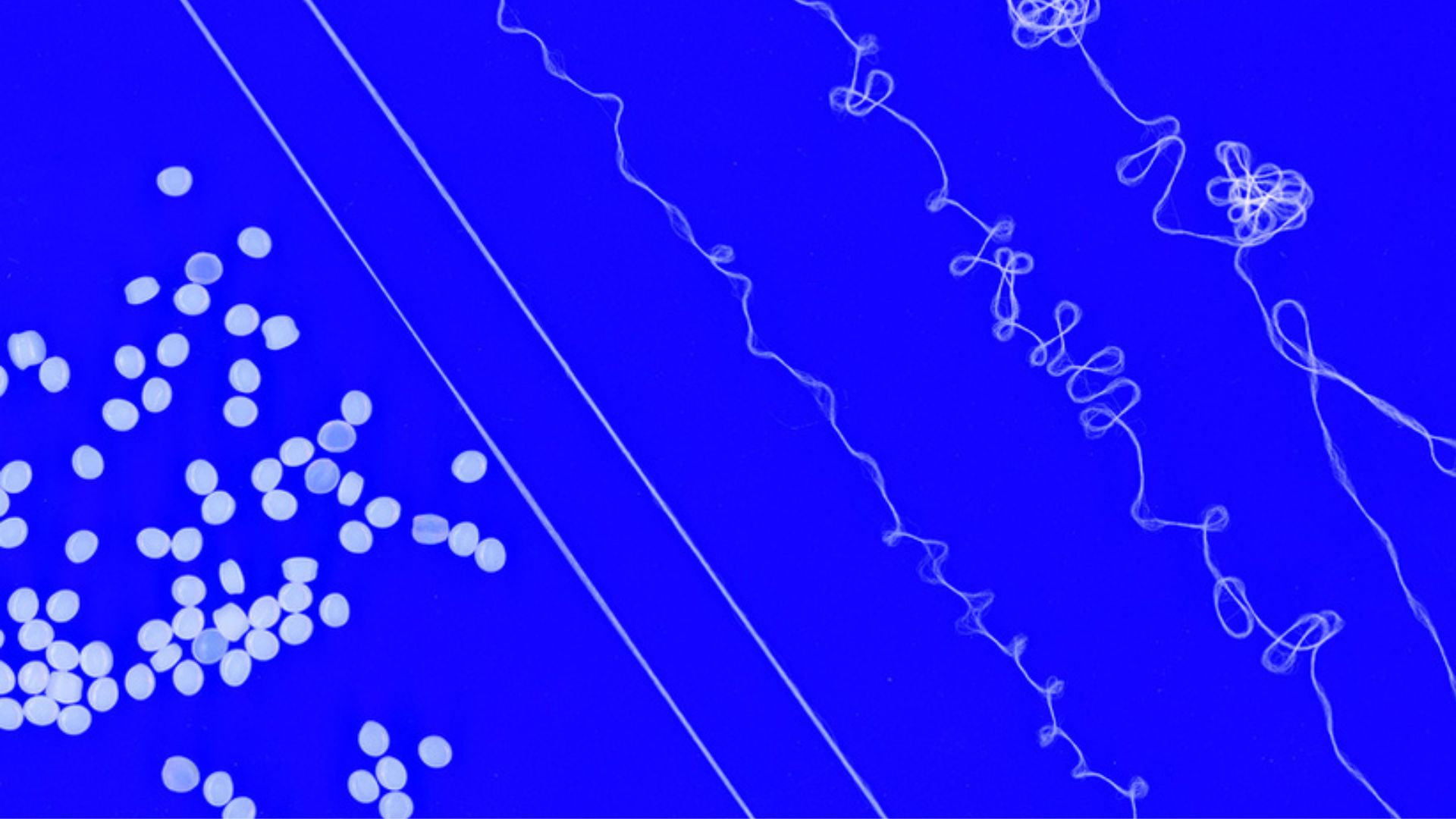
The manufacturing process follows techniques already used in fiber production. Plastic pellets are placed into a heated hopper, where the temperature reaches about 350 degrees Fahrenheit, melting the material. The molten plastic then passes through tiny openings to form extremely thin fibers before being wound into yarn.
Kim compared the process to making spaghetti. The melted plastic is pushed through small openings in much the same way pasta dough passes through a pasta machine. Once the fibers are produced, industrial equipment wraps the stronger outer fibers around the elastic inner core.
Elastic Yarn Survives Recycling
To evaluate performance, the researchers repeatedly recycled the yarn through multiple production cycles. They first created a complete spool of elastic yarn, then melted it down and spun it into new yarn. This recycling process was repeated ten separate times.
After each recycling cycle, the team tested the yarn’s strength and flexibility using mechanical stretching experiments. The recycled fibers continued to deliver performance comparable to the original material. Even after ten recycling rounds, the yarn maintained strength and elasticity comparable to those of conventional commercial elastic threads.
The recycled outer fibers can also be paired with a newly produced elastic core to create fresh yarn for textile manufacturing. This approach allows materials to remain in circulation rather than becoming waste after a single product life. It also reduces the need to manufacture entirely new raw materials for every garment.
The researchers believe the design offers an important advantage over existing elastic fabrics. Since both the core and outer sheath share the same basic chemistry, recycling becomes much simpler than with spandex-based yarns. The entire thread can be melted into a single material before being transformed into fresh fibers or other plastic products.
Beyond producing new clothing, recycled polyethylene from worn garments may also be used to manufacture accessories. The material can be moulded into items such as buttons, buckles, or other plastic components after melting. This expands the number of ways the recycled material can remain useful.
READ ALSO: AI Underwater Robots Read Divers’ Bubble Patterns to Detect Stress and Improve Diving Safety
Future Clothing Recycling
The research team says the yarn can be manufactured using industrial-scale production systems already used by the textile industry. As with conventional yarn production, large clothing manufacturers would require kilometers of fiber to produce commercial fabrics. The researchers believe scaling the process should therefore be practical.
If adopted widely, garments made from the recyclable yarn could enter dedicated recycling systems after use. Instead of being discarded, old clothing could be collected, melted, and converted into new fibers for future garments. This approach supports the idea of keeping materials in continuous use rather than replacing them with newly produced plastics.
The work also reflects wider efforts across the textile industry to reduce environmental impacts through better material design. Many companies and research groups are exploring fibers that use fewer resources and generate less waste throughout their life cycle. Designing products that are recyclable from the start is an important goal.
Simplifying recycling also has potential economic benefits. Manufacturers may recover more valuable materials from used clothing rather than relying entirely on new plastic production. Consumers may also benefit from future recycling programs that treat old garments as reusable resources rather than disposable waste.
The researchers are now focusing on the next stage of development by turning the yarn into woven and knitted fabrics suitable for clothing production. They expect continued testing will examine long-term performance in finished garments under everyday use. However, the recyclable polyethylene yarn may help reshape how stretchable clothing is designed, manufactured, and recycled in the years ahead.