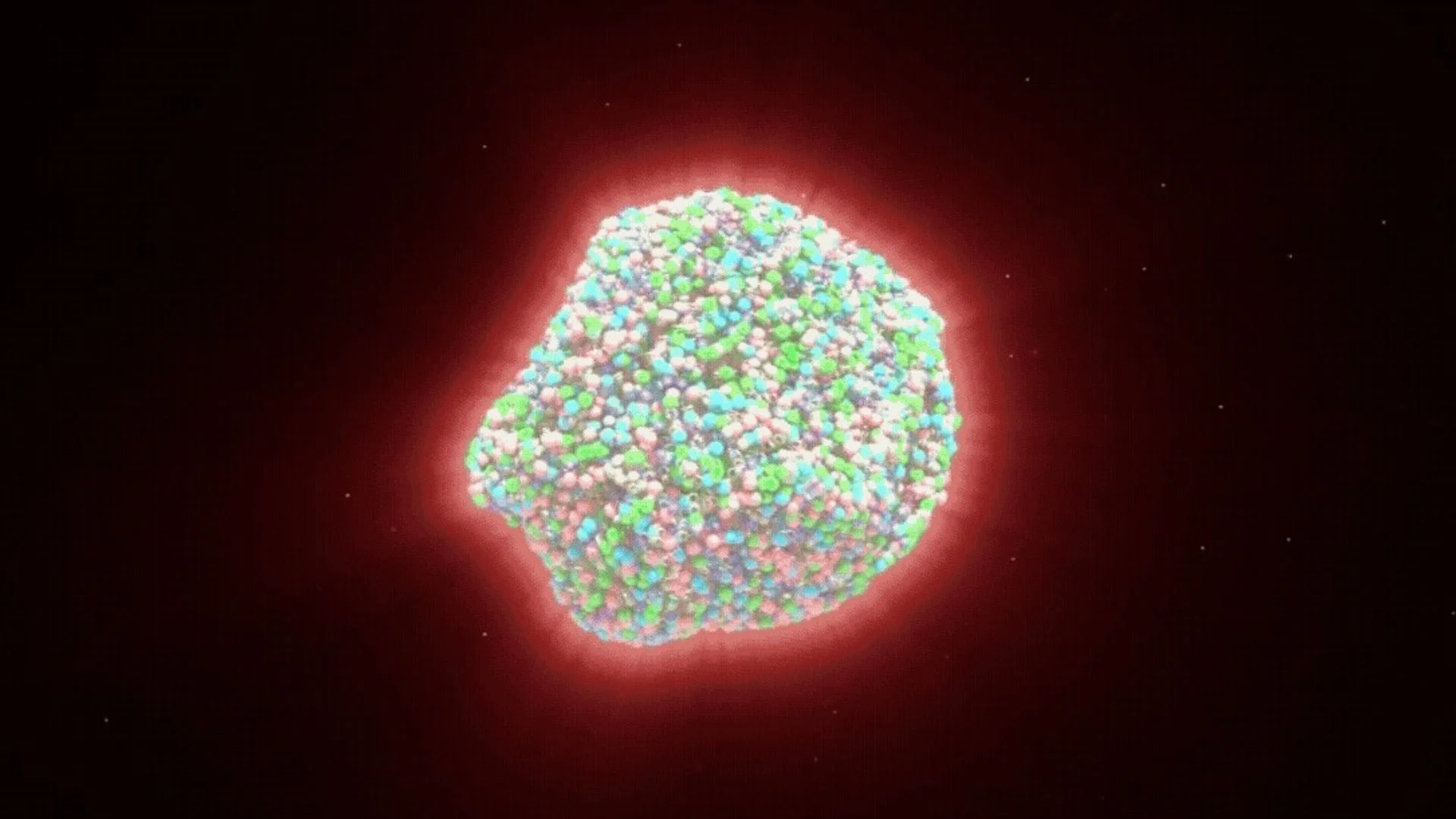
Scientists working at the Large Hadron Collider (LHC) have reported stronger evidence that collisions involving oxygen and neon atoms can create quark-gluon plasma, an extreme state of matter believed to have filled the Universe immediately after the Big Bang.
The findings come one year after the LHC carried out its first-ever oxygen collision experiments. Results from all four major LHC experiments, ALICE, ATLAS, CMS and LHCb, indicate that even lighter atomic nuclei can generate this remarkable state under the right conditions.
Quark-gluon plasma(QGP), forms at temperatures more than 100,000 times hotter than the center of the Sun and under enormous pressure.
In this state, particles such as protons and neutrons break apart into their fundamental building blocks called quarks and gluons. Scientists believe the entire Universe existed in this form for a tiny fraction of a second after the Big Bang before cooling into the matter seen today.
Beyond Heavy Ions
For many years, researchers believed only collisions involving heavy ions such as lead could create the conditions needed for QGP. Lead nuclei are more than 200 times heavier than the protons usually accelerated inside the LHC, making them ideal for producing extremely dense and hot environments. However, recent studies have steadily challenged that assumption.
Earlier this year, the ALICE experiment reported signs of QGP even in proton-proton and proton-lead collisions. Last year, oxygen-oxygen collisions provided the first hints that lighter atomic nuclei might also generate the same state of matter. The latest analysis strengthens those earlier observations by finding several independent indicators of QGP in both oxygen-oxygen and neon-neon collisions.
One important signature of quark-gluon plasma is known as parton energy loss. Quarks and gluons traveling through the hot plasma lose energy, much like a fast-moving object slows down when passing through a dense medium. Measuring this energy loss allows scientists to determine whether QGP formed during a collision.
READ ALSO: China Unveils AI-Powered Space Computing Network to Process Satellite Data Before Earth
Lighter Nuclei, Quark-Gluon Plasma
The ATLAS experiment observed this effect by studying pairs of particle jets produced during oxygen and neon collisions. Researchers found a growing imbalance between the two jets, showing that one jet lost more energy while passing through the dense medium. The effect became stronger in more direct collisions, where scientists expect a larger volume of quark-gluon plasma to form.
ATLAS also carried out preliminary studies using charged particles produced alongside photons. These measurements followed the same trend, with energy loss increasing in more central collisions. The results further support the presence of QGP in collisions involving lighter atomic nuclei.
The ALICE, CMS and LHCb experiments searched for similar evidence using a different method. Instead of focusing on particle jets, they examined how the plasma reduced the production of highly energetic particles. A lower number of these particles than in normal proton-proton collisions points to energy loss inside the plasma.
CMS recorded this suppression in both oxygen-oxygen and neon-neon collisions. LHCb compared particles containing a charm quark with a lighter quark and found stronger suppression in neon collisions than in oxygen collisions. That pattern matches expectations because larger collision systems are believed to create larger volumes of quark-gluon plasma.
Patterns Match Predictions
To rule out other possible explanations, ALICE compared neutral pion production in oxygen-oxygen collisions with proton-oxygen collisions. This comparison isolated the effects linked directly to parton energy loss. Researchers said the results provide clear evidence that oxygen collisions produce the hot medium associated with QGP.
Scientists also investigated another well-known signal involving short-lived particles made of a heavy quark and its corresponding antiquark. These bound states normally survive for only a brief time after collisions. When QGP forms, the intense environment weakens these bonds, causing some of these particles to disappear more frequently.
CMS observed this suppression pattern in upsilon mesons by comparing oxygen and neon collision data. LHCb also reported preliminary evidence of similar behavior using proton-oxygen and oxygen-oxygen collision results. These independent observations add further weight to the growing evidence for QGP formation in lighter collision systems.
ALICE presented another early result involving the movement of particles created during collisions. It found that three-quark particles, known as baryons, showed a stronger preferred direction of motion than two-quark particles called mesons. Scientists consider this anisotropic flow another characteristic feature of quark-gluon plasma because particles inherit this collective motion as they pass through the dense medium.
READ ALSO: Gallium Nitride Powers China’s Geosynchronous Radar Satellite for Nonstop Earth Monitoring
Looking Ahead
The latest findings mark an important step in understanding how quark-gluon plasma forms across different types of particle collisions.
Instead of relying only on heavy lead ions, scientists now have growing evidence that much lighter elements such as oxygen and neon can also recreate conditions similar to those that existed shortly after the birth of the Universe. This wider range of collision systems offers researchers new ways to study the behavior of matter under the most extreme conditions.
Researchers will continue analyzing the large volume of data collected during recent LHC runs. At the same time, the accelerator is being upgraded into the High-Luminosity LHC, which will deliver many more collisions and much larger datasets.
However, these future experiments are expected to provide an even clearer picture of quark-gluon plasma and deepen our understanding of the earliest moments in the history of the Universe.