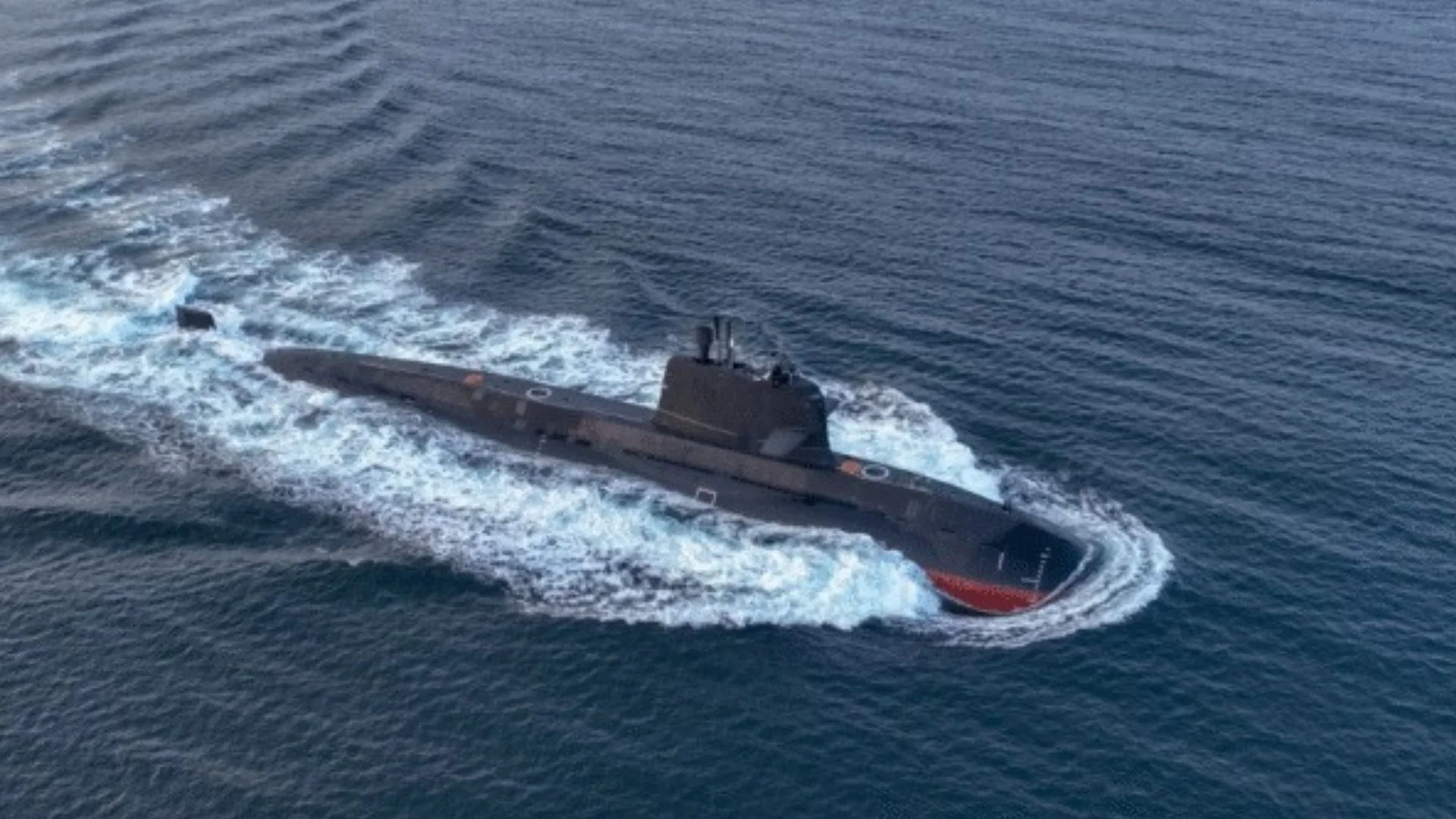
New satellite imagery suggests China is constructing a previously unidentified attack submarine at Shanghai’s Jiangnan Shipyard, according to defense analysts.
The vessel appears larger than China’s current Type 093 attack submarines and features a noticeably smaller sail, suggesting a new design focused on reducing underwater noise and improving performance.
Although Chinese authorities have not confirmed the project, experts say the submarine may represent another step in Beijing’s expanding naval modernization program.
The submarine first gained public attention in early June after naval analyst H.I. Sutton published his observations through Naval News. Additional satellite images and assessments later appeared through The War Zone (TWZ) and Japan’s Asahi Shimbun. Together, these reports have sparked renewed discussion about China’s future underwater capabilities.
High-resolution images captured by BlackSky on May 29 show the submarine resting on a floating dock at Jiangnan Shipyard. Analysts estimate the vessel measures around 120 meters in length, with a beam of about 10 meters. That makes it similar in width to the existing Type 093 class but roughly 10 meters longer overall.
Smaller Sail Design
One of the submarine’s most noticeable features is its significantly smaller sail, the vertical structure rising above the hull. Timothy Heath, owner of research firm Perceptum, said the vessel appears to represent an entirely new submarine class based on its dimensions and overall shape. He noted that reducing the sail size can lower water resistance as the submarine moves beneath the surface.
Lower resistance allows submarines to travel more efficiently through water. It may also improve speed and maneuverability, and reduce the flow of water around the hull, which helps lower the noise the vessel generates. However, Heath explained that overall stealth depends on many other factors, including hull coatings, sound insulation and other noise-reduction technologies.
A Western submarine analyst, who spoke anonymously, agreed that the vessel appears different from existing Chinese submarines. He said its size suggests nuclear propulsion, although a conventionally powered design cannot yet be ruled out. Without official information or closer inspection, analysts cannot confirm the submarine’s propulsion system.
The same analyst said the submarine’s streamlined shape may reduce flow noise while operating underwater. He added that if the vessel also uses a pump-jet propulsion system, it may become quieter than any submarine currently serving in the Chinese navy. However, he cautioned that a noisy nuclear reactor could reduce some of those advantages.
READ ALSO: Collins Aerospace Advances Hybrid-Electric Aviation With SWITCH Testing at The Grid
China’s New Attack Submarine
Satellite imagery also indicates that the submarine uses X-shaped stern control surfaces instead of the traditional cross-shaped arrangement. This configuration improves underwater handling, enhances maneuverability and provides greater stability during complex movements. Several modern submarine designs around the world have adopted this layout for those reasons.
China previously used similar X-shaped control surfaces on the smaller Type 041, also known as the Zhou class. That submarine was built at Wuchang Shipbuilding in Wuhan and introduced several modern design concepts. The appearance of the same feature on this larger vessel suggests Chinese designers may be expanding successful technologies into future submarine classes.
The latest submarine also resembles a smaller experimental vessel photographed at Jiangnan Shipyard during 2018 and 2019. That earlier submarine measured roughly 45 meters long and featured a similarly reduced upper structure. Analysts believe China may have tested design ideas on that prototype before applying them to a full-sized operational submarine.
Christopher Sharman, director of the China Maritime Studies Institute at the US Naval War College, urged caution when interpreting satellite imagery.
Speaking in a personal capacity, he said external appearance alone cannot confirm the submarine’s exact capabilities or propulsion system. He noted that Chinese technical publications have increasingly discussed compact nuclear reactors designed for conventionally sized submarines.
Expanding Nuclear Fleet
The newly spotted submarine appears different from another nuclear-powered submarine seen earlier this year at Bohai Shipyard. That vessel has often been identified by observers as the Type 095, although China has never officially confirmed its designation. The existence of two different designs suggests multiple submarine development programs may be progressing at the same time.
Rear Admiral Mike Brookes, commander of the US Office of Naval Intelligence, described China’s submarine strategy during testimony before the US-China Economic and Security Review Commission in March.
He said the People’s Liberation Army Navy is making a major transition from diesel-electric submarines towards an increasingly nuclear-powered fleet. Brookes estimated that China may operate around 80 submarines by 2035, with approximately half powered by nuclear reactors.
Research by the International Institute for Strategic Studies also reflects the pace of China’s naval expansion. The institute found that China launched 10 nuclear-powered submarines between 2021 and 2025, representing about 79,000 tonnes of displacement. During the same period, the United States launched seven nuclear submarines with a combined displacement of roughly 55,500 tonnes.
Most of China’s larger nuclear-powered submarines have traditionally been built at Bohai Shipyard. If Jiangnan Shipyard is now constructing similar vessels, it would represent an important expansion of China’s industrial capacity. Sharman said this possibility remains unconfirmed but described it as one of the most interesting questions raised by the recent satellite images.
Heath said adding submarine production capability at Jiangnan would allow China to increase both production speed and future fleet size. The anonymous Western analyst remained more cautious in his assessment. He suggested the vessel may serve as a test platform for evaluating new technologies before large-scale production begins.
READ ALSO: GE Aerospace, Magellan Partner on F414 Engine Support Plan for Canada’s Future Gripen Fleet
Regional Security Impact
The submarine’s overall dimensions place it broadly within the same size category as the US Navy’s Virginia-class attack submarines. Size alone, however, does not determine how quiet or capable a submarine will be during operations. Analysts generally agree that American submarines continue to maintain an advantage in underwater stealth, although Heath believes that technological gap is gradually becoming smaller.
Masashi Murano, a senior fellow at the Hudson Institute, said a larger fleet of advanced nuclear submarines would strengthen China’s ability to conduct long-range operations across the western Pacific.
Such submarines could escort aircraft carrier groups, patrol for longer periods and position missiles closer to locations such as Japan and Guam. Those developments would increase demands on anti-submarine warfare and missile defense systems operated by the United States and its allies.
Heath added that quieter submarines with greater endurance would allow China to operate farther from its coastline. They could also increase the Chinese navy’s ability to monitor or intercept naval forces approaching Taiwan during any future regional crisis.
While many questions remain unanswered, further satellite observations and official disclosures will likely determine whether this newly spotted submarine becomes the next major addition to China’s growing underwater fleet.