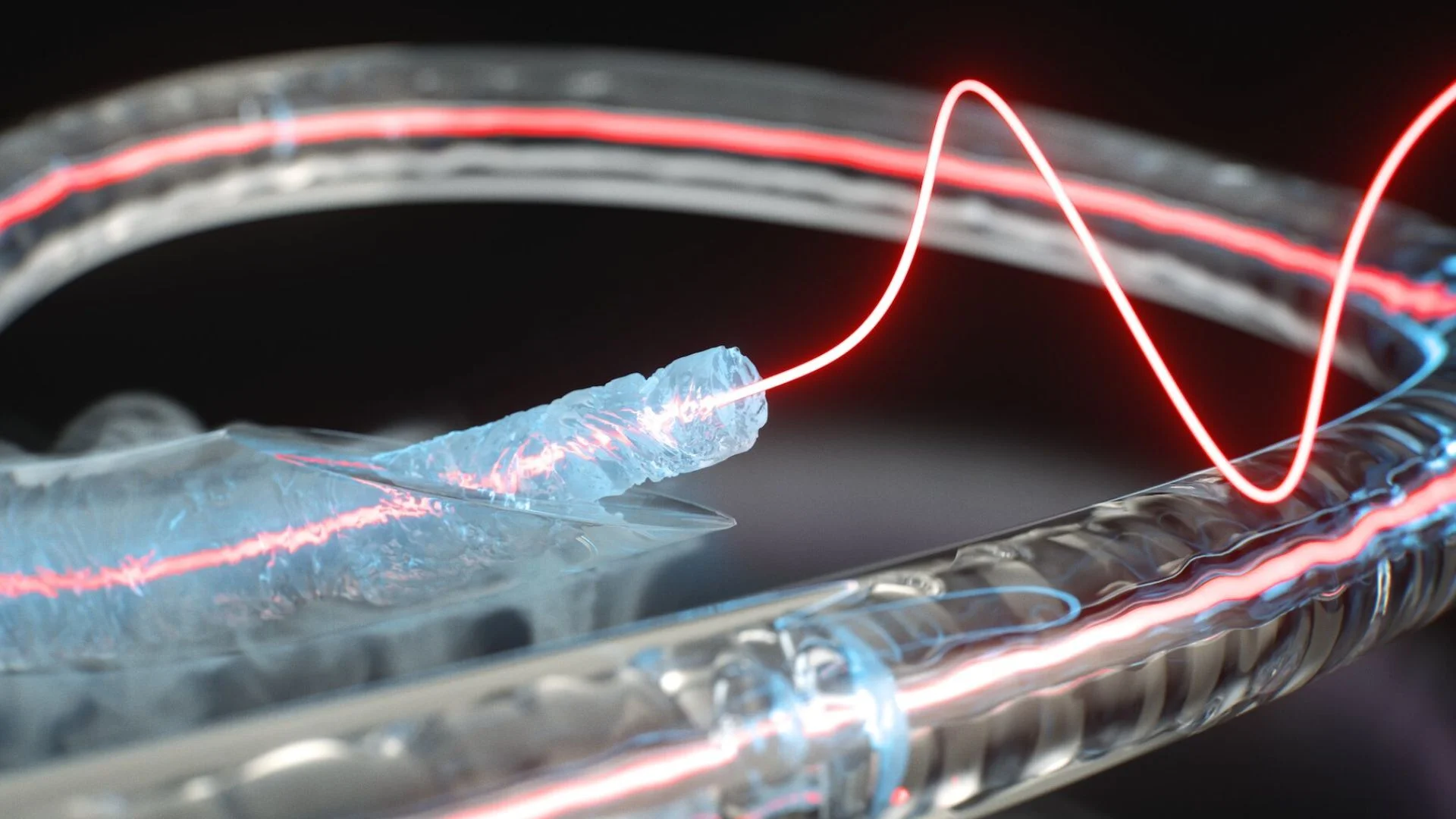
Researchers have created a new type of optical fiber by freezing the liquid inside a glass capillary, enabling light and sound waves to travel together with exceptional efficiency.
The new design increases the interaction between light and sound by more than 1,000 times compared with standard glass optical fibers.
Scientists say the achievement may help reduce the energy needed for photonic computing, quantum information processing, and advanced sensing technologies.
The research was carried out by scientists from the Max Planck Institute for the Science of Light (MPL) in Erlangen, Leibniz University Hannover (LUH), and the Leibniz Institute for Photonic Technologies (IPHT) in Jena.
Their findings have been published in the journal Optica. The work builds on earlier advances in liquid-core optical fibers while introducing an entirely new operating approach.
Freezing Changes Everything
The idea behind the new fiber comes from a familiar natural process where liquids become solids after cooling. Similar changes happen when lava hardens into rock or when lakes freeze during winter. During these transitions, materials change properties such as density and refractive index, which influence how light and sound travel through them.
READ ALSO: Deep-Space CubeSat Aims to Give Earth Up to 3 Hours of Solar Storm Warning Before Impact
Optical fibers normally carry light through a solid glass core over long distances with very little loss. These fibers form the backbone of modern communication networks and internet infrastructure. Special versions, including hollow-core fibers, are also used in lasers, medical imaging, and sensing applications.
Hollow-core fibers can be filled with gases or liquids depending on their intended use. Scientists have used them as miniature laboratories to study chemical reactions or monitor environmental conditions. In this study, researchers filled the fiber with liquid and then cooled it using liquid nitrogen at -196 degrees Celsius, causing the liquid core to freeze into a solid.
The Frozen Optical Fiber
Unlike many materials that lose useful properties after freezing, the frozen fiber continues to guide light efficiently. Both the frozen and liquid sections also allowed extremely high-frequency sound waves, known as hypersonic sound waves, to travel through them. This unusual combination created the conditions needed for much stronger interactions between light and sound.
The team relied on a physical effect called Brillouin-Mandelstam scattering to achieve this interaction.
In simple terms, the effect allows light waves and sound waves to exchange energy while traveling through a material. Although the effect already exists in conventional optical fibers, the frozen fiber creates a much denser and more tightly confined environment that dramatically strengthens the interaction.
Simon Seiderer, one of the study’s lead authors and a researcher in Dr. Birgit Stiller’s Quantum Optoacoustics group, said the frozen section retained its ability to guide light after the phase change.
He explained that both the liquid and frozen parts of the fiber also support hypersonic sound waves. This combination allows researchers to take full advantage of the stronger light-sound interaction.
Lower Energy Computing
The stronger interaction enabled researchers to demonstrate an optoacoustic memory inside the fiber. This system temporarily stores information by transferring it from fast-moving light waves to much slower sound waves before converting it back into light. Using sound as temporary storage creates an important building block for photonic neuromorphic computing systems.
Photonic neuromorphic computing aims to process information using light instead of electrical signals. Since light moves much faster than electricity and generates less heat, it offers an attractive path toward faster and more energy-efficient computing. The stronger coupling inside the frozen fiber reduces the amount of energy required for this process by several orders of magnitude.
Researchers believe the technology may also support quantum information processing, where delicate signals require precise control. It may further benefit microwave photonics, which combines optical and radio-frequency technologies for communication systems. High-precision sensing applications, including scientific instruments and industrial monitoring, may also gain from the enhanced performance.
READ ALSO: Wistron Opens Texas AI Factory to Build NVIDIA Superchips in $700 Million US Manufacturing Push
Future Research Directions
The project benefited from long-standing collaboration with researchers Markus Schmidt and Mario Chemnitz from IPHT Jena, who pioneered work on liquid-core optical fibers.
By adding the freezing step, the team achieved much stronger nonlinear optical effects than previously possible. Nonlinear effects describe situations where light behaves differently under intense interactions, enabling advanced optical functions.
Dr. Birgit Stiller said freezing the liquid core created an entirely new physical platform that combines extreme nonlinear performance with practical handling.
She added that demonstrating highly efficient optoacoustic memory marks an important first step for the technology. According to Stiller, the same level of light-sound interaction also opens opportunities in neuromorphic computing, quantum technologies, microwave photonics, and precision sensing.
The research provides a fresh direction for optical fiber technology by combining phase-change physics with advanced photonics. It shows how a simple process such as freezing can significantly change the behavior of materials at microscopic scales.
However, frozen optical fibers may become an important platform for the next generation of energy-efficient computing and high-performance photonic systems.