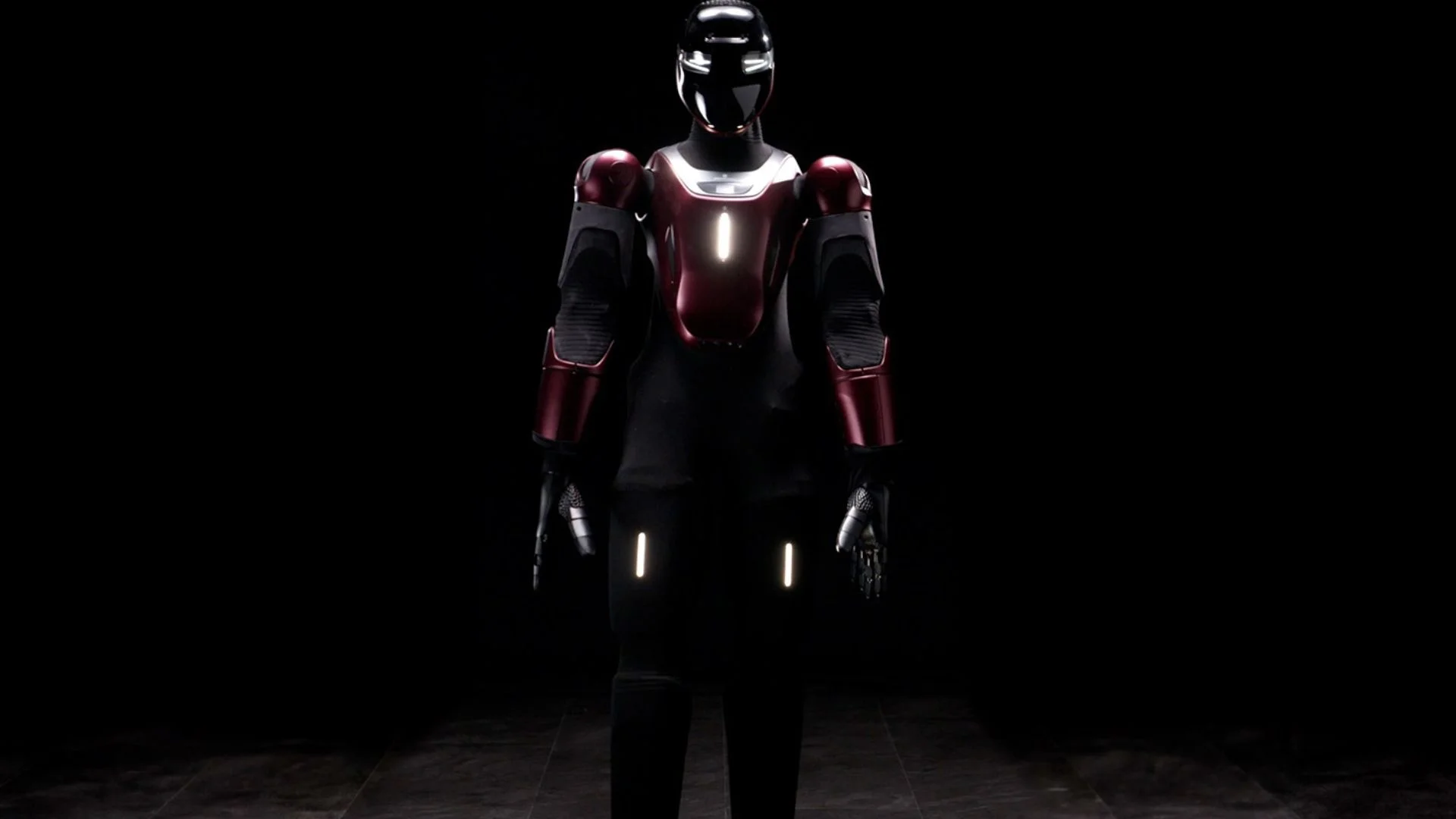
Generative Bionics has introduced Gene.01, a humanoid robot designed for industrial applications with full-body tactile sensing and a physics-based artificial intelligence system.
The company unveiled the robot during AMD Advancing AI 2026 after completing its development in just six months. The launch marks the first public demonstration of a platform built to work closely with people in demanding industrial environments.
The company said Gene.01 combines its body, mechanical design, and AI into a single system instead of treating them as separate components.
This approach allows the robot to understand physical interactions better while responding naturally to its surroundings. The goal is to improve safety, efficiency, and flexibility in workplaces where humans and robots operate together.
Unlike many humanoid robots that follow a standard design, Gene.01 is built as a customizable platform. Generative Bionics said customers can tailor the AI system, external design, and end-effectors according to specific industrial tasks. This allows one core robot platform to support different industries without requiring a completely new machine each time.
Gene.01: Built to Feel
One of Gene.01’s key features is its distributed tactile skin that covers the robot’s body. The sensors detect touch, force, temperature, and nearby objects, allowing the robot to recognize human presence before direct contact occurs. This additional awareness helps reduce the risk of accidental collisions during shared tasks.
READ ALSO: Robot Fighting Arrives: 32 Teams Battle Humanoid Robots in World’s First URKL Tournament
The company designed the sensing system to make human-robot collaboration more natural. Instead of relying only on cameras, the robot also understands physical contact through its skin-like sensors. This gives it more information about its surroundings, especially in busy industrial settings where visual data alone may not be enough.
Another advantage of the tactile system is that workers can teach the robot by demonstrating both movement and applied force. This is important for tasks such as gripping objects securely, where pressure matters as much as motion. Generative Bionics said video-based learning methods often struggle to capture this type of information accurately.
Integrated Physical Intelligence
Gene.01 runs on the company’s proprietary physical AI architecture. Rather than optimizing hardware and software separately, the platform develops movement, sensing, and intelligence together as one connected system. The company believes this creates more reliable performance in real-world industrial environments.
The AI uses digital models of both the robot and its human partner while planning movement. It continuously evaluates factors such as walking stability, balance, and ergonomic interaction during tasks. This allows the robot to adapt its movements while maintaining safe and efficient collaboration with nearby workers.
Generative Bionics also developed a digital twin for Gene.01 to simplify software development. Developers can access the robot model through common robotics platforms, including PyPI, conda-forge, and the official ROS build farm. A simple installation process allows researchers and developers to begin testing applications within existing simulation and AI environments.
Industrial Deployment Plans
Gene.01 serves as the foundation for a family of specialized humanoid robots. Instead of producing different robots from scratch, Generative Bionics plans to customize one core platform for various industries. The company said this strategy supports larger-scale manufacturing while reducing development complexity.
Each version of the robot will receive application-specific modifications. Engineers will adapt the AI models for individual tasks, redesign external components for different workplaces, and replace end-effectors such as hands or feet based on operational requirements. This flexibility allows the same platform to support multiple industries.
The company’s first industrial deployment is taking shape through a collaboration with Fincantieri, one of the world’s leading shipbuilders. They are developing a welding humanoid for complex shipyard operations. Shipbuilding environments often involve confined spaces and physically demanding tasks where robotic assistance can improve productivity and worker safety.
READ ALSO: GA-ASI, KONGSBERG Move MQ-9B Closer to Long-Range Strike With JSM Missile Integration
Generative Bionics expects future versions of Gene.01 to support logistics, manufacturing, inspection, healthcare, and public safety.
Each sector has different operational needs, making customization an important part of the company’s long-term strategy. A common hardware platform combined with task-specific software may also simplify maintenance and future upgrades.
European Robotics Vision
Generative Bionics is based in Genoa, Italy, and aims to strengthen Europe’s physical AI ecosystem. The company said it wants to build robotics technology around trusted supply chains, industrial capability, and human-centered design. It also emphasizes compliance with European safety and regulatory standards.
To support this objective, the company has partnered with Germany-based Synapticon. The collaboration focuses on developing an actuation system protected within Europe for future humanoid robots. Their work includes actuator development, final assembly, calibration, and safety testing designed specifically for Gene.01.
The company traces its technology back more than two decades of humanoid robotics research at the Italian Institute of Technology. After spinning out from the institute in 2024, Generative Bionics secured exclusive licenses to several important technologies developed during that research. This provides the company with a strong technical foundation as it expands its commercial products.
In late 2025, Generative Bionics raised €70 million, or about $81.2 million, to support its next stage of growth. The funding will help the company expand product development, train its physical AI systems, and build its first production facility. However, Gene.01 represents an important step toward scalable, application-focused humanoid robotics with practical industrial use.