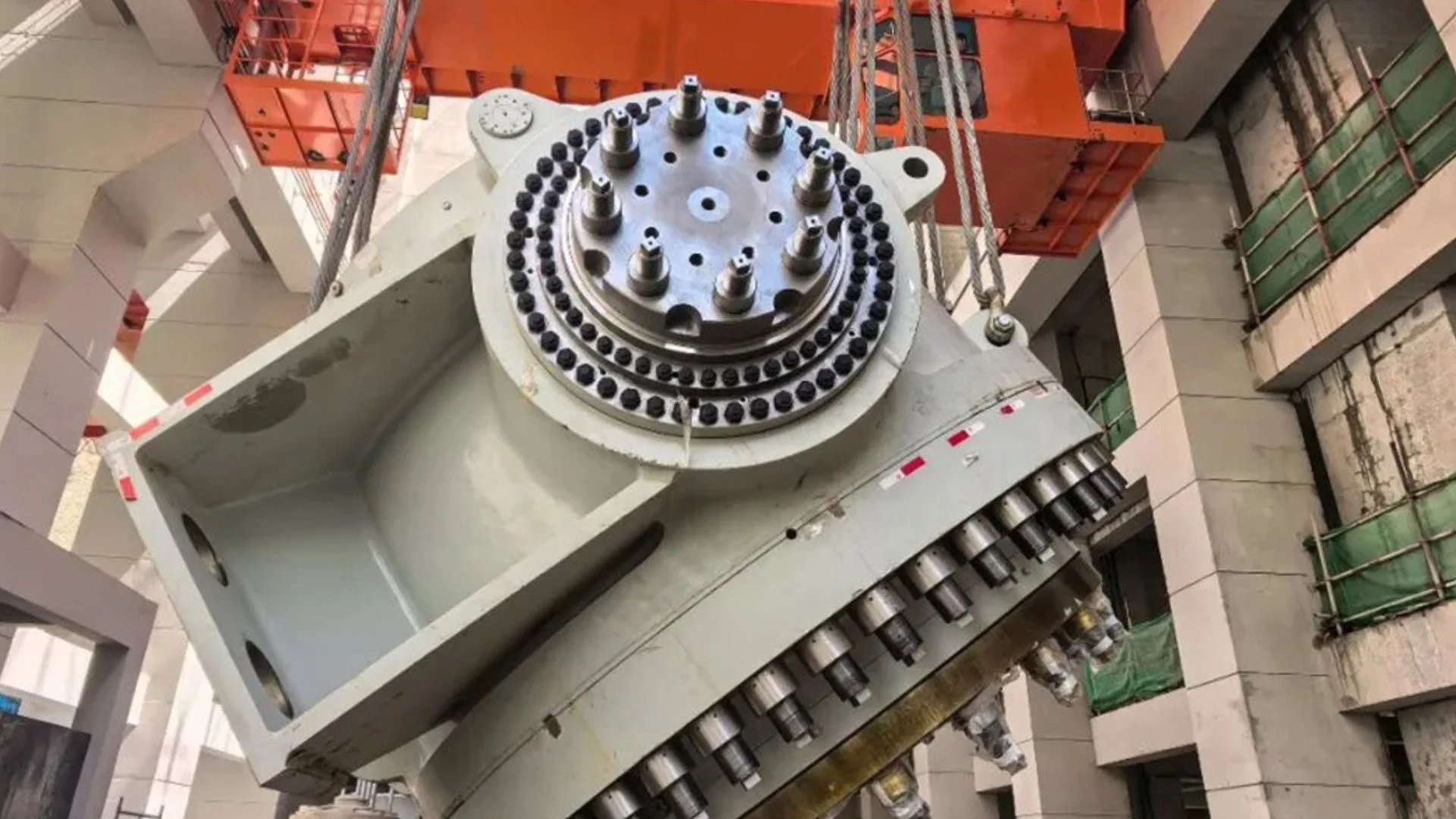
A massive steel valve just cleared one of the toughest tests in hydropower engineering. Workers in Southwest China’s Xizang Autonomous Region confirmed that a giant inlet spherical valve at the Datang Zhala Hydropower Station passed its hydrostatic pressure test.
The valve belongs to the world’s first 500-megawatt impulse hydropower unit, a project that is reshaping how engineers think about high-altitude power generation.
A Giant Valve Tested
The inlet spherical valve for Unit 1 at Zhala Hydropower Station recently completed its pressure test. Engineers confirmed that its sealing performance met design standards under every operating condition. The Securities Times first reported the milestone on Sunday, calling it the completion of the station’s first giant inlet valve assembly.
This valve is not a small part. It measures 2.9 meters across and is built to handle a design pressure of 9 megapascals, a measure of how much force the metal must withstand without leaking. Its assembled weight tops 300 tons, roughly the weight of two fully loaded jumbo jets.
The valve includes several major components. These include a large valve body, a small valve body, a valve disc, and a valve shaft. Each piece had to fit together with extreme precision before the test could even begin.
READ ALSO: Researchers Build Thin-Film Electronics That Dock and Undock Themselves on Demand
Built For Extreme Conditions
Datang Zhala Hydropower Station will run on two 500 MW impulse units, also known as Pelton turbines. Pelton turbines work differently from typical hydropower designs, using fast jets of water to spin a wheel rather than relying on constant water flow through a chamber. This makes them well suited for sites with a steep drop in elevation and lower water volume, exactly the conditions found in Xizang’s mountains.
Dongfang Electric Corporation is supplying one full unit for the project. The company shared details of the milestone through its official WeChat account on Sunday. It described the valve’s design, manufacturing, and installation as reaching new levels of difficulty for the industry.
Assembly did not happen in a typical factory setting. Instead, workers built the valve in an open-air yard due to space constraints. That meant dealing with limited working rooms, restricted areas for lifting heavy parts, and unpredictable outdoor weather throughout the process.
A First For Xizang
This project holds a distinct place in China’s energy plans. It is the first approved megawatt-level hydropower project located in the Xizang Autonomous Region. It is also the only hydropower project in China set up to research, develop, and demonstrate 500 MW-class impulse units at this scale.
National regulators have taken notice of its importance. The National Energy Administration placed the project on its list of first major technical equipment initiatives in the energy sector. Officials and engineers alike view it as a proving ground for next-generation turbine technology.
The station also plays a bigger regional role. It will serve as a key power source for a national clean energy demonstration base in southeastern Xizang. That base combines hydropower, wind, and solar resources into a single integrated system designed to boost renewable output in the region.
READ ALSO: US Navy Diverts Five Ships Near Strait of Hormuz as Iran Maritime Operation Intensifies
What This Means Next
Passing this pressure test clears the way for further assembly work at the station. Engineers can now move forward with confidence that the valve’s core sealing systems will perform safely under real operating loads. This reduces risk for the rest of the installation process ahead.
The achievement also builds China’s technical know-how in a specialized field. Few countries have attempted impulse hydropower projects at this size and altitude combined. Each completed milestone adds practical data that engineers can apply to future high-head power projects elsewhere.
As construction continues, the Zhala Hydropower Station remains one of the most technically demanding hydropower builds anywhere in the world today. Its progress will likely influence how future high-altitude, high-head power stations are designed and built. For now, this successful valve test marks a solid step forward in a much longer engineering journey.