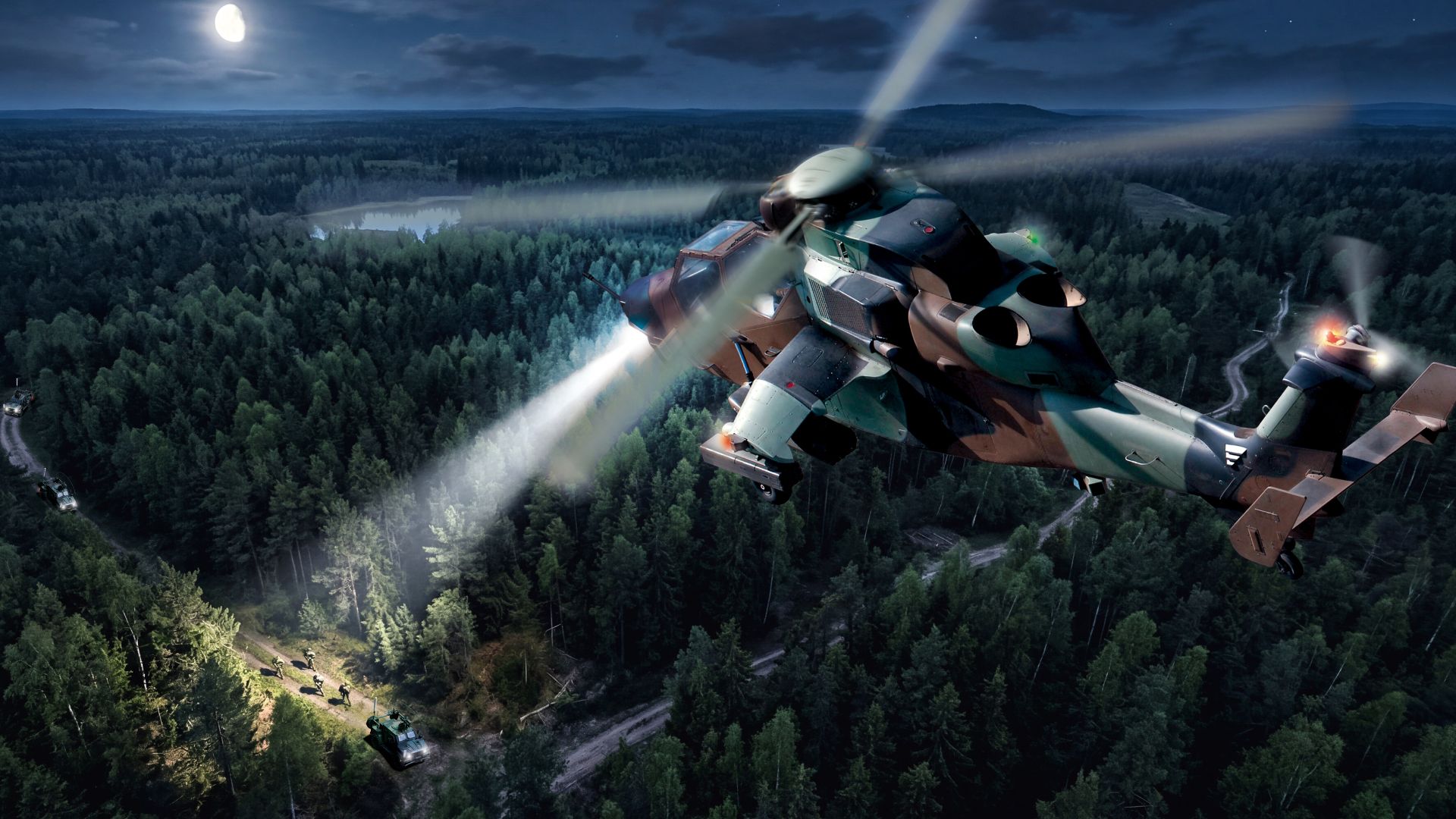
Thales has launched a new generation Search and Landing Light (SLL) designed to improve visibility during demanding helicopter operations.
The compact lighting system combines full 360-degree coverage, connected software features, and high-power illumination in a single package. It is built to support military, search-and-rescue, security, and civil aviation missions where reliable lighting is essential.
Unlike many conventional helicopter searchlights, the new SLL is flush-mounted in the aircraft rather than protruding from the fuselage. This design reduces aerodynamic drag while allowing unrestricted movement in every direction. The system also removes illumination dead zones, ensuring crews maintain continuous visibility around the helicopter.
Mission Ready Features
The Search and Landing Light uses a software-defined architecture that allows operators to tailor its functions to different mission needs. It connects directly with onboard systems such as Forward-Looking Infrared (FLIR) cameras, helmet-mounted displays, and multifunction cockpit screens. By linking these systems, crews gain better situational awareness and can make faster operational decisions.
FLIR cameras detect heat rather than relying solely on visible light, helping pilots identify people, vehicles, or obstacles in darkness or poor weather. The SLL works alongside these sensors by providing stable, accurate lighting wherever required. This combination gives flight crews a clearer understanding of their surroundings during complex operations.
The system also supports multiple users during a mission. Pilots, co-pilots, and hoist operators can independently control one or more lights depending on operational requirements. This flexibility helps different crew members focus on their specific tasks without interrupting others’ work.
Thales Enhances Rescue Visibility
Search and rescue missions often take place at night or in difficult environments such as forests, mountains, or snow-covered regions. In these situations, helicopter crews need lighting that follows survivors, rescue teams, and landing areas without requiring constant aircraft repositioning. The SLL’s full 360-degree movement allows continuous illumination throughout the mission.
During rescue or medical evacuation operations, helicopters frequently use hoists to lift people from locations where landing is impossible. The new lighting system provides stable illumination directly over the hoist area throughout the recovery process. Hoist operators can independently adjust the light in real time, improving safety and helping crews work more efficiently in low-visibility conditions.
READ ALSO: TU Berlin’s SpaceBox Battery Project Aims to Transform Satellite Power Storage
Maritime rescue operations also benefit from accurate lighting because reflections on the water and changing weather conditions can reduce visibility. Continuous illumination helps rescuers maintain visual contact with both survivors and recovery equipment. This reduces operational complexity during time-sensitive missions.
Tactical Night Missions
The Search and Landing Light also supports military helicopter operations conducted after dark. It includes dedicated covert operating modes designed to reduce the aircraft’s visual and infrared signature while still providing the illumination needed for mission success. This feature helps crews operate more discreetly during infiltration, extraction, and special operations.
Reducing infrared visibility is particularly important because many modern surveillance systems detect aircraft by the heat they emit. By reducing their infrared signature, the lighting system makes helicopters harder to detect while preserving operational effectiveness. This balance supports missions in contested or high-risk environments.
Beyond tactical advantages, the connected architecture allows future software updates that can introduce additional mission-specific capabilities. This makes the system adaptable as operational requirements continue to evolve. It also gives operators greater flexibility without requiring major hardware changes.
Designed And Manufactured
Thales designed the complete optical assembly for the high-power LED lighting subsystem used in the new Search & Landing Light. The company also handles system integration, assembly, and testing at its facility in Dourdan, France. Keeping these activities under one organization supports quality control throughout production.
Nicolas Bonleux, Vice President of Aerospace Communications at Thales, said the company developed the system with helicopter crews operating in demanding conditions in mind.
He said the new Search and Landing Light gives operators greater flexibility, improves mission effectiveness, and adapts to a wide range of operational scenarios from a single system. He added that the product reflects Thales’ commitment to delivering solutions that evolve alongside customer mission requirements.
Modern helicopter missions continue to demand better visibility, improved coordination, and adaptable onboard systems across both military and civilian sectors.
As operators face increasingly complex environments, connected lighting technologies like the new Search and Landing Light are expected to play a larger role in improving safety, mission performance, and operational efficiency.