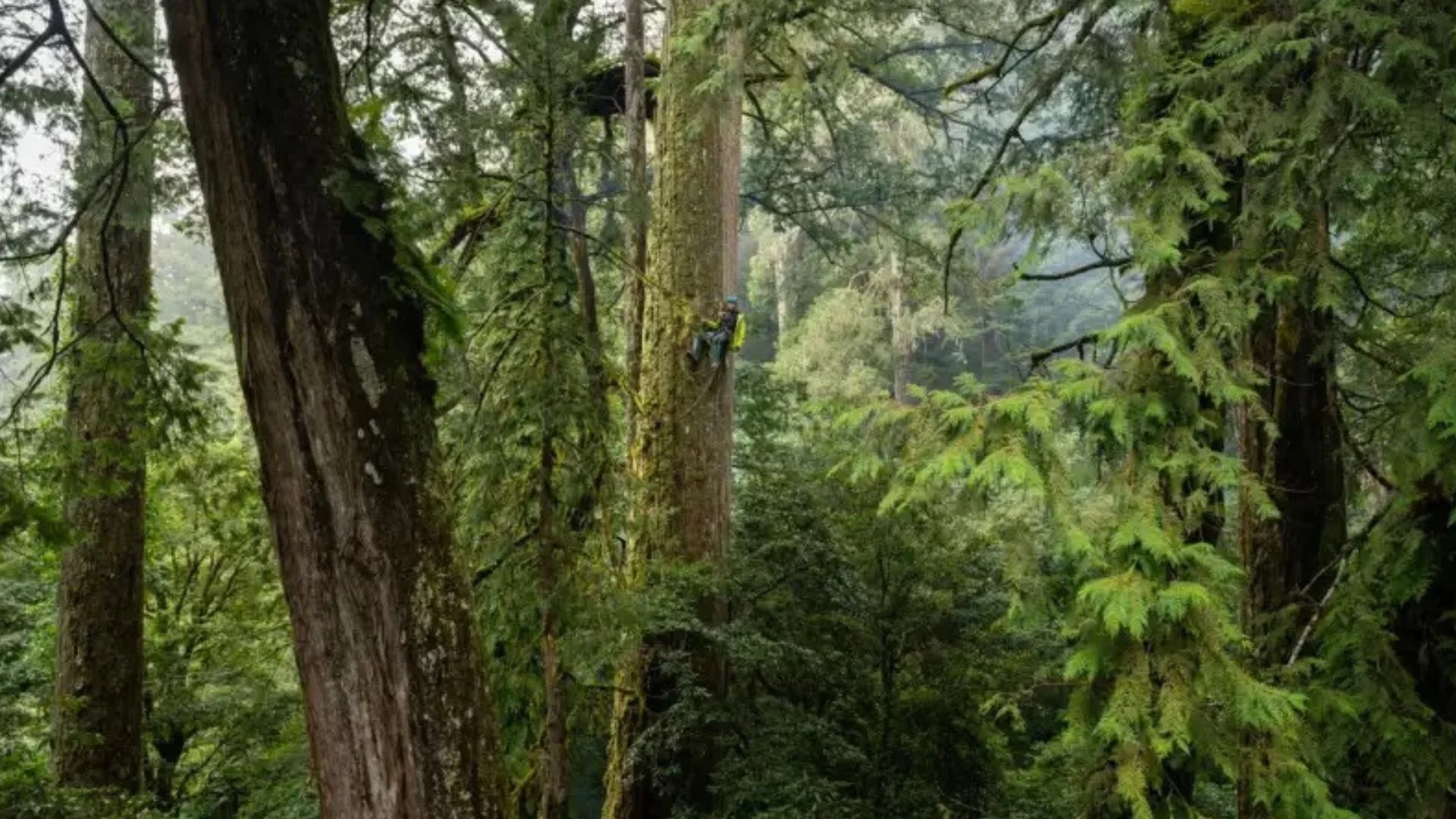
Deep inside Taiwan’s rugged mountains, researchers have identified the tallest tree ever recorded in East Asia.
The giant Taiwania fir stands 84.1 meters tall and now holds the regional height record. The tree was officially measured in January 2023 after years of searching.
The towering tree earned the name ‘Heaven Sword of the Da’an River.’ It belongs to the species Taiwania cryptomerioides, one of Asia’s most impressive conifer trees. Indigenous Rukai communities have long referred to such giant trees as ‘the tree that hits the moon.’
The discovery was made by a team known as the Taiwan tree seekers. The group includes ecologists, professional tree climbers, geologists, and remote sensing specialists. Since 2014, they have worked together to locate and document Taiwan’s tallest trees.
Taiwan is uniquely suited for growing giant trees. The island covers about 36,000 square kilometers, making it roughly the size of Switzerland. Its dramatic mountains and diverse climate create ideal conditions for forest growth.
The island contains 258 mountain peaks that rise above 3,000 meters. The highest peak, Jade Mountain, reaches 3,952 meters above sea level. These elevations support a wide range of ecosystems across relatively short distances.
Taiwan is home to around 5,000 plant species. Its landscapes range from tropical forests near the coast to alpine environments in the highest mountains. This biodiversity has helped create some of Asia’s most remarkable forest habitats.
READ ALSO: BAE Systems Secures $70 Million Contract for Upcoming Virginia Payload Module Missile Tubes
About 60 percent of Taiwan remains covered by forests. Researchers estimate that roughly 950 million trees grow across the island. Many forests survived because steep slopes made logging difficult in remote areas.
Large-scale timber harvesting took place between 1912 and 1991. While logging reduced many old-growth forests, some ancient stands remained untouched. These protected pockets became important refuges for giant trees.
A Decade-Long Search for Hidden Giants
The organized search for Taiwan’s tallest trees began in August 2014. Scientists from the Taiwan Forestry Research Institute launched an expedition to the Cilan conservation area. Their goal was to study a famous group of giant trees known locally as the Chilan Three Sisters.
The team carefully measured the trees for the first time. The tallest among them reached 69.3 meters. Its trunk diameter measured nearly three meters across.
Interest in Taiwan’s giant trees grew internationally in 2017. Professional climbers from Australia’s The Tree Projects traveled to Taiwan to photograph the Chilan Three Sisters. Their images introduced many people around the world to Taiwan’s ancient forests.
Researchers then turned their attention to a more remote area near Mount Benya. Local reports suggested that the region was home to one of the largest populations of Taiwania fir trees. The site sits close to Great Ghost Lake, a place considered sacred by Indigenous communities.
Reaching the area was extremely challenging. Team members spent four days hiking through difficult mountain terrain. The effort revealed how difficult it was to identify the tallest trees solely from ground observations.
READ ALSO: MSU research: How race, socioeconomic status contribute to math education inequalities
Dense forest canopies often create visual illusions. Trees can appear taller or shorter depending on their surroundings. During one expedition, researchers climbed a tree measuring 71.7 meters but realized more advanced tools were needed.
Heaven Sword Pierces Sky
Scientists soon understood that traditional field surveys alone would not be enough. Millions of trees were spread across remote valleys and mountains. Finding the tallest among them required a more efficient method.
To improve the search, researchers partnered with experts from National Cheng Kung University. They used LiDAR, a technology that creates detailed three-dimensional maps. The system helped identify potential giant trees across vast forested regions.
LiDAR stands for Light Detection and Ranging. The technology sends laser pulses from aircraft toward the ground and forest canopy. By measuring how quickly the light returns, scientists can calculate tree heights with remarkable detail.
The technology dramatically increased the number of trees that could be analyzed. However, Taiwan’s steep terrain created new challenges. Trees growing beside cliffs often appeared much taller in the computer-generated data.
Automatic software frequently miscalculated heights because of these landscape features. Researchers found that many promising candidates were actually far shorter than expected. Human review became essential for improving accuracy.
In 2020, the project expanded into a nationwide citizen science effort. Hundreds of volunteers examined LiDAR images and helped identify errors. Their contributions significantly reduced the number of false leads.
The results were striking. Researchers discovered that about 93 percent of automatically identified giant trees had been mismeasured. Citizen scientists helped eliminate thousands of incorrect targets before field expeditions began.
READ ALSO: Heat-Free Technology Revolutionizes Fruit Dehydration
Without public participation, researchers might have spent years investigating inaccurate locations. The collaboration saved valuable time and resources. It also demonstrated how technology and community involvement can work together in scientific research.
The project reached another milestone in late 2022. Researchers published the Taiwan Giant Tree Map after analyzing years of data. The map identified 941 individual trees taller than 65 meters.
Armed with this new information, the team organized another expedition during the Lunar New Year holiday in January 2023. Their target was a tree that appeared to be the strongest candidate for Taiwan’s height record. The journey involved a 20-kilometer river trek followed by two days of steep climbing.
When climbers finally reached the top, they lowered a measuring tape from the crown to the forest floor. The final measurement confirmed a height of 84.1 meters. The tree immediately became the tallest known tree in Taiwan and East Asia.
The discoveries did not stop there. By early 2026, researchers had climbed ten Taiwania trees exceeding 70 meters in height. Two of those trees exceeded 80 meters.
The Giant Tree Map also revealed extraordinary concentrations of giant trees. Near Mount Benya, researchers found a single hectare containing 11 trees taller than 65 meters. Such density is rare even among the world’s most famous old-growth forests.
When researchers returned to the Great Ghost Lake area a decade after their first visit, they found what they described as a forest of giants. Around 30 massive Taiwania firs were growing together in an ancient cluster. The discovery highlighted the ecological importance of Taiwan’s remaining old-growth forests.
These forests are important for more than their size. Giant trees store large amounts of carbon in their trunks, branches, and surrounding ecosystems. This makes them valuable allies in efforts to manage atmospheric carbon dioxide.
WATCH ALSO: Chinese company’s humanoid robot dodges arrow with side flip
In 2024, researchers and citizen scientists studied a valley known as the Tao Tree site. The area contains Taiwan’s third-tallest tree and is an important research site. Scientists measured how much carbon the forest stores.
The findings showed a carbon density of 1,384.5 megagrams per hectare, even without including underground root systems. This places Taiwan’s giant forests among the most carbon-rich ecosystems on Earth. Their carbon storage capacity rivals some of the world’s most celebrated old-growth forests.
The discovery of the Heaven Sword highlights both the scientific value and environmental importance of Taiwan’s forests. It also demonstrates how modern technology, field research, and public participation can uncover hidden natural treasures. As researchers continue exploring remote mountain regions, more giant trees and major ecological insights are expected to emerge.