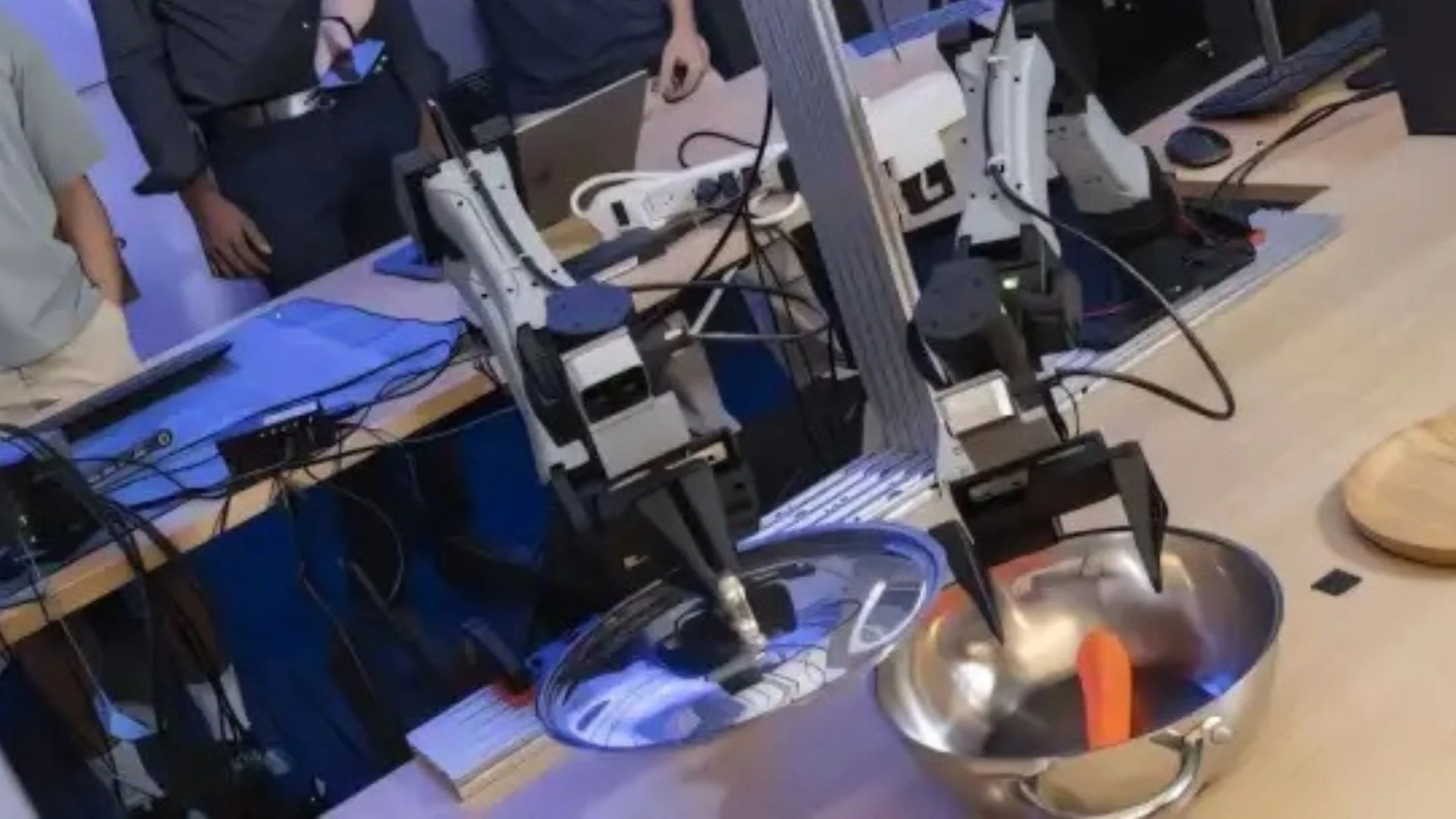
Researchers at Georgia Tech have introduced a new platform, COBALT, that turns a smartphone into a controller for robotic arms.
The system allows users to remotely control a robot by simply moving their phone. A secure internet connection links the smartphone to a server, which sends commands to the robot in real time.
The technology was presented at the IEEE International Conference on Robotics and Automation held in Vienna. The project was led by Ayush Agarwal, a Ph.D. student in Georgia Tech’s School of Interactive Computing. He works with a research team focused on making robot operation more accessible to everyday users.
The app is designed to be simple and intuitive. Users can move their phones in different directions, and the robot arm copies those movements. Buttons on the screen allow users to pick up, move, and release objects with minimal training.
Researchers intentionally designed the system to feel familiar. The experience feels more like playing a mobile game than operating industrial machinery. This approach reduces the learning curve and allows first-time users to start controlling robots quickly.
Agarwal and his team tested the platform with participants from nine different countries. These users remotely controlled robot arms located inside Georgia Tech’s People, AI & Robotics Lab. Many participants had never operated a robot before joining the study.
The results showed that novice users could successfully complete tasks using the system. Researchers also collected valuable information from these interactions. That data can be used to train AI systems that help robots perform tasks more independently in the future.
COBALT Builds Robotic Intelligence
One of the biggest challenges in robotics is collecting enough data to train intelligent systems. Robots learn many tasks by observing human actions and receiving examples of how jobs should be completed. Gathering this information at a large scale remains difficult and expensive.
The COBALT platform was designed to help solve that problem. Instead of relying on a small number of trained operators, researchers can invite people from around the world to contribute. Every interaction provides useful information that can help improve robotic learning systems.
Assistant Professor Animesh Garg, who directs the PAIR Lab and advises the project, sees large-scale participation as an important step for the robotics industry. He believes future robot development will require massive amounts of real-world data. Simulations alone cannot provide everything robots need to learn complex tasks.
Garg has worked on this idea for many years. During his time as a postdoctoral researcher at Stanford University, he developed an earlier system called RoboTurk. COBALT builds on that foundation while expanding accessibility through smartphones.
The concept capitalizes on the global popularity of mobile devices. Nearly five billion people worldwide use smartphones. By turning these devices into robot controllers, researchers gain access to a huge network of potential contributors.
READ ALSO: Battleship-Trained AI Learns Smarter Questions, Lifting Win Rates From 8% to 82%
This approach could dramatically increase the amount of data available for training robotic systems. More data often leads to better AI performance. As robots become more capable, they can handle increasingly complex tasks in homes, factories, and other environments.
Education, Remote Work, and Future Applications
Beyond AI training, the technology has important educational benefits. Students can learn robotics without needing expensive equipment in their classrooms. A smartphone and an internet connection are enough to interact with real robotic systems.
Georgia Tech recently demonstrated this potential by hosting students from Midtown High School in Atlanta. The students used their phones to control robot arms remotely. The experience provided hands-on exposure to robotics and computer science concepts.
Researchers believe the platform can also support new forms of remote work. People could log in and operate robots from home whenever assistance is needed. This idea resembles existing gig economy platforms that connect workers with temporary tasks.
In a household setting, a remote operator could control an assistive robot to help complete everyday chores. Individuals who need support could request help through a digital platform. Operators located elsewhere would perform tasks using the robot in place of their physical presence.
READ ALSO: General Dynamics to upgrade Virginia-class submarines with $1 billion contract
Industrial applications are another area of interest. Modern factory robots already handle many repetitive jobs with limited human involvement. However, unusual situations still require human intervention from time to time.
With COBALT, a worker does not need to be physically present at the factory. Instead, the person can connect remotely and guide the robot through difficult tasks. Once the issue is resolved, the robot can return to autonomous operation.
Researchers also studied different control methods during development. Participants compared smartphones with virtual reality headsets, keyboards, computer mice, and specialized controllers. The studies found that people generally preferred using smartphones.
According to Agarwal, smartphones offered an intuitive experience while maintaining data quality comparable to other control systems. Since most people already know how to use a phone, additional training requirements remain low. This makes the technology easier to scale across different regions and user groups.
READ ALSO: Thales and KNDS France Unveil RAPIDFire Land: New Ground-Based Variant of 40mm Naval Defence System
The system also delivers video feedback with very little delay. Users can see the robot’s actions almost instantly after moving their phones. Fast response times are important because delays can make precise control difficult.
The platform relies on Web Real-Time Communication(WebRTC) technology. This is the same communication framework used by many video conferencing and streaming services. It helps maintain smooth communication between users, servers, and robots across long distances.
Researchers say the project’s most important achievement is not just the phone-based controls. The larger accomplishment is the creation of a complete global infrastructure for remote robot operation and large-scale data collection.
As robotics companies seek more efficient ways to train AI systems and deploy machines worldwide, platforms like COBALT could play an important role in connecting people and robots across the globe.