Researchers at the National Institute of Standards and Technology (NIST) have developed a new method that improves how metals are mixed during 3D printing.
The technique uses a specially controlled laser to stir molten metal while it is being printed. Scientists say the approach opens new possibilities for producing advanced metal alloys that have been difficult to manufacture.
The research addresses a long-standing challenge in metallurgy. Different metals often resist mixing evenly when they melt together. This can lead to weak spots and inconsistent material properties in the finished product.
Metals are used in many demanding environments. Engineers need materials that can withstand heat, corrosion, radiation, stress, and wear. To achieve these properties, researchers combine different elements to create alloys with specific characteristics.
Alloys have played an important role throughout human history. Bronze helped shape early civilizations. Steel became essential for buildings, bridges, and transportation systems.
Today, scientists continue searching for new alloy combinations. Modern industries such as aerospace, energy, defense, and manufacturing require materials that can perform under increasingly demanding conditions. This demand has driven interest in more complex alloy designs.
One of the most promising groups of materials is known as high-entropy alloys(HEAs). Unlike traditional alloys, HEAs contain several different metals in nearly equal amounts. This unique structure can give them exceptional strength and stability at high temperatures.
READ ALSO: Sofia Offshore Wind Farm Makes History with UK’s First Recyclable Blades
Traditional alloys typically rely on a single dominant metal. Steel, for example, is primarily made of iron with smaller amounts of carbon and other elements. These added elements improve specific properties while keeping the overall composition relatively simple.
HEAs follow a very different formula. Instead of one main ingredient, several metals share similar proportions. A high-entropy alloy might contain five different metals, each contributing about 20 percent of the total composition.
This balanced mixture creates unusual atomic arrangements. These arrangements help improve performance in extreme environments. As a result, HEAs attract interest for applications such as jet engines, power systems, and nuclear reactors.
However, manufacturing these alloys presents major challenges. Each metal behaves differently when heated and cooled. Differences in density, melting temperature, and surface tension often cause the metals to separate rather than blend evenly.
Scientists compare the problem to mixing oil and water. Even after melting, the metals tend to form separate regions as they cool. This separation weakens the final material and reduces performance.
Researchers have struggled to overcome this limitation using conventional production methods. Casting, one of the most common manufacturing techniques, does not always provide enough control over how different metals mix. Producing high-quality HEAs, therefore, requires additional effort and precision.
The NIST team believed metal 3D printing offered a possible solution. Metal additive manufacturing already allows engineers to create complex shapes while reducing waste. The technology is increasingly used in aerospace, automotive production, and industrial manufacturing.
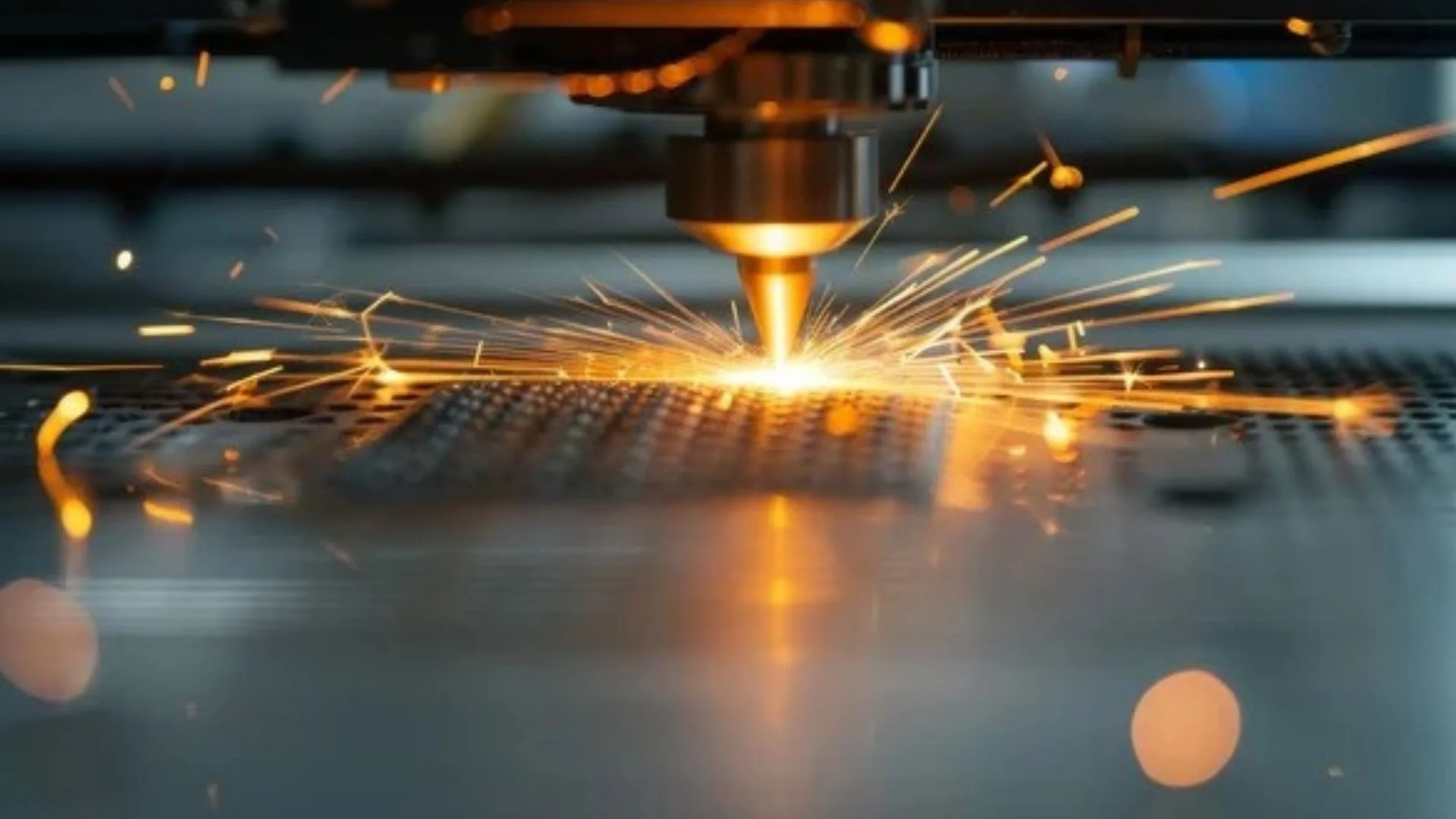
A common metal printing process is called laser powder bed fusion. During printing, a powerful laser moves across a layer of metal powder. The laser briefly melts the powder into a tiny molten pool, which then quickly solidifies.
This process naturally creates some mixing between different metals. However, the mixing is often insufficient for demanding alloy systems such as HEAs. Researchers needed a way to improve the blending process inside the molten metal.
WATCH ALSO: Rolls-Royce tests world’s first high-speed marine engine powered by methanol
Laser Stirs 3D Alloy
NIST researcher Ho Yeung and his colleagues developed a surprisingly simple solution. Instead of moving the laser in straight lines, they programmed it to follow looping patterns. These loop-the-loop movements actively stirred the molten metal while printing.
The laser effectively acted like a whisk in a kitchen. As the beam moved through the molten pool, it encouraged different metals to mix more thoroughly. This extra motion improved blending at the microscopic level.
Creating the technique required more than changing the laser path. Existing commercial software did not support these complex movements. The research team therefore created new software to control the laser patterns.
An important advantage of the system is that it does not require major hardware changes. Existing metal 3D printers could potentially adopt the approach through software updates. This could make implementation easier across the industry.
To test the method, the researchers selected two metals that are normally difficult to combine. One material was a dense high-entropy alloy known as RHEA-19. The other was a lightweight titanium alloy.
The team placed the two materials side by side. They then passed the looping laser across the boundary between them. The goal was to determine whether the laser stirring could create a more uniform alloy.
Verifying the results required advanced scientific tools. The researchers needed to observe how atoms behaved as the molten metal cooled and solidified. This entire process occurs in less than a second.
To capture these changes, NIST partnered with Argonne National Laboratory. The laboratory operates the Advanced Photon Source(APS). This large scientific facility generates extremely bright X-ray beams.
READ ALSO: US Navy’s latest 6th gen jet could have 25% higher range
The APS is one of the most powerful X-ray sources in the world. Its X-rays are hundreds of billions of times brighter than those used in medical and dental imaging. Such brightness enables scientists to study rapid events within dense materials.
The research team directed the X-rays through the metal while it solidified. As the X-rays interacted with atoms, they produced patterns that revealed the material’s internal structure. Scientists could then track the evolution of those structures in real time.
This technique is known as X-ray diffraction. It helps researchers understand how atoms are arranged inside materials. By analyzing the resulting patterns, they can observe phase changes and structural development during manufacturing.
The team also examined the finished samples using electron microscopes. These detailed images provided additional confirmation of how well the metals had mixed. Together, the measurements showed that the laser stirring technique successfully improved alloy formation.
Beyond proving the concept, the project introduced a valuable new research capability. Scientists now have a better way to observe metal solidification in real time. This information can support future improvements in additive manufacturing.
The implications extend beyond high-entropy alloys. The same approach can be applied to more conventional alloy systems. Manufacturers could potentially create new materials directly during the printing process.
Researchers compare the concept to color printing. A standard office printer combines a small number of inks to create many colors. Similarly, future metal printers might mix a limited set of elemental powders to produce a wide range of alloys on demand.
Such flexibility could reduce material inventories and lower manufacturing costs. Companies would not need separate powder supplies for every alloy they wish to print. Instead, they could create customized compositions during production.
WATCH ALSO: Explore Raytheon’s giant facility where it develops powerful naval radar SPY-6
The technology also supports advanced component design. Different sections of a single part could contain different alloy compositions. This would allow engineers to optimize performance in specific areas without relying on welding or assembly.
A jet engine component offers a useful example. One section could prioritize heat resistance, while another could focus on strength. The transition between materials could occur during printing itself.
As metal additive manufacturing continues to expand, methods that improve material control are becoming increasingly important. The new laser-stirring approach provides a practical way to enhance alloy quality using existing printing systems.
Researchers believe the technique can help accelerate the development of next-generation materials and expand the capabilities of industrial 3D printing in the years ahead.