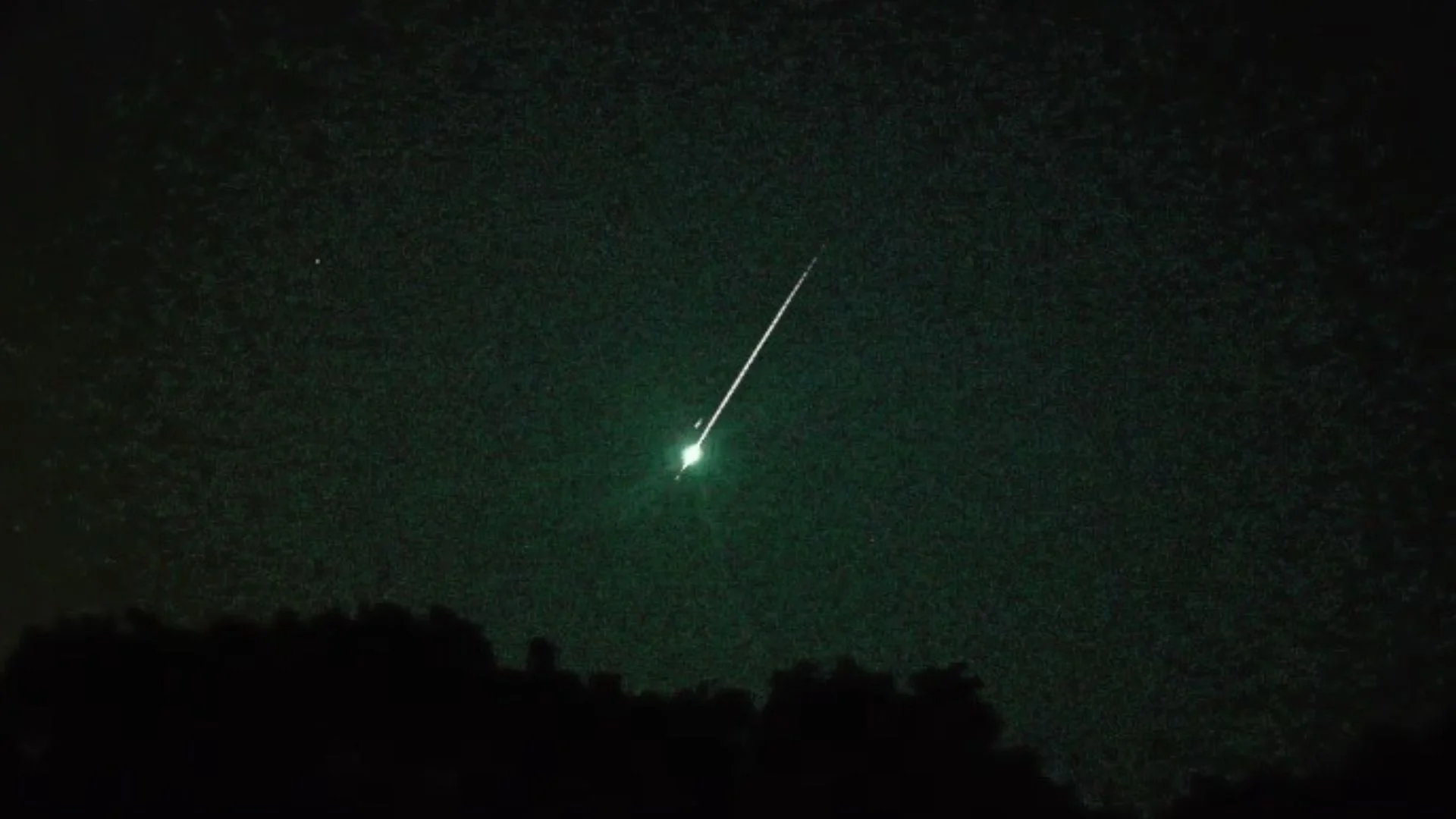
A rare green fireball meteor lit up the skies above Mount Mayon in the Philippines late on May 25.
The bright object was seen streaking across the night sky while the volcano continued its ongoing eruption in Albay province. Multiple livestream cameras captured the event, and the footage quickly spread across social media platforms.
Early reports suggested the meteor had struck the volcano’s slopes, triggering widespread online speculation. Scientists later confirmed that the fireball exploded high in the atmosphere and never reached the ground.
The unusual combination of an erupting volcano and a glowing green meteor created a rare sight that drew attention from viewers around the world.
Green Fireball Caught Live
One video released by the Philippine Institute of Volcanology and Seismology (PHIVOLCS) showed a bright flash near the volcano’s summit in black-and-white footage. Another livestream from afarTV captured the meteor in full color, clearly showing its green trail moving across the dark sky. The lava glow from the volcano and the green meteor created a rare visual combination.
Early reports from PHIVOLCS suggested that the meteor had struck the northern slopes of Mount Mayon. That statement quickly spread online, leading to viral social media posts claiming that a space rock had crashed into the erupting volcano. Scientists later reviewed seismic records, infrasound data, and additional camera footage before correcting the report.
PHIVOLCS later confirmed that the meteor exploded in the atmosphere and never reached the volcano’s surface. Experts explained that no earthquake signals or rockfall activity were detected around Mayon during the event. If a large object had impacted the volcano, monitoring systems around the mountain would have recorded strong ground vibrations.
READ ALSO: France’s X-Fire Rocket Artillery Clears Live Fire Tests, Rivaling US HIMARS
The Philippine Space Agency described the object as a fireball meteor. Fireballs are brighter-than-normal meteors created when pieces of rock from space enter Earth’s atmosphere at extremely high speeds. Friction with the atmosphere heats the object to the point that it glows brightly before breaking apart.
Scientists explained that these events usually happen between 60 and 100 kilometers above Earth’s surface. As the meteor burns, the surrounding air becomes ionized, creating the glowing trail often called a shooting star. In this case, the bright green color was likely due to nickel and other metallic elements within the asteroid fragment.
Large fireball meteors are uncommon, but they are seen several times each year around the world. Most burn up completely before reaching the ground. In some cases, small fragments survive the descent and land as meteorites, giving scientists valuable material to study the early solar system.
Experts also noted that if the object had actually struck Mount Mayon, the impact would have been powerful. Some estimates suggested the force could have been equivalent to about 7,500 tons of dynamite. Such an impact would have caused visible damage and strong seismic activity around the volcano.
The timing of the event made it especially unusual, as Mount Mayon was already under close observation due to its ongoing eruption. The volcano has produced lava flows, ash emissions, and rockfalls in recent months. Thousands of residents in nearby communities have remained alert as authorities continue to monitor volcanic activity.
WATCH ALSO: World’s first motorbike backflip between two moving trucks successfully completed
The fireball event also highlights how modern monitoring technology helps scientists quickly verify unusual natural events. Livestream cameras, seismic sensors, and atmospheric monitoring tools allowed researchers to confirm that the meteor exploded high above the volcano. Without these systems, false claims about impact could have continued to spread online.
Similar fireball sightings have recently been reported in other parts of the world, including the US. In some cases, meteor fragments have damaged buildings or created sonic booms that shook nearby areas. These events continue to attract scientific interest because they provide insight into objects moving through Earth’s atmosphere.
For now, the Mount Mayon fireball remains a rare but harmless natural event. The combination of an erupting volcano and a glowing meteor created a scene rarely seen on camera. Scientists are expected to continue studying the footage to better understand the object’s size, composition, and flight path.