Quantum sensors are moving beyond research laboratories and entering real-world applications across healthcare, navigation, defense, and astronomy.
These advanced devices use atoms, light, and electron behavior to detect extremely small changes that traditional sensors often miss. Scientists and engineers are now developing compact and practical systems that could reshape industries ranging from medicine to space exploration.
Quantum technology is often linked with futuristic computers, but quantum sensors are already delivering practical results today. Hospitals, research labs, and aerospace agencies are using these devices to measure signals that are too weak for standard instruments. Their growing use shows how quantum science is shifting from theory into everyday technology.
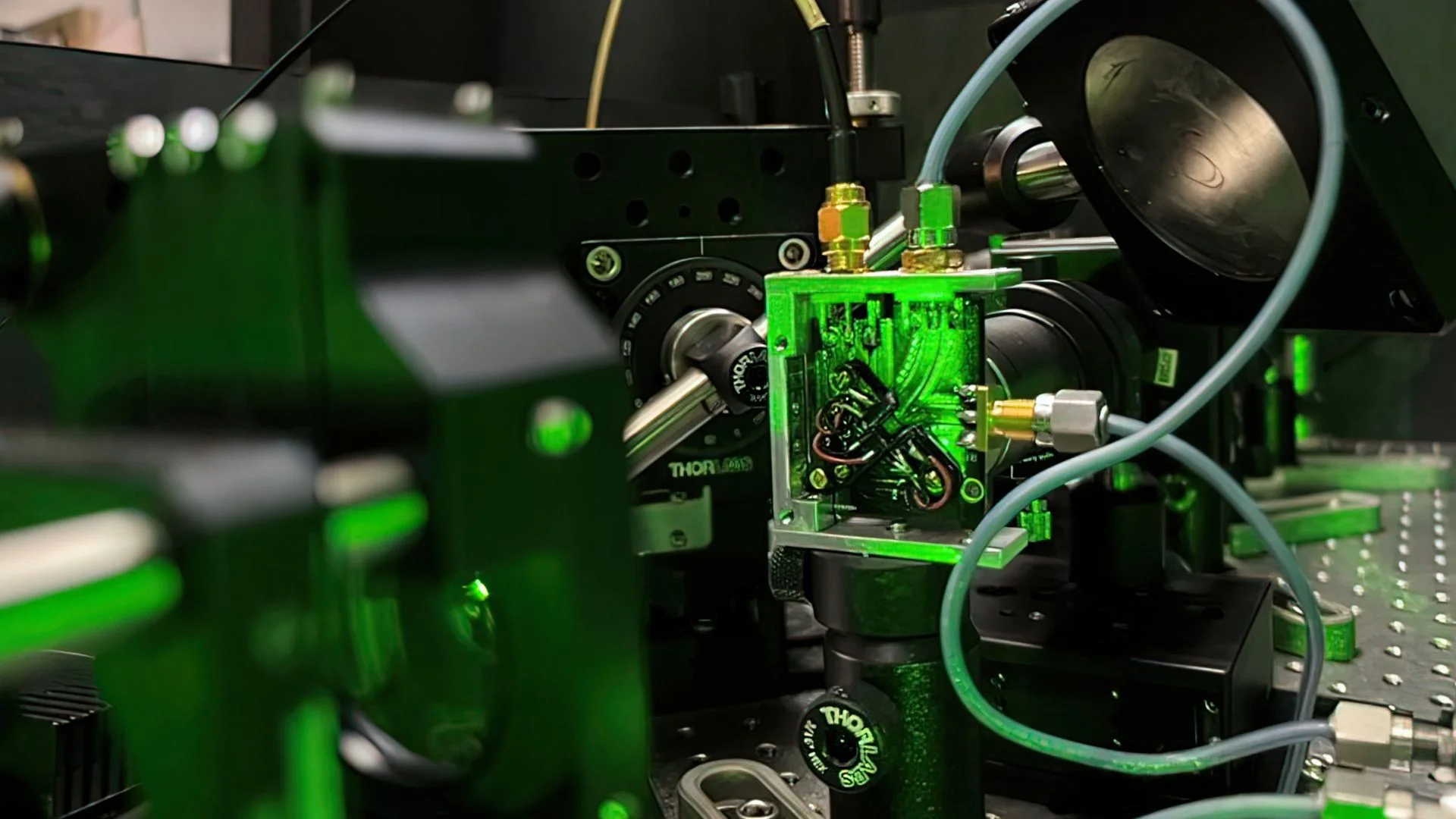
A quantum sensor uses tiny quantum systems as measuring tools. These systems include atoms, electron spins, and superconducting electrical circuits. Unlike ordinary sensors, quantum systems respond to physical changes with exceptional precision.
Traditional sensors rely on mechanical or electronic components that can wear down over time. Heat, vibration, and aging often reduce their accuracy. Quantum sensors avoid many of these problems because atoms of the same type naturally behave identically.
Scientists compare atomic energy levels to steps on a ladder. Light or microwave signals move atoms between these levels only at exact frequencies. When gravity, motion, or magnetic fields disturb the atoms, the changes can be measured with very high accuracy.
READ ALSO: Elbit’s SkyStriker Loitering Munition Combines Stealth Propulsion With Precision Strike
Another important quantum property is known as spin. Electron spins behave somewhat like tiny magnets or spinning tops. External magnetic fields make these spins wobble, and sensors can measure that motion to determine the strength of the surrounding field.
Some systems also use superconducting circuits cooled to extremely low temperatures. One of the best-known examples is the superconducting quantum interference device(SQUID). These loops can detect tiny magnetic changes that normal electronics cannot observe.
Most quantum sensors follow a similar operational process. First, the device prepares a stable quantum state. Then the surrounding environment slightly changes that state, and the sensor measures the difference.
Many systems rely on interference patterns, which are similar to ripples overlapping on water. Tiny environmental changes shift these patterns in measurable ways. This allows researchers to detect motion, magnetic fields, or gravity with extreme sensitivity.
One major area where quantum sensors are already useful is medical imaging. Human brain activity produces magnetic signals that are incredibly weak. These signals are much smaller than the magnetic noise found in an ordinary room.
Doctors use a technique called magnetoencephalography(MEG) to measure these signals. MEG systems help map brain activity before epilepsy surgery and support neurological research. Many current systems use SQUID-based sensors housed in shielded rooms to block external interference.
READ ALSO: No Isolation’s AV1 Robot Aims to Combat Loneliness for Chronically Ill Kids
Quantum Sensors Advance
Researchers are now developing smaller and more flexible alternatives. The US National Institute of Standards and Technology (NIST) has created chip-scale atomic magnetometers that operate at room temperature. These devices avoid the bulky cooling systems required by SQUID sensors.
Scientists believe room-temperature systems could make medical scanning more accessible. Researchers have already demonstrated fetal heart monitoring using arrays of optically pumped magnetometers. This opens the possibility of lighter, more portable medical imaging systems in the future.
Another promising technology uses defects inside diamonds called nitrogen-vacancy centers. These defects form when a nitrogen atom sits beside a missing carbon atom. The defect acts like a controllable quantum spin that reacts to magnetic fields.
Nitrogen-vacancy sensors are useful for studying tiny magnetic structures. They can measure signals at the nanometer scale, which is far smaller than the diameter of a human hair. Researchers use them to study advanced materials and inspect electronic circuits.
Quantum sensing is also attracting attention in navigation technology. Modern navigation systems depend heavily on GPS signals from satellites. However, these signals can be blocked, jammed, or spoofed during conflicts or technical failures.
WATCH ALSO: SpaceX rocket sends 11,000 pounds of scientific investigations, cargo to space station
Conventional backup systems use accelerometers and gyroscopes, like those in smartphones. These systems slowly accumulate errors over time. Even small mistakes can eventually lead to significant navigation inaccuracies.
Quantum navigation systems use clouds of laser-cooled atoms instead of moving mechanical parts. The atoms behave like waves, and their interference patterns change during acceleration or rotation. By studying these changes, the system calculates movement with much greater stability.
Governments and aerospace agencies are actively testing these systems. The European Space Agency has described quantum navigation as an important backup when satellite signals become unreliable. British researchers have also completed public flight trials using quantum navigation technologies.
Defense and aviation sectors see strong value in this technology. Military aircraft, submarines, and ships often operate in environments where satellite signals are disrupted. Quantum navigation systems could provide more resilient positioning during those situations.
Gravity sensing is another fast-growing field for quantum technology. Tiny differences in gravity reveal hidden structures beneath Earth’s surface. Scientists use this information to locate underground water, mineral deposits, and geological formations.
NASA’s Jet Propulsion Laboratory is currently developing the Quantum Gravity Gradiometer Pathfinder. This project aims to measure subtle variations in gravity from space. The technology could improve resource exploration and environmental monitoring worldwide.
The planned system uses two clouds of ultra-cold rubidium atoms as test masses. Scientists cool atoms to within a few degrees of absolute zero, where they behave like waves. Comparing the motion of these atomic waves reveals small differences in gravity caused by underground structures.
WATCH ALSO: A robot was recently kicked and violently dragged to test its abilities
Quantum sensors are also helping astronomers study the universe. Gravitational-wave observatories such as LIGO detect tiny distortions in space caused by massive cosmic events. These events include black hole mergers and neutron star collisions.
LIGO uses long laser beams traveling through two giant tunnels, placed at right angles to each other. A passing gravitational wave changes the beam travel times by an incredibly small amount. Detecting these tiny differences requires extremely precise measurements.
Quantum physics itself creates one of the biggest limits in these observations. Random fluctuations known as quantum noise interfere with laser measurements. To overcome this issue, LIGO uses a method called squeezed light.
Squeezed light rearranges quantum uncertainty to reduce noise in the most important part of the measurement. According to researchers, this method has significantly improved detector performance. Scientists say it has increased the number of detectable cosmic mergers by around 60%.
Despite their advantages, quantum sensors still face technical challenges. Quantum states are delicate and can easily be disturbed by heat, vibration, or stray electromagnetic fields. Many systems still require vacuum chambers, shielding, and advanced laser setups.
Engineers are now focused on reducing the size and complexity of these devices. Portable systems are important for hospitals, aircraft, and industrial use. Lower costs will also help expand commercial adoption across different industries.
READ ALSO: Carnegie Mellon University Researchers Give AI and Wheels to Everyday Objects
The growing interest in quantum sensing reflects a wider shift in global technology development. Countries are investing heavily in quantum research for healthcare, defense, communications, and scientific discovery. Quantum sensing is becoming one of the first areas where this investment is producing practical tools.
Industry experts believe the next decade will bring major improvements in sensor durability and portability. Smaller devices could appear in wearable medical tools, autonomous vehicles, and advanced environmental monitoring systems. Space agencies are also expected to increase investment in quantum-based instruments.
Quantum sensors are no longer limited to experimental physics labs. They are already supporting brain imaging, navigation testing, gravity mapping, and astronomical observation. As the technology becomes smaller and more reliable, quantum sensing is set to play a larger role in science, medicine, transportation, and global security.