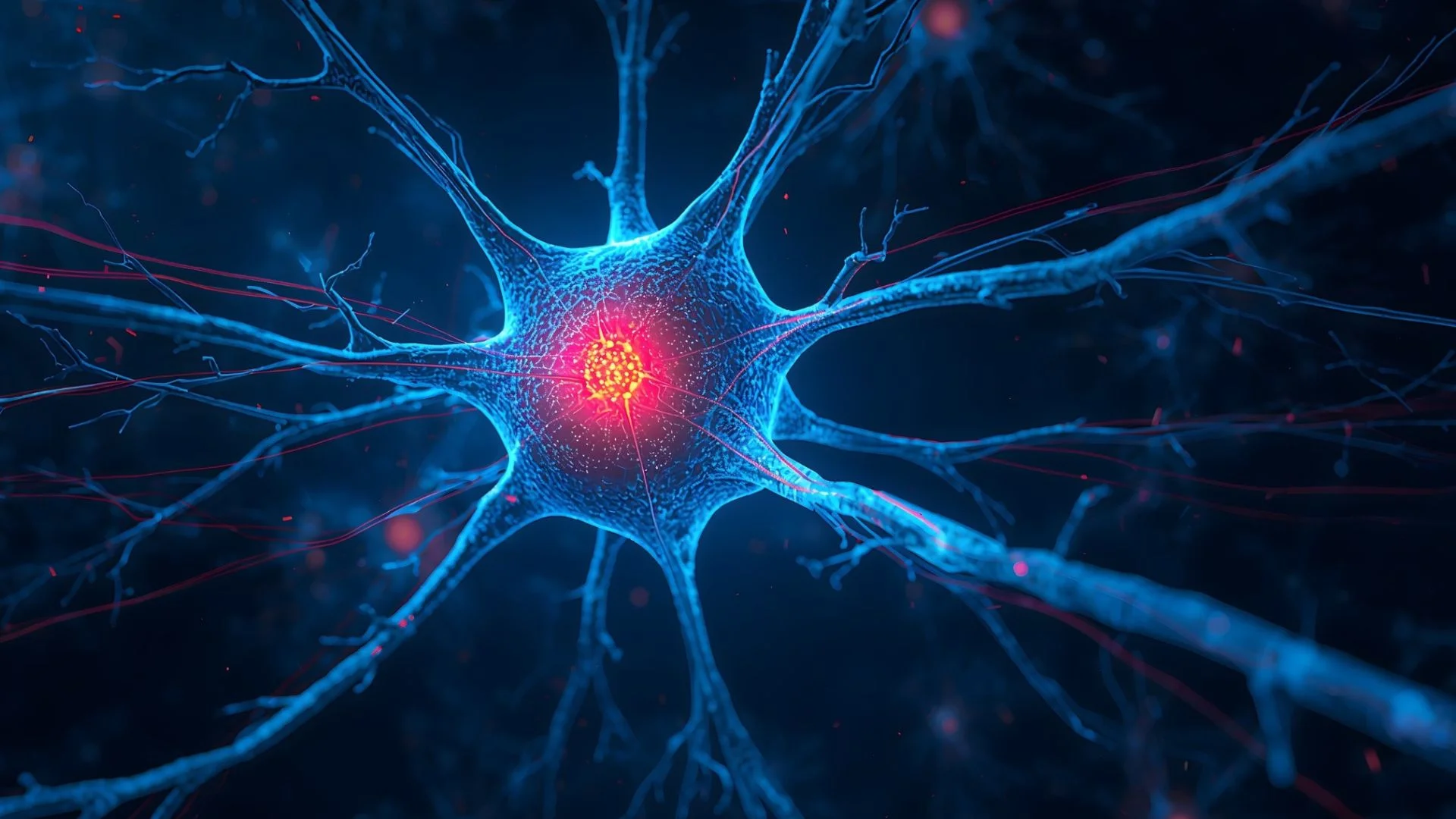
Scientists have created tiny artificial neurons that can directly communicate with real brain cells, opening new possibilities for smarter computing and advanced brain implants.
The study, published in Nature Nanotechnology on April 15, shows how these lab-made neurons can copy the behavior of natural ones. Researchers say this is an important step toward building machines that think and learn more like humans.
The team behind the work includes experts from Northwestern University. Study co-author Mark Hersam explained the goal clearly.
He said, “We are trying to mimic the brain as faithfully as possible.” He added that the team wants to build a new kind of computing system that can handle large amounts of data while using far less energy.
READ ALSO: BAE Systems Secures $146M Deal to Launch M776 Cannon Production for U.S. Army
Mimicking Brain, Not Chip
Traditional computers rely on rigid silicon chips. These chips are flat and built with fixed connections. They process information in a structured and predictable way.
Brain cells are soft and flexible. They form complex connections in three dimensions. These connections can change over time. They grow stronger with use and weaken when ignored. This ability helps the brain learn and adapt constantly.
Because of these differences, most current brain-computer interfaces struggle. They often send simple electrical signals that do not match how real neurons behave. This limits how well machines can interact with the brain.
A New Kind of Artificial Neuron
To solve this problem, the researchers developed a new material system. They used printable inks mixed with tiny flakes of molybdenum disulfide, a semiconductor, and graphene, a strong electrical conductor. These inks were printed onto a flexible plastic-like surface.
In the past, such materials were seen as a problem because they interfered with electrical signals. But the team turned this weakness into an advantage.
WATCH ALSO: World’s first motorbike backflip between two moving trucks successfully completed
By carefully heating and adjusting the material, they controlled how electricity moved through it. This allowed the artificial neurons to behave more like real ones.
Instead of sending a steady signal, the artificial neurons produced sharp bursts of activity. This pattern closely matches how biological neurons fire.
Hersam described this process as a key innovation. He said the controlled breakdown of the material helps create energy spikes similar to real brain signals.
Matching Rhythm of Life
The team did not stop at basic signals. They fine-tuned the system to create different patterns of activity. The artificial neurons could produce steady spikes, slow rhythms, or sudden bursts. These patterns are all found in real brain activity.
Hersam said, “We can achieve all different types of spiking responses that mimic biology.”
To test their design, the scientists placed the artificial neurons next to slices of mouse brain tissue in a lab dish.
The real neurons responded to the artificial ones. They fired at the same pace, as if they were communicating with natural brain cells. This suggests the artificial signals were realistic enough for the brain to understand.
This development could shape two major fields: computing and medicine. In computing, it supports the rise of neuromorphic systems. These are machines designed to work like the brain. They promise faster processing with much lower energy use, especially for artificial intelligence. In medicine, the impact could be even more personal.
READ ALSO: This Raytheon Camera Sees Heat Changes First, Targets Can’t Stay Hidden
Better artificial neurons may improve brain-computer interfaces. These systems already help control prosthetic limbs and assist communication devices. More natural signals could make them smoother and more effective.
Some scientists even believe artificial neurons could one day replace damaged brain cells. This could help treat diseases like Alzheimer’s disease or restore lost brain functions.
Timothée Levi from the University of Bordeaux praised the work. He noted that the artificial neurons match the natural firing frequency of real ones. However, he also pointed out a key limitation.
Right now, scientists can control these systems only for short periods. Long-term stability remains a challenge. This means the technology is not yet ready for permanent use inside the human brain.
A single artificial neuron is not enough. The brain works through vast networks of neurons connected by synapses. To truly replicate brain function, scientists must build complete systems where these elements work together.
Hersam highlighted this challenge. He said the next step is to integrate different components into full circuits that can match the brain’s complexity.
WATCH ALSO: American company’s next-generation ejection seat offers a 92% survivability rate
This research marks an important move toward machines that do not just compute, but behave like living systems. Artificial neurons that can talk to real ones bring science closer to merging biology and technology. While many hurdles remain, the direction is clear.
The future of computing and possibly medicine may not be built on silicon alone, but on systems that think, adapt, and communicate like the human brain.