The US Navy has taken a quiet step toward future naval warfare by testing a drone-killing laser from an aircraft carrier deck.
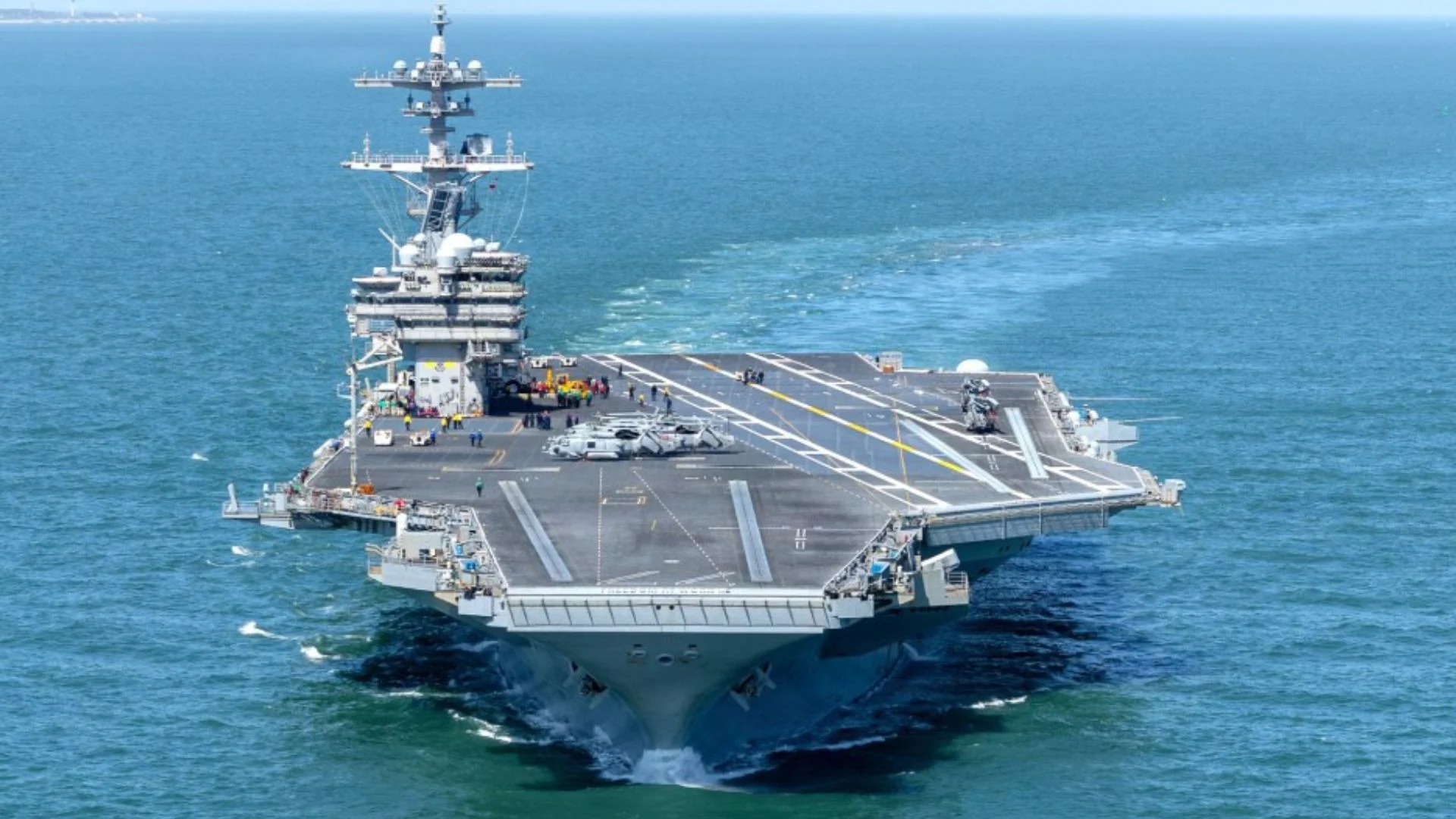
The system, known as LOCUST, was installed aboard the USS George H.W. Bush, marking a rare and significant milestone for directed energy weapons at sea.
This test is believed to be the first time a laser weapon has been deployed on a US aircraft carrier. While the Navy has experimented with lasers before, placing one on a massive, moving warship like a carrier presents a new level of complexity.
The system, developed by AeroVironment, is called the LOCUST Laser Weapon System (LWS). It is designed to counter drones, which are becoming one of the most common threats in modern warfare. The Navy released images from the test, which took place on October 5, 2025, though they were only made public recently during the Navy League’s Sea-Air-Space exposition.
READ ALSO: Binder Fuses Materials Mid-Print for Seamless 3D Parts in Industrial Use
During the test, the laser system successfully detected, tracked, and destroyed multiple unmanned aerial vehicles. Officials described the event as a major step toward making directed energy weapons operational across different platforms.
AeroVironment confirmed the results in a statement. The company said the system tracked, engaged, and neutralized multiple target drones, proving that the technology works even in the demanding conditions of a moving aircraft carrier.
At the heart of LOCUST is a high-energy laser mounted in a turret. The system includes electro-optical and infrared cameras, which help it find and track targets. It can also work with additional sensors, such as small radars and radio frequency detectors, to improve accuracy and response time.
WATCH ALSO: Skid AI to boost development of its robotic intelligence platform, raises USD 1.4 billion
Right now, the system operates at about 20 kilowatts. This puts it on the lower end of military laser systems, but it is enough to destroy small drones. Some versions have reached about 26 kilowatts, though it is still unclear how much more power can be added without changing the design.
One of LOCUST’s key strengths is its flexibility. The system is palletized, meaning it can be placed on different platforms without major modifications. It has already been mounted on vehicles like the Joint Light Tactical Vehicle and the Infantry Squad Vehicle.
The Navy test showed that it can also work on large ships with minimal setup. In this case, the system was simply secured to the carrier’s flight deck.
This flexibility is important. It means the same system can be used on land, at sea, or even moved between locations depending on mission needs. The US Army has already received several versions of LOCUST and has deployed some of them overseas. The system has also been used domestically, including in operations involving US border security.
READ ALSO: US Navy’s Long-Stalled 6th-Gen F/A-XX Stealth Fighter Heads Toward August Call
Despite the test’s success, laser weapons still face serious limitations. One major issue is range. As the laser beam travels through the air, it loses power. Weather conditions such as fog, dust, and smoke can further weaken it. This makes lasers most effective at short distances.
Another challenge is that a laser can only hit one target at a time. In situations where multiple drones attack at once, this can be a serious drawback. Traditional weapons, like missiles or guns, can sometimes handle multiple threats more quickly.
There are also technical challenges. Laser systems rely on sensitive optics that must remain stable and clean. On a ship, this is not easy. Saltwater, rough seas, and constant movement can affect performance. Cooling the system is another issue, as lasers generate significant heat and require steady power.
Even with these challenges, the Navy continues to push forward. Military leaders believe lasers will play a key role in future defense systems. Chief of Naval Operations Adm. Daryl Caudle has been clear about his vision. He said he wants directed energy weapons to become the first option for ships facing close-range threats.
He explained that lasers offer a major advantage: they do not run out of ammunition in the traditional sense. As long as the ship has power, the weapon can keep firing. This infinite magazine concept could change how warships are designed and operated.
WATCH ALSO: Drum-shaped antenna reflector on NASA-ISRO NISAR satellite deployed
Caudle also noted that using lasers for defense enables ships to save their missiles for offensive operations. This could improve overall efficiency and make naval forces more flexible in combat.
As laser technology improves, higher-powered systems may be able to take on more serious threats, including incoming missiles. For now, however, their main role is expected to remain focused on countering drones and other small targets.
The Navy has faced delays and setbacks in developing these systems over the years. Progress has been slower than expected, and officials have often expressed frustration. Still, tests like the one aboard the USS George H.W. Bush show that steady progress is being made.
Looking ahead, lasers are expected to be a key part of future naval fleets. They may even play a central role in next-generation warships, including concepts like heavily armed battleship-style vessels designed for modern combat.
For now, the LOCUST test represents a clear signal. The Navy is not just experimenting with laser weapons anymore; it is actively working to bring them into real-world operations. And while the technology is not perfect, its potential is too important to ignore.
As drone threats continue to grow, systems like LOCUST may soon become a common sight on warships, quietly defending them with beams of light instead of traditional firepower.