Scientists are exploring a new class of materials that defy traditional physics. These materials generate their own energy, allowing them to move, react, and adapt without external force. Known as active matter, they can behave in ways that appear almost alive.
Inspired by nature, like flocks of birds moving in perfect coordination, researchers from the University of Amsterdam, the University of Cambridge, and the University of New South Wales are now recreating such systems in the lab using simple components like rods, rubber bands, and tiny motors.
Their findings were recently published in two major journals: Proceedings of the National Academy of Sciences and Physical Review X.
One of their most striking discoveries involves how these materials bend and snap.
READ ALSO: Sikorsky Lands $65M US Army Deal for UH-60M Black Hawk to Sustain Airlift
To understand this, imagine holding a paper ticket between your fingers and pressing it inward. At first, it resists. Then suddenly, it bends to one side. If you push further, it snaps to the other side. This is a one-time response. The paper does not keep moving unless you keep applying force.
That is how inactive materials behave. But when the researchers built an active version of this system, everything changed.
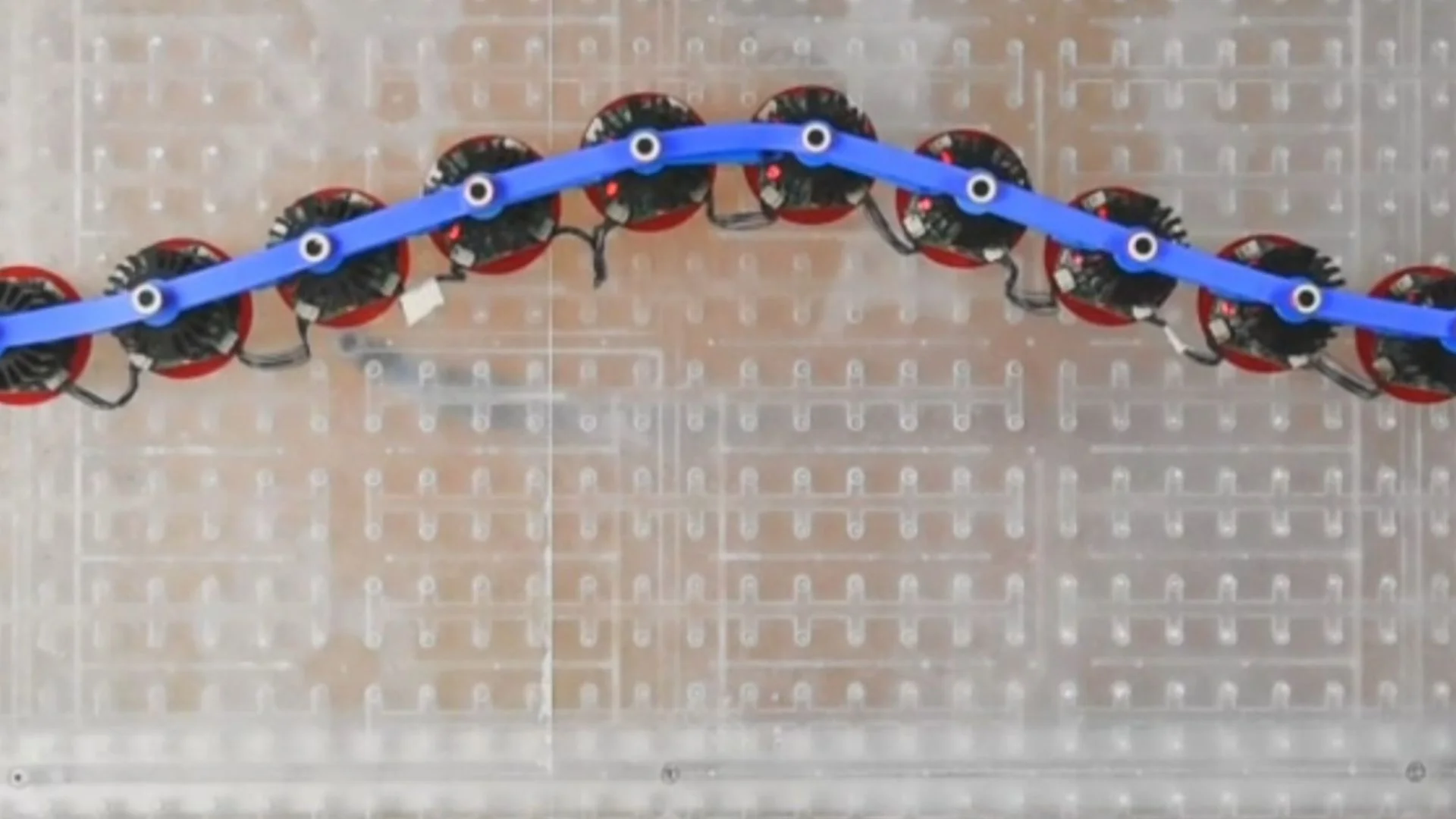
They created a chain of connected rods. At each joint, they attached tiny motors. These motors caused uneven interactions between the rods. In simple terms, when one rod moved, the other did not respond in the same way.
WATCH ALSO: Rolls-Royce tests world’s first high-speed marine engine powered by methanol
This imbalance is called non-reciprocal interaction. Because of this, the chain did not just bend and snap once. It kept repeating the motion. It could buckle, snap back, and continue this cycle on its own.
In some cases, the chain even started to move. It crawled. It walked. It dug into surfaces.
The scientists explain that this happens because the system reaches what they call a critical exceptional point. In simple terms, this is a state where the material does not change shape just once; it keeps evolving dynamically.
Sami Al-Izzi from the University of New South Wales and Yao Du from the University of Amsterdam led this part of the research. Their work was featured on the cover of Proceedings of the National Academy of Sciences.
“This shows a new way to build materials that can act on their own,” the researchers explain. “These systems can perform multiple functions without needing central control.”
This idea has strong potential in soft robotics. Instead of relying on complex programming and control systems, future robots could use such materials as their bodies. The material itself would handle movement and response.
The team also explored another surprising aspect of active matter. In traditional engineering, there is a well-known principle known as Le Châtelier’s Principle. It suggests that changes at a small level reflect at a larger level.
READ ALSO: AMTI Race Begins: US Air Force Secret Satellite Hunt for Aircraft from Space
For example, if you make individual parts of a structure stiffer, the entire structure becomes stiffer. But active materials do not always follow this rule.
In a second study, the researchers built a two-dimensional lattice of rods and motors. They then tested how the material behaved when they increased the activity of its building blocks.
In some cases, making individual components more active made the entire structure less active. This seems counterintuitive. But the explanation lies in something called percolation.
Percolation describes how something spreads through a system. A simple example is water passing through coffee powder. If the powder is too dense, water cannot flow properly.
Similarly, in active materials, if less active components are packed too closely together, they can block the overall response. Even if other parts are highly active, the system as a whole may not show strong movement or elasticity.
WATCH ALSO: United Launch Alliance’s Atlas V rocket delivers success for Amazon Leo
Jack Binysh, the lead author of this study from the University of Amsterdam, explains that this finding challenges existing assumptions. The researchers believe this discovery will be important for several fields. These include soft matter physics, mechanical engineering, life sciences, and robotics.
It could also impact the design of biophysical gels, epithelial cell layers, and neuromorphic networks, systems that mimic the human brain.
What makes this research exciting is its simplicity. The materials are built from basic components. Yet they exhibit complex, lifelike behavior.
They blur the line between materials and machines, not just responding but adapting and sometimes moving autonomously. As research advances, materials will not just be strong or flexible; they will act on their own.