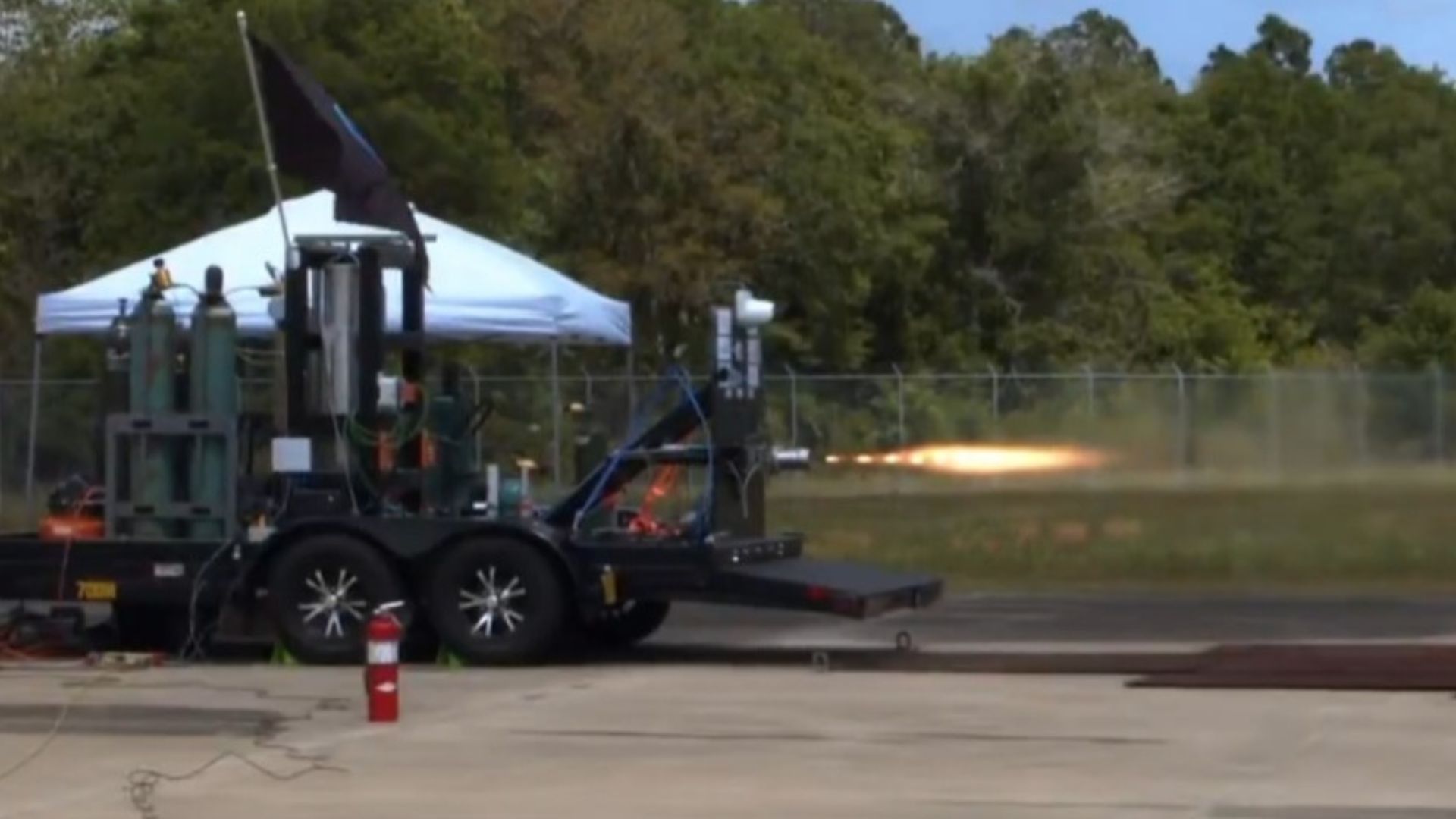
A team of undergraduate students at the University of Florida (UF) has successfully designed, built, and tested the first liquid rocket engine in the university’s history.
The project marks a significant step in student-led aerospace innovation.
The journey began 2.5 years ago at Turlington Plaza. At that time, the idea of building a rocket engine existed only on paper. There were sketches, CAD models, and spreadsheets, but no physical system.
“Do you want to build a rocket engine?” was the question that started it all.
The students joined Florida Rocket Lab (FRL) with limited experience. Like many, they believed rocket science was only for elite experts.
READ ALSO: Battlefield AI: Startups Compete to Shape Future of Military Technology
However, exposure to other university programs changed their thinking. They realized that with effort and teamwork, even complex systems could be built from scratch.
The team took complete ownership of the project. Each group focused on different systems. Some worked on guidance, navigation, and control software. Others handled fluid systems, ignition, and testing.
The project demanded long hours. What started as a part-time commitment soon became a full-time effort. Students balanced academics with intense engineering work. Many gave up hobbies and free time.
But the payoff was worth it. The result was Sparrow, a fully functional liquid rocket engine.
Liquid Rocket Engine Features
The Sparrow engine delivers a thrust of 550 pound-force and operates as a bipropellant liquid rocket engine, using carefully controlled flows of fuel and oxidizer. Its ignition system was rigorously tested through multiple igniter trials before full operation.
READ ALSO: China’s Industrial Robot Surge Hits 31%: What’s Driving This Sudden Factory Shift?
The engine demonstrated strong test capability by successfully completing seven full-duration hot fires. During these tests, it achieved its exact design thrust, highlighting its precise performance.
It also demonstrated high reliability, with no failures across all runs. Supporting the engine are custom-built fluid trailers and advanced electronic systems, while all operations were conducted under strict industry-grade safety standards to ensure safe, consistent performance.
The engine was designed to handle extreme heat and pressure. Every component was built to ensure durability and safety.
Testing at Cecil Spaceport
After two years of development, the team moved to testing. The engine was hot-fired at Cecil Spaceport in Jacksonville.
WATCH ALSO: Humanoid robot folds towel autonomously after observing human
The process included several wet dress rehearsals. These tests ensured that all systems worked correctly before ignition. Once ready, the team conducted 7 full-duration hot fires. Each test was successful.
The engine performed exactly as planned. It reached its designed thrust without any failure.
The students emphasized that the project was about learning by doing. Many started with little technical knowledge.
“Nothing is magic. Nothing is too complicated if you keep showing up and refuse to quit,” the team said.
They learned coding, system design, and testing from scratch. Over time, they developed advanced engineering skills. The project also helped them build leadership abilities. They managed teams, coordinated tasks, and maintained project timelines.
WATCH ALSO: China’s new massive battle tank takes part in live-fire test
The project was carried out under the guidance of Youngsup Song, Ph.D., assistant professor in the Department of Mechanical and Aerospace Engineering.
Multiple sub-teams contributed to the engine. These included combustion, fluids, avionics, testing, and vehicle engineering groups. Their combined effort made the project successful.
The achievement goes beyond building a rocket engine. It has also transformed the student community.
FRL has seen rapid growth. Membership increased by over 150 percent after the success. The team also introduced a structured program for new members. This helps students develop an engineering mindset early.
The goal is not just to build rockets. It is to prepare students for real-world challenges in the aerospace industry.
The team is now preparing for its next mission. They plan to launch a rocket named “Mirage” at the FAR-OUT rocketry competition in May 2026.
READ ALSO: Artemis II Nears Launch, But Its Story Began 100 Years Ago with Goddard’s Rocket
This upcoming project will build on the success of Sparrow. It will involve more advanced systems and greater challenges.
A Milestone for UF
The successful hotfire of Sparrow marks a historic moment for UF. It shows what undergraduate students can achieve with dedication and teamwork.
The team believes their journey proves one simple idea:
“No matter how difficult something seems, it becomes easier with time and effort.”
Their work has set a strong foundation for future aerospace projects at the university. More importantly, it has inspired a new generation of engineers to aim higher.