A century ago, a small rocket rose just 40 feet above a quiet field in Massachusetts. It may have seemed like a modest experiment at the time. But that brief flight changed the future of space exploration forever.
A Century-Old Rocket to Artemis II
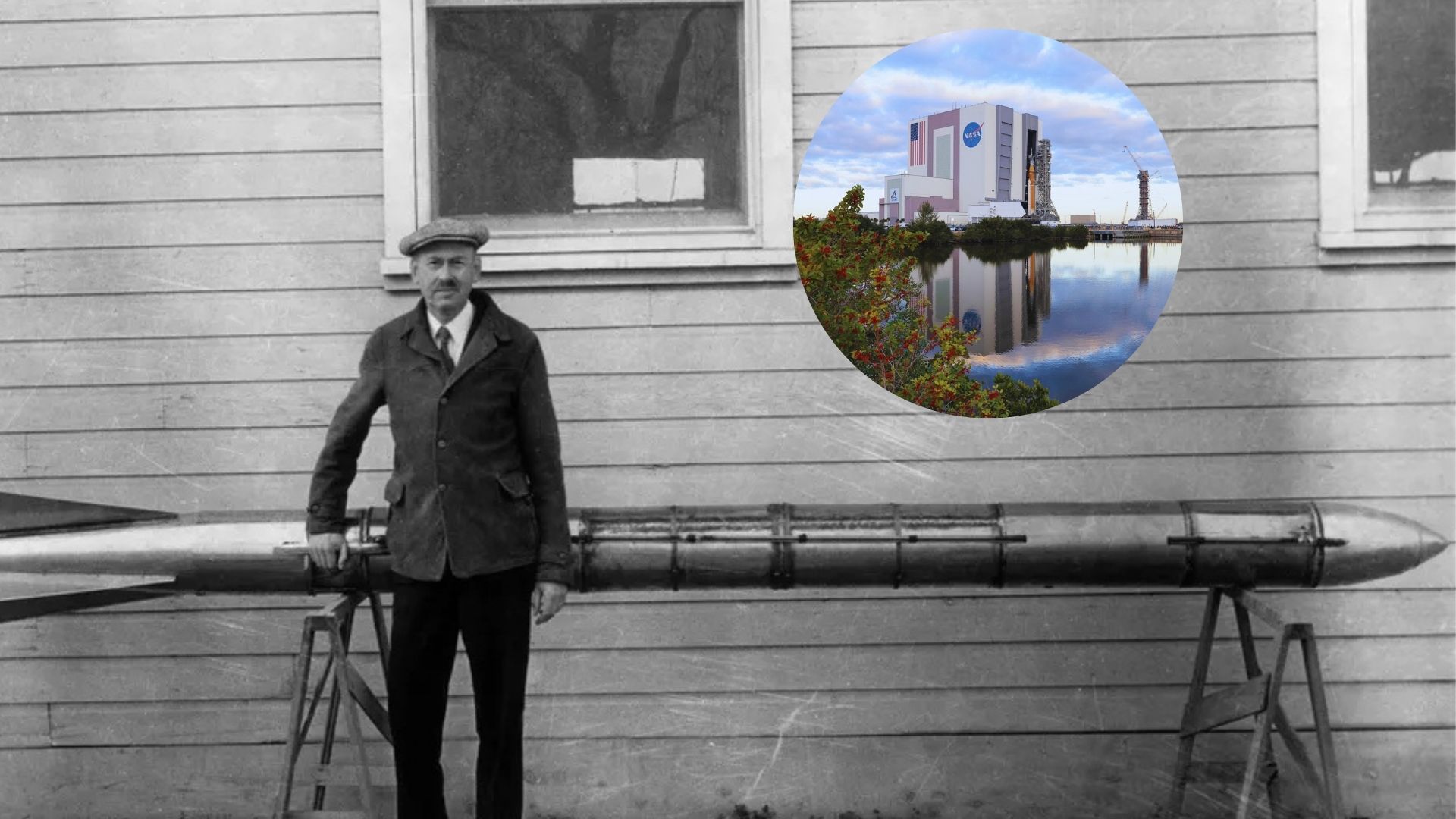
On March 16, 1926, physicist Robert H. Goddard launched the world’s first liquid-fueled rocket. The test took place in Auburn, Massachusetts.
The rocket was simple, standing only about 10 feet tall. It used liquid oxygen and gasoline as fuel. This was a bold idea in an era when solid fuels dominated rocket design.
That short flight marked the beginning of modern rocketry.
Today, 100 years later, the same basic idea is powering missions to return humans to the Moon.
Goddard’s early work laid the foundation for almost every rocket system used today. His designs introduced key technologies.
READ ALSO: China’s New AI Radar Can Spot Real Drone Threats While Ignoring Decoys
These included turbopumps, which efficiently move fuel, and gimbaled engines, which help steer rockets. He also worked on gyroscopic guidance systems that keep rockets on course.
These innovations became essential during the 20th-century space race. They powered missions that sent satellites into orbit and astronauts into space. Programs like Mercury, Gemini, and Apollo were all built on principles that Goddard helped develop.
Now, those same fundamentals are being used again in NASA’s Artemis program.
The Artemis program aims to return humans to the Moon. It also plans to establish a long-term human presence there. This effort marks a new chapter in space exploration.
At the center of this mission is the Space Launch System (SLS). It is a massive rocket, about 322 feet tall. That makes it nearly 30 times larger than Goddard’s original rocket. Despite the size difference, the core idea remains the same.
READ ALSO: U.S. Startup Starcloud Plans 88,000 Satellites for AI Data Centers
Like Goddard’s design, SLS uses liquid fuel and liquid oxygen. These are pumped into a combustion chamber. There, they ignite and produce hot gases. These gases are expelled at high speed, pushing the rocket upward.
Liquid fuel offers important advantages. Engineers can control the thrust. They can increase or decrease power as needed. This makes the rocket more flexible and efficient.
Solid rocket boosters are also used in modern launches. These boosters provide extra thrust during liftoff. However, they cannot be turned off once ignited. They burn until all fuel is used. In contrast, liquid systems allow better control during flight.
The Artemis II mission will be the first crewed flight of this new program. It will carry four astronauts on a journey around the Moon. The crew includes Reid Wiseman, Victor Glover, Christina Koch, and Canadian astronaut Jeremy Hansen.
Their spacecraft, Orion, will sit atop the SLS rocket. The mission is expected to last about 10 days. It will orbit the Moon and then return to Earth.
WATCH ALSO: China commissions world’s largest open-sea offshore solar photovoltaic project
NASA officials say the mission is a key step forward. “This flight will test our systems with humans on board,” they explain. “It will help us prepare for future lunar landings.”
The Artemis program follows a step-by-step approach. Each mission builds on the previous one. Artemis II will test life support and navigation systems.
The next mission, Artemis III, is planned for later this decade. It will focus on docking and landing operations. Eventually, astronauts will return to the lunar surface.
NASA aims to achieve a crewed Moon landing by 2028 under the Artemis IV program. This would mark the first human return to the Moon since 1972.
Preparations for Artemis II are already underway. The SLS rocket is set to roll out to the launch pad at Kennedy Space Center in Florida. This rollout is scheduled for March 19.
The launch window is expected to open between April 1 and April 6. If successful, it will mark a major milestone in human spaceflight.
READ ALSO: Trump Pushes Japan to Send Warships to Hormuz, Leaving Takaichi in Tight Spot
The journey from Goddard’s small rocket to today’s advanced systems shows how far technology has come. Yet, the core principles remain the same.
What began as a simple experiment in a cabbage field has grown into a global effort to explore space. Rockets have evolved from basic machines into powerful tools. They now carry humans, satellites, and scientific instruments across the solar system.
This progress highlights the importance of early innovation. Goddard’s work proved that liquid-fueled rockets were possible. His vision continues to shape modern space missions.
As humanity prepares to return to the Moon, the legacy of that first launch remains strong. It serves as a reminder that even small steps can lead to giant leaps.
A hundred years later, the dream of space exploration is still rising, powered by the same idea that once lifted a small rocket into the sky.