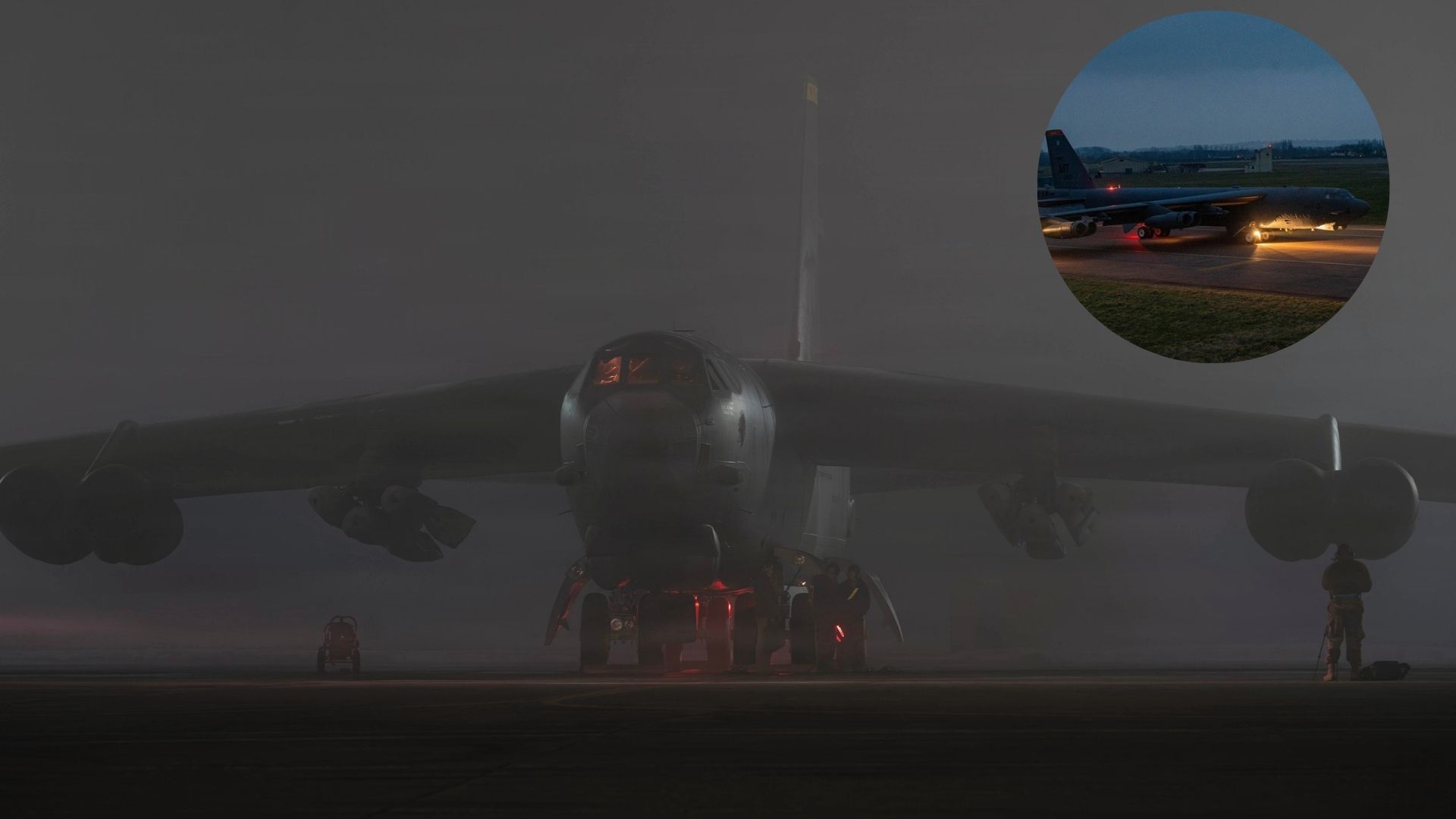
The US has deployed B-52 Stratofortress strategic bombers armed with AGM-158 JASSM cruise missiles during the opening phase of Operation Epic Fury, targeting Iranian missile infrastructure.
According to footage released by US Central Command (CENTCOM), multiple B-52 aircraft took off carrying the long-range missiles. The bombers launched the weapons from outside Iranian airspace, allowing them to strike targets while avoiding direct exposure to Iranian air defenses.
Military officials said the attacks focused on ballistic missile facilities and command centers used to coordinate Iran’s missile operations.
The B-52: A Long-Range Strategic Strike Platform
The B-52H Stratofortress remains one of the most powerful long-range bombers in the US Air Force. Despite first entering service decades ago, continuous upgrades allow it to carry modern precision weapons.
The aircraft has a wingspan of 56.4 meters and a maximum takeoff weight of about 220 tons. It is powered by eight Pratt & Whitney TF33 turbofan engines, giving it enough thrust to fly long distances while carrying heavy weapons loads.
The bomber can reach speeds close to Mach 0.86 and operate at altitudes above 15,000 meters.
Its design allows it to carry weapons both inside an internal bomb bay and on external wing pylons. In total, the aircraft can carry around 31,500 kilograms of weapons.
READ ALSO: https://modernmechanics24.com/post/scientist-device-earthquake-damage/
With an unrefueled range of more than 7,000 kilometers, the aircraft can strike targets across continents when supported by aerial refueling.
Advanced Sensors and Mission Systems
Modern B-52 aircraft use upgraded electronics and targeting systems.
The bomber is equipped with the AN/APQ-166 radar, which supports navigation and precision targeting during long-range missions. Digital mission systems also allow the aircraft to integrate modern guided weapons.
These upgrades enable the bomber to operate as a stand-off missile platform, launching weapons from safe distances.
JASSM: The Missile Designed for Defended Targets
The AGM-158 Joint Air-to-Surface Standoff Missile (JASSM) is designed to strike heavily protected targets such as bunkers, radar installations, and command centers.
WATCH ALSO: https://modernmechanics24.com/post/ula-orbits-amazon-kuiper-third-satellite-batch/
Developed by Lockheed Martin, the missile combines stealth design with precision guidance.
The standard AGM-158A version has a range of about 370 kilometers. The newer JASSM-ER variant can travel roughly 925 kilometers.
Each missile weighs about 1,020 kilograms and carries a 450-kilogram penetrating warhead capable of destroying hardened structures.
The missile is powered by a Williams International turbofan engine, allowing it to fly at subsonic speed along a low-altitude path.
How the Missile Finds Its Target
JASSM uses a combination of inertial navigation and GPS guidance during most of its flight.
In the final stage, an imaging infrared seeker identifies the target and guides the missile to impact.
READ ALSO: https://modernmechanics24.com/post/tesla-model-3-cybertruck-car-hack-risk/
Its design reduces radar visibility and allows it to fly close to the ground. This makes detection and interception more difficult for air defense systems.
Why Standoff Strikes Matter
Launching missiles from outside enemy airspace is a key advantage of the B-52 and JASSM combination.
Iran operates S-300 air defense systems along with domestically developed radars and interceptor missiles. Flying directly into defended airspace would expose aircraft to these systems.
By firing standoff cruise missiles, bombers can strike important targets while remaining hundreds of kilometers away.
Operation Epic Fury also highlights how the US uses different bomber aircraft for different roles.
READ ALSO: https://modernmechanics24.com/post/agilitys-digit-humanoids-in-toyota/
The B-2 Spirit provides stealth for penetrating defended areas. The B-1B Lancer offers high speed and large payload capacity. Meanwhile, the B-52 Stratofortress serves as a long-range missile carrier capable of launching large numbers of precision weapons.
These aircraft allow the US military to maintain sustained pressure on targets while adapting to different combat environments.