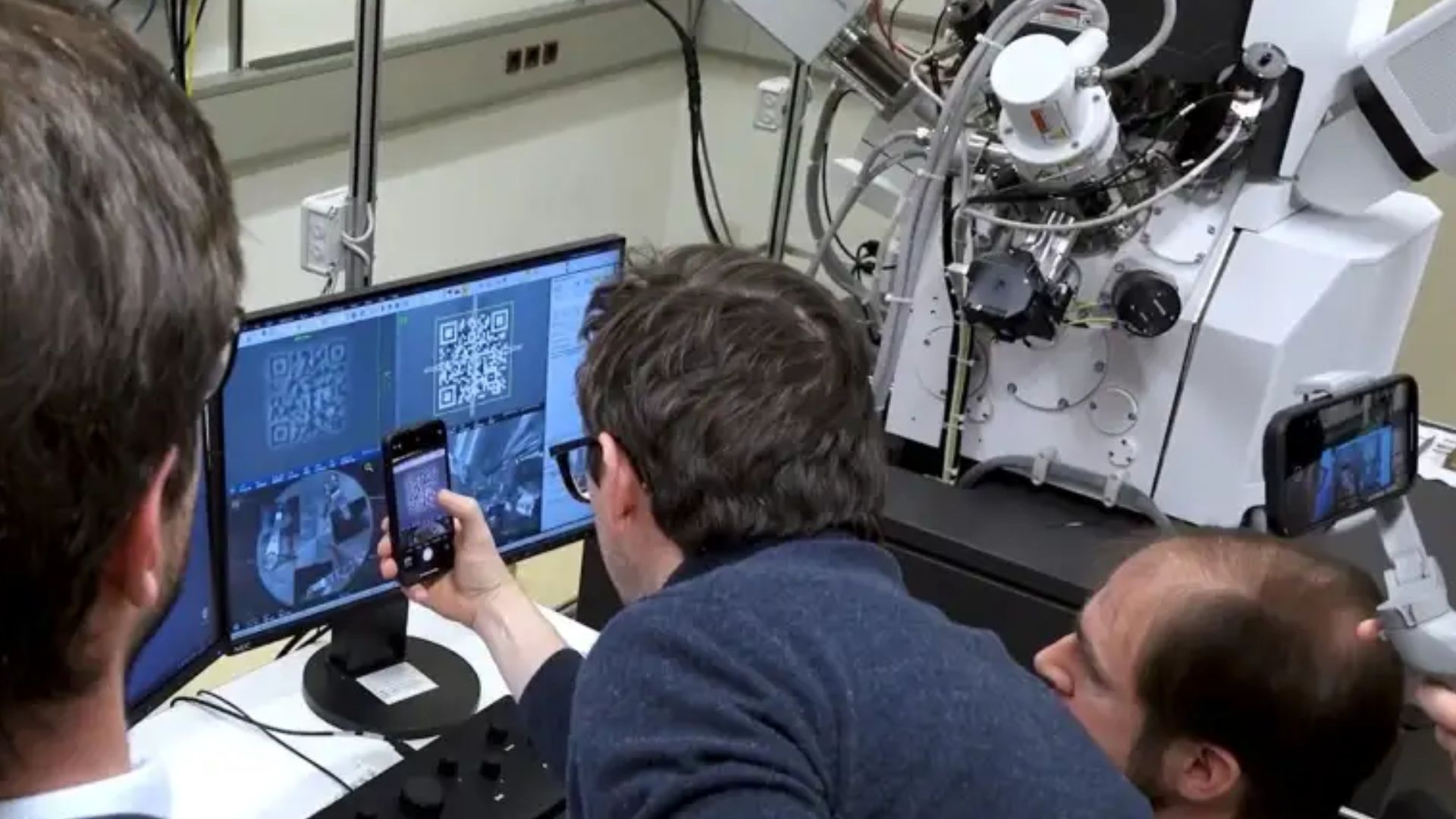
Researchers in Austria have created the world’s smallest QR code, so tiny it is invisible to the naked eye and even to standard optical microscopes.
Blurring the line between nanotechnology and digital innovation, the achievement is verified by Guinness World Records. It could redefine how humanity preserves information for centuries to come.
The microscopic code is developed by scientists at TU Wien in collaboration with data storage firm Cerabyte. It measures just 1.98 square micrometers.
To put that into perspective, it is smaller than most bacteria and can only be viewed using an electron microscope.
READ ALSO: https://modernmechanics24.com/post/china-seedance-2-0-ai-shakes-hollywood/
Despite its nearly invisible footprint, the code remains stable and readable. It’s an accomplishment that sets it apart from earlier nanoscale experiments.
“This structure is so fine that optical microscopes cannot detect it at all,” said Prof. Paul Mayrhofer from TU Wien’s Institute of Materials Science and Technology.
He emphasized that while fabricating tiny structures is no longer unusual in modern nanotechnology, ensuring long-term stability at that scale is the real challenge. “We created a tiny, stable, and repeatedly readable QR code,” he added.
Experimental atomic-scale patterns can degrade over time due to atomic diffusion. But this QR code is etched into a thin ceramic film. These films, commonly used as protective coatings for high-performance cutting tools, are engineered to endure extreme conditions.
Researchers Erwin Peck and Balint Hajas explained that durability was the key advantage. “Materials used for industrial tools must remain stable under extreme stress, and that makes them ideal for reliable data storage,” they said.
To fabricate the record-breaking code, the team employed a focused ion beam to mill the pattern into the ceramic layer. Each pixel measures just 49 nanometers. It is approximately ten times smaller than the wavelength of visible light. Because of this, the code cannot be resolved with visible light, much like Braille cannot be felt through a thick barrier. When examined under an electron microscope, the QR code can be read accurately and repeatedly.
WATCH ALSO: https://modernmechanics24.com/post/us-giant-robot-fights-wildfires/
Apart from the world record title, the innovation carries profound implications for long-term data storage. Conventional magnetic and electronic storage systems typically last only a few years before data degradation begins. They also require continuous energy input, cooling systems, and regular data migration to remain functional. On the other hand, Ceramic-based storage promises exceptional longevity without ongoing energy consumption.
Alexander Kirnbauer, involved in the project, highlighted the urgency of the issue.
“We live in the information age, yet we store our knowledge in media that are astonishingly short-lived,” he said. He pointed out that earlier civilizations carved their knowledge into stone, allowing it to survive thousands of years. “With ceramic storage media, we are pursuing a similar approach. We write information into stable, inert materials that can withstand the passage of time and remain fully accessible.”
The storage density achieved through this method is remarkable. Researchers estimate that more than 2 terabytes of data could fit on the surface area of a single A4 sheet using similar nanoscale encoding.
Modern data centers consume enormous amounts of electricity and contribute significantly to global carbon emissions. But ceramic data carriers require no energy to preserve stored information.
The Guinness World Record certification process involved independent verification by the University of Vienna, with witnesses present during both the fabrication and electron microscope readout.
The new QR code measures just 37 percent of the size of the previous record holder. It marks a significant leap forward in nanoscale engineering.
READ ALSO: https://modernmechanics24.com/post/us-navy-ai-unmanned-fleets-at-sea/
“This confirmed world record marks just the start of a very promising development,” Kirnbauer said. The team now aims to refine materials, accelerate writing speeds, and develop scalable manufacturing processes that could move ceramic data storage from laboratory experiments to industrial applications.
They are also exploring more complex data structures beyond QR codes, aiming to robustly and efficiently store larger, more intricate datasets. This approach could usher in a climate-friendly era of permanent data preservation, one where digital knowledge no longer depends on fragile, energy-hungry infrastructure.
As the world generates unprecedented volumes of data, the question is no longer just how to store it but how to preserve it for generations. With a QR code smaller than a bacterium, Austrian scientists may have just offered an answer hidden at the nanoscale.