In a striking fusion of mathematics and artificial intelligence, Chinese researchers made significant progress on the 300-year-old kissing number problem.
This problem is an enduring geometric puzzle with implications for data storage, information theory, and advanced telecommunications.
This solution came from an AI system called PackingStar, developed by teams from Peking University, Fudan University, and the Shanghai Academy of AI for Science (SAIS).
Their findings were published as a preprint on the open-access repository arXiv in November. It has drawn global attention for pushing the limits of high-dimensional geometry.
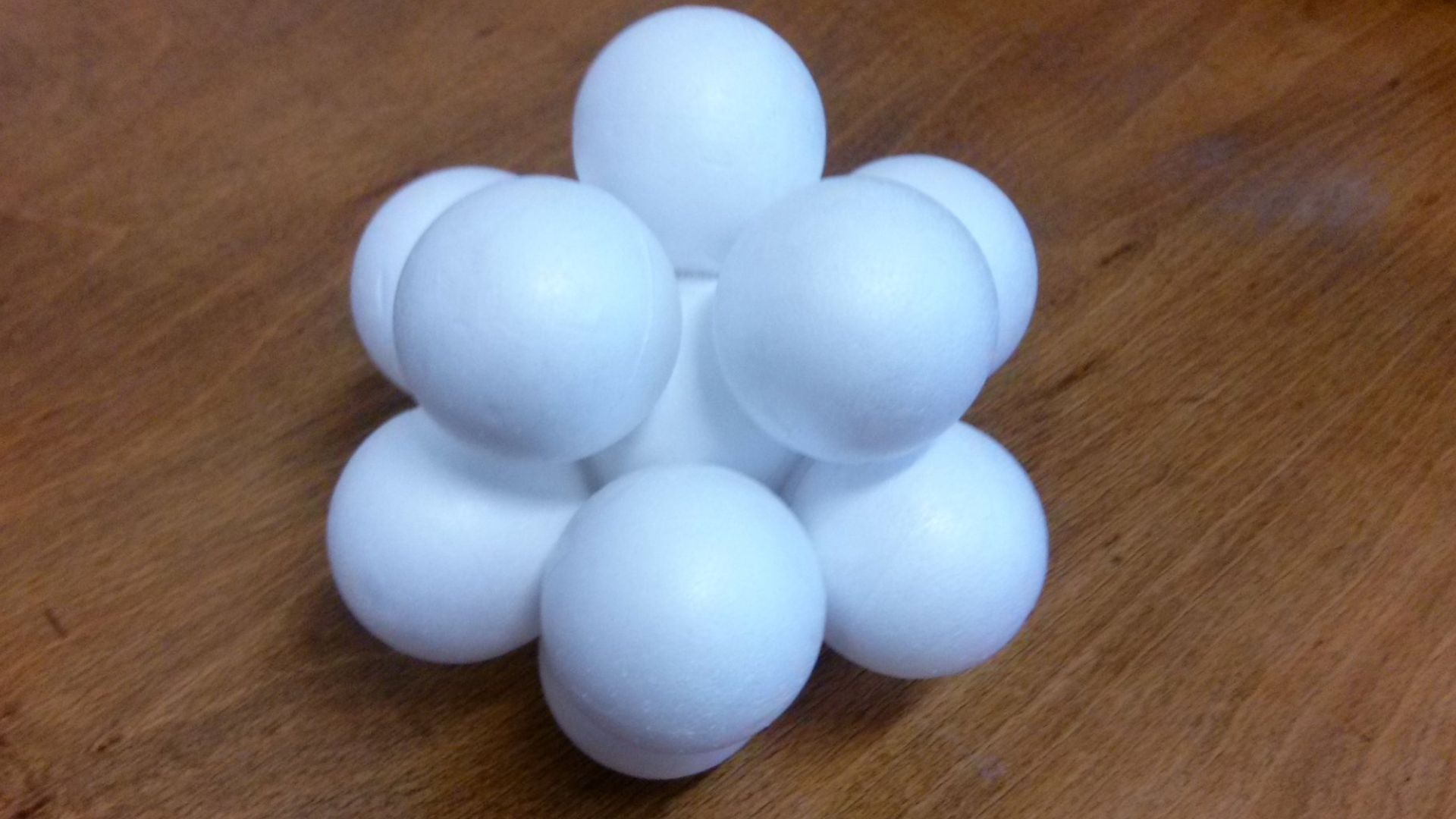
The kissing number problem dates back to a 1694 debate between English polymath Isaac Newton and Scottish mathematician David Gregory. The question is deceptively simple: how many identical spheres can simultaneously touch or kiss a central sphere of the same size without overlapping?
READ ALSO: https://modernmechanics24.com/post/auto-deploying-umbrella-opens-in-rain/
In three-dimensional space, Newton argued that 12 spheres could surround a central one, while Gregory believed 13 might fit. The matter was conclusively settled in 1953, when mathematicians proved that 12 is the maximum.
While straightforward in lower dimensions, the problem becomes exponentially more complex in higher dimensions. Over the centuries, it has become a cornerstone problem in geometry and number theory.
In 1900, German mathematician David Hilbert included sphere packing as the 18th problem in his famous list of 23 unsolved mathematical problems, cementing its importance in modern mathematics.
Now, the kissing number problem extends far beyond theoretical curiosity. “In information coding, you want to compress the most information using the fewest bits, and that’s closely related to the sphere packing problem,” Qi Yuan, chief scientist at SAIS and professor at Fudan University, said in a video released by Peking University. In engineering terms, the arrangement of spheres mirrors the optimal distribution of communication signals. Those are essential for quantum coding, satellite communications, and large-scale data storage.
Definitive solutions have been proven only in dimensions 1, 2, 3, 4, 8, and 24. In 2003, Russian mathematician Oleg Musin proved that the kissing number in four dimensions is 24. The solution in 24 dimensions—196,560 spheres—was established nearly five decades ago. However, in most other dimensions, researchers have only been able to determine upper and lower bounds, leaving exact answers unresolved.
WATCH ALSO: https://modernmechanics24.com/post/mit-insect-scale-flying-microrobot/
The Chinese team sought to tackle this challenge using reinforcement learning. They designed PackingStar as a cooperative system involving two AI agents that explore high-dimensional geometric configurations within a strategic game. Unlike traditional mathematical software, the system was trained from scratch, without relying on human-designed assumptions or prior geometric rules.
“PackingStar automatically discovers high-dimensional kissing configurations that outperform all known constructions and exhibit clear mathematical structure,” the researchers wrote in their paper.
With AI assistance, the team established new lower bounds for dimensions 25 through 31, areas where progress had stalled for decades. They also achieved notable advances in dimension 13, marking the first substantial progress in rational sphere configurations in that dimension since 1971. In total, the system generated thousands of new sphere arrangements. It opens new avenues for both theoretical mathematics and applied sciences.
The researchers described the collaboration as a romance between humans and machines. They emphasized that AI did not replace mathematicians but expanded their ability to visualize and test complex geometric patterns.
The team also acknowledged limitations. While PackingStar can propose promising configurations, it cannot provide formal mathematical proofs.
READ ALSO: https://modernmechanics24.com/post/machine-eye-beats-human-vision-speed/
By combining computational exploration with mathematical insight, the researchers believe AI can help reshape established intuitions and accelerate the development of solutions to long-standing scientific problems.