A mysterious ultra-high-energy cosmic ray, known as the ‘Sun Goddess’ particle, is puzzling scientists worldwide.
Officially called the Amaterasu particle, this extraordinary cosmic ray carries more energy than almost anything ever detected hitting Earth from space.
First observed in 2021, the particle has now triggered a global research race. Scientists are trying to answer three key questions: Where did it come from? How did it gain such extreme energy? And could it change our understanding of physics?
What Is the ‘Sun Goddess’ Particle?
The Amaterasu particle is an ultra-high-energy cosmic ray. Cosmic rays are charged particles that travel through space at nearly the speed of light. They constantly strike Earth’s atmosphere, creating showers of secondary particles.
READ ALSO: https://modernmechanics24.com/post/porsche-cayenne-electric-production-starts/
What makes Amaterasu special is its staggering energy level. Researchers say it carried about 40 million times more energy than particles produced by the Large Hadron Collider, the most powerful particle accelerator ever built.
It is the second most energetic cosmic ray ever recorded. The only one more powerful was the famous Oh-My-God particle, detected in 1991.
Scientists named the new particle after Amaterasu, the Japanese sun goddess whose name means “shining in heaven.” The name reflects both its extreme energy and the mystery surrounding it.
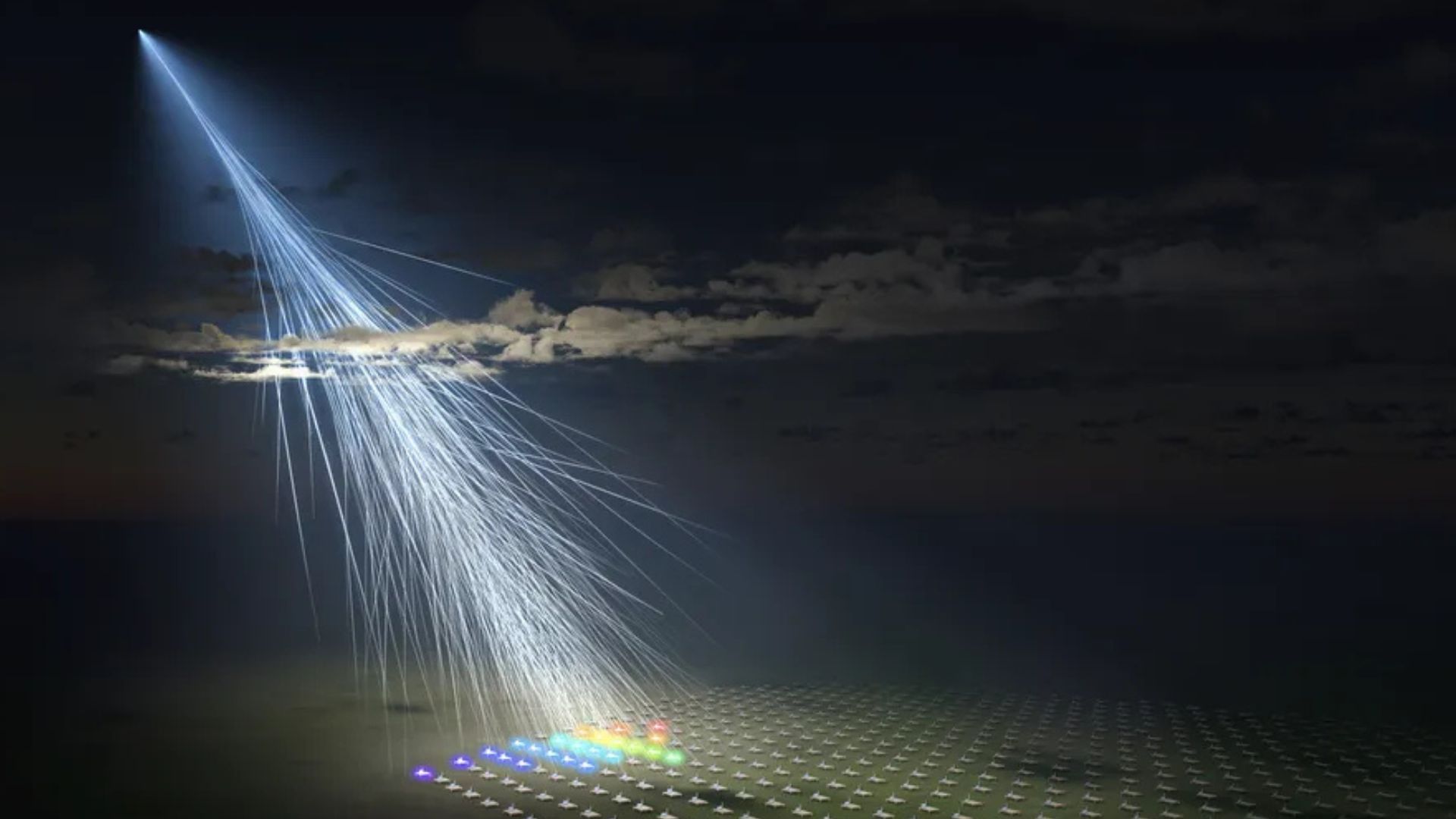
The particle was detected by the Telescope Array experiment, a large cosmic-ray observatory based in Utah, US.
The discovery team includes researchers from Osaka Metropolitan University. Toshihiro Fujii, one of the scientists involved, described its significance clearly. He said, “This is the most energetic charged particle ever detected by the Telescope Array experiment.”
The particle appeared as a massive air shower in Earth’s atmosphere, created when it collided with air molecules. The event stood out because of its unusual direction and enormous energy.
A Mystery?
Ultra-high-energy cosmic rays are rare. Scientists believe they usually come from extreme cosmic events, such as exploding stars (supernovae), or from regions near supermassive black holes at the centers of galaxies.
But Amaterasu seems to have come from a strange place known as the “Local Void.” The Local Void is a region of space with very few galaxies. It lacks the violent environments thought necessary to produce such powerful particles.
WATCH ALSO: https://modernmechanics24.com/post/ehang-next-gen-evtol-first-public-flight/
This unexpected origin deepened the mystery. If the particle truly came from the Local Void, it would challenge existing theories about how cosmic rays are formed.
Now, new research suggests the particle may not have originated in the Local Void after all.
Francesca Capel and Nadine Bourriche from the Max Planck Institute for Physics conducted a fresh analysis of the data. Their study was published in The Astrophysical Journal on January 28.
Using a data-driven statistical method called Approximate Bayesian Computation, they simulated the particle’s possible path through space. Since cosmic rays are charged particles, magnetic fields in space can bend their trajectories. This makes tracing their origins extremely difficult.
Bourriche explained their method clearly. “This approach works by comparing the results of realistic, physics-based simulations with actual observational data to infer the most probable source locations,” she said.
Their results produced probability maps suggesting the particle may have originated in nearby star-forming galaxies rather than the Local Void. One possible source is Messier 82 (M82), a galaxy known for intense star formation and energetic activity.
Bourriche stated, “Our results suggest that, rather than originating in a low-density region of space like the Local Void, the Amaterasu particle is more likely to have been produced in a nearby star-forming galaxy such as M82.”
READ ALSO: https://modernmechanics24.com/post/hydrowing-world-largest-tidal-2030/
Why It Matters
The study of ultra-high-energy cosmic rays is more than just space curiosity. It helps scientists understand how the universe accelerates matter to extreme energies.
Francesca Capel emphasized the broader impact. “Exploring ultra-high-energy cosmic rays helps us to better understand how the Universe can accelerate matter to such energies, and also to identify environments where we can study the behavior of matter in such extreme conditions,” she said.
If scientists can identify the true sources of particles like Amaterasu, they may uncover new physics beyond current theories. It could even reshape parts of astrophysics and particle physics.
Extreme cosmic rays also test the limits of Einstein’s theory of relativity and models of magnetic fields across intergalactic space. Each new detection adds valuable data.
A New Chapter in High-Energy Astrophysics?
The Amaterasu particle may open the door to a new era in high-energy astrophysics. Its unusual properties are forcing scientists to refine models, improve detection systems, and develop more advanced statistical tools.
WATCH ALSO: https://modernmechanics24.com/post/drdo-akhash-ng-missile-trials-success/
Researchers are combining large observatories, global collaborations, and advanced simulations to track these rare visitors from deep space.
Scientists hope that studying the Sun Goddess particle will unlock new insights into the universe’s most powerful forces.
On the other hand, Amaterasu remains both a cosmic messenger and a cosmic puzzle, shining light on the unknown edges of space.