An aerospace engineer transformed a simple swinging pendulum into a tiny power generator capable of producing up to 80 volts, showing how mechanical energy can be converted into usable electricity.
Tom Stanton, an engineer and popular YouTube creator, demonstrated how the potential energy of a pendulum can be harvested and stored to power small devices, such as LEDs and a fan.
Known for his innovative engineering experiments and 3D printing projects, Stanton’s latest build explores energy harvesting in a creative yet practical way.
Turning Motion Into Electricity
Stanton captures the energy of a swinging pendulum and converts it into electrical power. But the execution required careful design and multiple engineering refinements.
READ ALSO: https://modernmechanics24.com/post/coal-waste-yields-rare-earth-elements/
Stanton began with a basic setup. He suspended a magnet from a rope and allowed it to swing over a solid copper block. As the magnet moved across the copper surface, it induced electric currents in the metal. These currents generated an opposing magnetic field, which created resistance and produced heat.
Instead of allowing the energy to dissipate as heat, Stanton replaced the copper block with a wire coil. This allowed the induced current to flow through the coil, producing usable electrical energy.
However, the current was alternating current (AC), which could only briefly light an LED. To solve this, Stanton added a bridge rectifier to convert AC into direct current (DC). He also included a capacitor to store the charge and smooth out voltage fluctuations. This ensured the LEDs stayed lit even between pendulum swings.
Scaling Up Pendulum Generator
After proving the concept worked, Stanton scaled up the design. He used a heavy 40-kilogram (88-pound) weight as the pendulum bob and mounted the system on a sturdy triangular frame resembling a trebuchet.
He also improved the magnetic system. Stanton arranged several magnets into a Halbach array, a special configuration that concentrates the magnetic field in one direction. A mild steel backing plate helped guide the magnetic field lines efficiently.
WATCH ALSO: https://modernmechanics24.com/post/us-hits-isis-terrorists-nigeria/
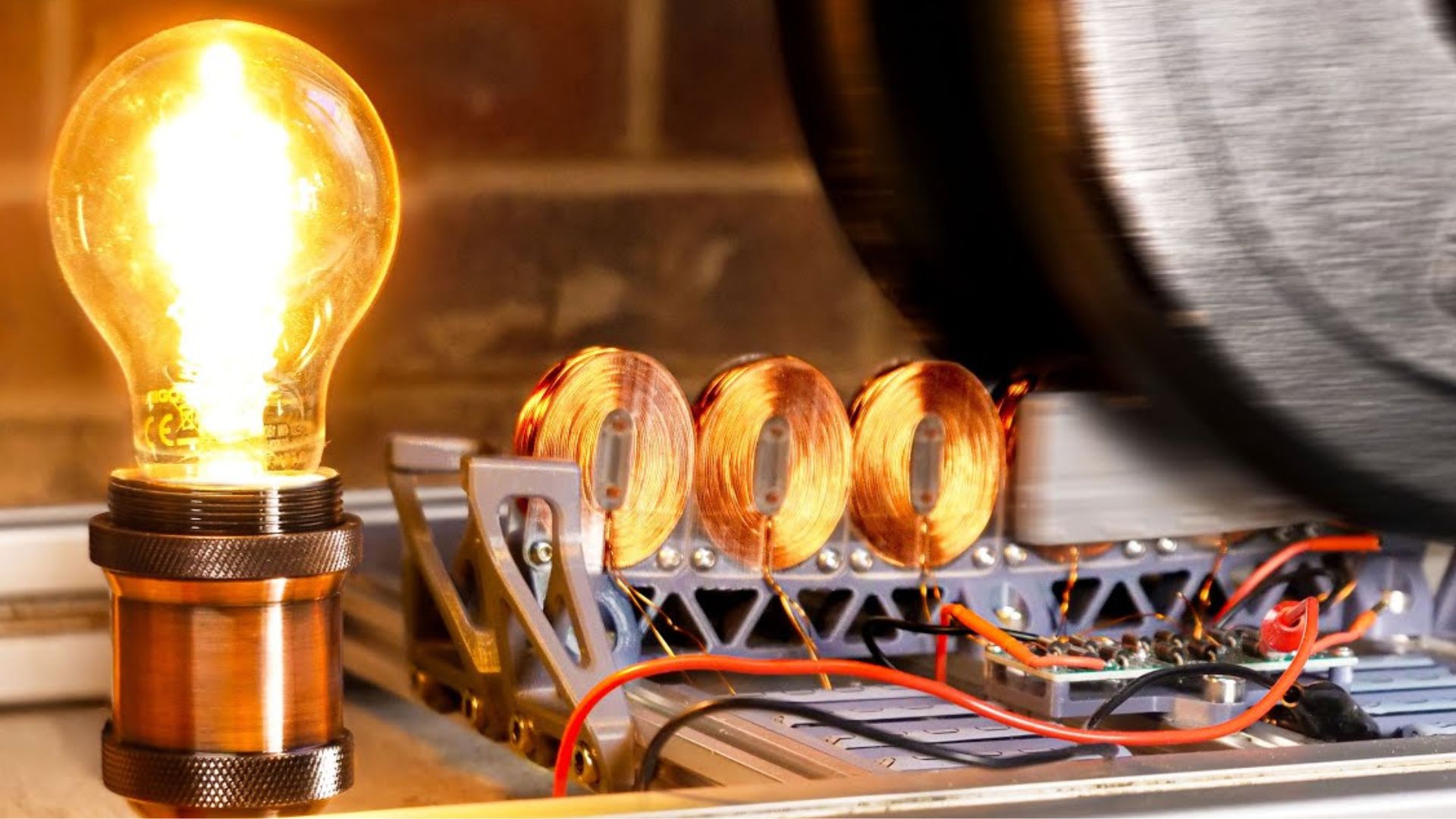
To collect the energy, he built six pickup coils using thick, enamelled copper wire. Stanton used custom 3D-printed parts to precisely shape and guide the coils. Each pair of coils was connected to its own rectifier, and a large 100,000-microfarad capacitor stored the generated electricity.
How Much Power Does It Generate?
According to Stanton, lifting the pendulum about 18 centimeters (seven inches) stores roughly 51 joules of energy. This equals around 0.014 watt-hours. While that may seem small, it is enough to power six LEDs for about three minutes as the swing gradually reduces.
When measured on an oscilloscope, the system generated around 80 volts AC at the midpoint of the swing. After rectification, the output dropped to about 30 volts DC.
Stanton also demonstrated the braking effect of electromagnetic induction. When he shortened the coils, the pendulum quickly slowed down due to the opposing magnetic field. This clearly showed how mechanical energy was being converted into electrical energy.
Practicality, Limitations
The stored charge can briefly power a small fan or drive a lightweight electromagnetic launcher. However, it is not strong enough to fully charge a smartphone. Lithium-ion batteries are highly energy-dense and require significantly more stored energy.
The project highlights the realities of small-scale renewable energy systems. The actual energy output is limited unless the system is scaled up dramatically.
Stanton’s experiment demonstrates an important principle of physics. Mechanical motion can be converted into electrical energy efficiently with the right setup.
READ ALSO: https://modernmechanics24.com/post/italy-first-certified-3d-printed-house/
However, the project is not only about replacing traditional batteries but also about exploring creative energy harvesting techniques.
It may not replace conventional batteries, but the pendulum battery highlights key principles of renewable micro energy systems. It shows electromagnetic induction, voltage rectification, magnetic braking, and small-scale power generation in action.
The project is proof that with smart design, magnets, coils, and 3D printing, even a swinging pendulum can become a working power generator.