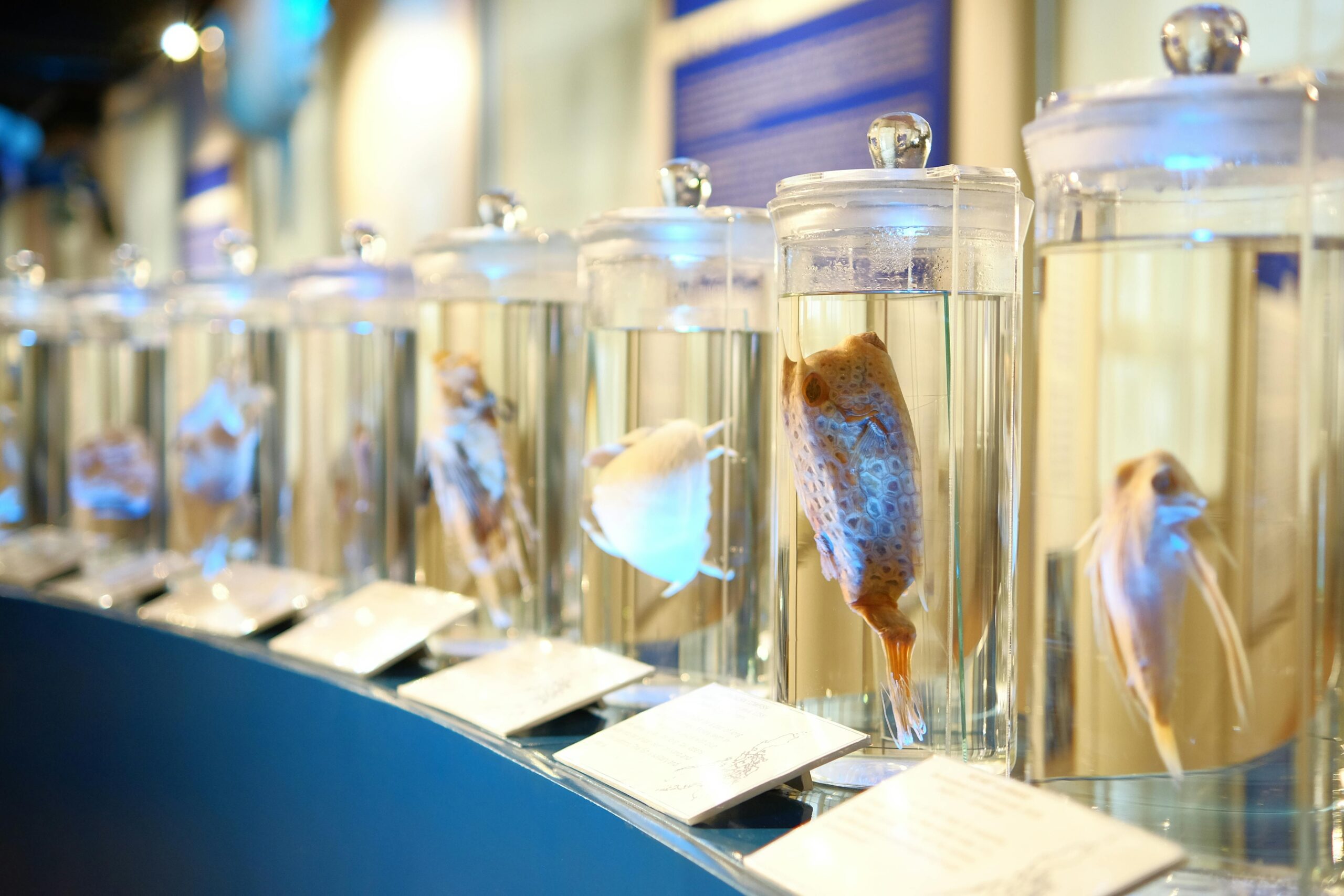
Natural History Museum London researchers have used portable laser spectroscopy to identify the preservation fluids inside Charles Darwin’s original Galapagos specimen jars—without ever opening them. Led by Dr. Wren Montgomery and physicist Sara Mosca, the team achieved nearly 80 percent accuracy in analyzing the chemical contents, preserving the integrity of collections that have remained sealed for nearly two centuries.
For two hundred years, they have sat in silence. Row upon row of glass jars, each holding a creature collected by Charles Darwin during the voyage of the HMS Beagle. Lizards. Finches. Shrimp. Jellyfish. Preserved in liquids that no living scientist dared to identify—because opening a jar meant risking evaporation, contamination, and irreversible damage to irreplaceable specimens.
The problem these researchers solved is both simple and profound. Museums house more than 100 million fluid-preserved specimens worldwide, many stored in unknown chemical cocktails. Over centuries, labels fade, fluids evaporate, and recipes are lost. Dutch anatomist Frederik Ruysch steeped cloves and pepper in ethanol. Pol Bouin favored formaldehyde mixed with picric acid. Carl Kaiserling dipped specimens sequentially in three different solutions. The result, according to Dr. Wren Montgomery of the Natural History Museum, is “considerable heterogeneity across collections, with mixtures of ethanol, methanol, glycerol, and formaldehyde commonly encountered in unknown proportions.”
READ ALSO: https://modernmechanics24.com/post/how-diesel-submarines-work-underwater/
Until now, the only way to know what was inside was to break the seal. That meant exposing delicate tissues to air, losing volatile compounds, and potentially destroying the very evidence curators were trying to protect.
What the technology actually does is elegant. The team deployed a portable form of spatially offset Raman spectroscopy, or SORS. Traditional Raman spectroscopy fires a single laser at a surface and reads the light scattered back. But that only penetrates a few hundred micrometers—the glass jar itself dominates the signal. SORS takes at least two measurements: one at the laser source, and one offset slightly to the side. By subtracting the two readings, the chemical fingerprint of both the glass and the liquid inside emerges. Multiple lasers, offset at varying distances, can map increasingly complex mixtures.
The basic function for museum curators is finally knowing what they are actually preserving. The team examined dozens of Darwin’s jars and found clear patterns. Mammals and reptiles were typically fixed in formalin, then transferred to ethanol for long-term storage. Invertebrates—particularly jellyfish and shrimp—were often kept in formaldehyde or buffered formaldehyde, sometimes with glycerol or phenoxetol added to maintain tissue integrity.
WATCH ALSO: https://modernmechanics24.com/post/wing-expands-walmart-drone-delivery/
There is, of course, a limitation. The technique successfully identified preservation fluids with nearly 80 percent accuracy, and another 15 percent of cases were partially accurate. But three samples—6.5 percent—could not be confidently identified at all. Complex mixtures, degraded compounds, or simply unknown historical recipes still resist even this sophisticated approach. The team acknowledges that SORS is not yet a universal key.
Still, the summary value is unmistakable. Museums are not just storehouses; they are time capsules. Darwin’s jars contain not only animals but evidence of how 19th-century science thought about preservation itself. Understanding those fluids means understanding the history of collection, the migration of chemical knowledge, and the subtle decay of specimens over centuries. More practically, it allows curators to stabilize deteriorating specimens without guesswork. As Mosca put it, “This technique allows us to monitor and care for these invaluable specimens without compromising their integrity.”
The innovator behind this application is physicist Sara Mosca from the Central Laser Facility at the UK’s Science and Technology Facilities Council. She adapted SORS—a technology originally developed for security scanning and pharmaceutical quality control—to the peculiar constraints of museum collections. The engineering was executed by a cross-disciplinary team including Montgomery and colleagues from both institutions, who spent months calibrating lasers against known reference fluids and testing the method on non-precious control jars before ever pointing a beam at Darwin’s original specimens.
READ ALSO: https://modernmechanics24.com/post/worlds-first-sodium-ion-battery-ev/
According to Montgomery, “Analyzing the storage conditions of precious specimens, and understanding the fluid in which they are kept, could have huge implications for how we care for collections and preserve them for future research for years to come.”The research, reported by ScienceAlert and published in ACS Omega, is already being studied by other major natural history museums facing the same silent crisis. If the method scales, curators may one day walk through archives with handheld scanners, reading the chemical history of every jar on every shelf—without lifting a single lid.