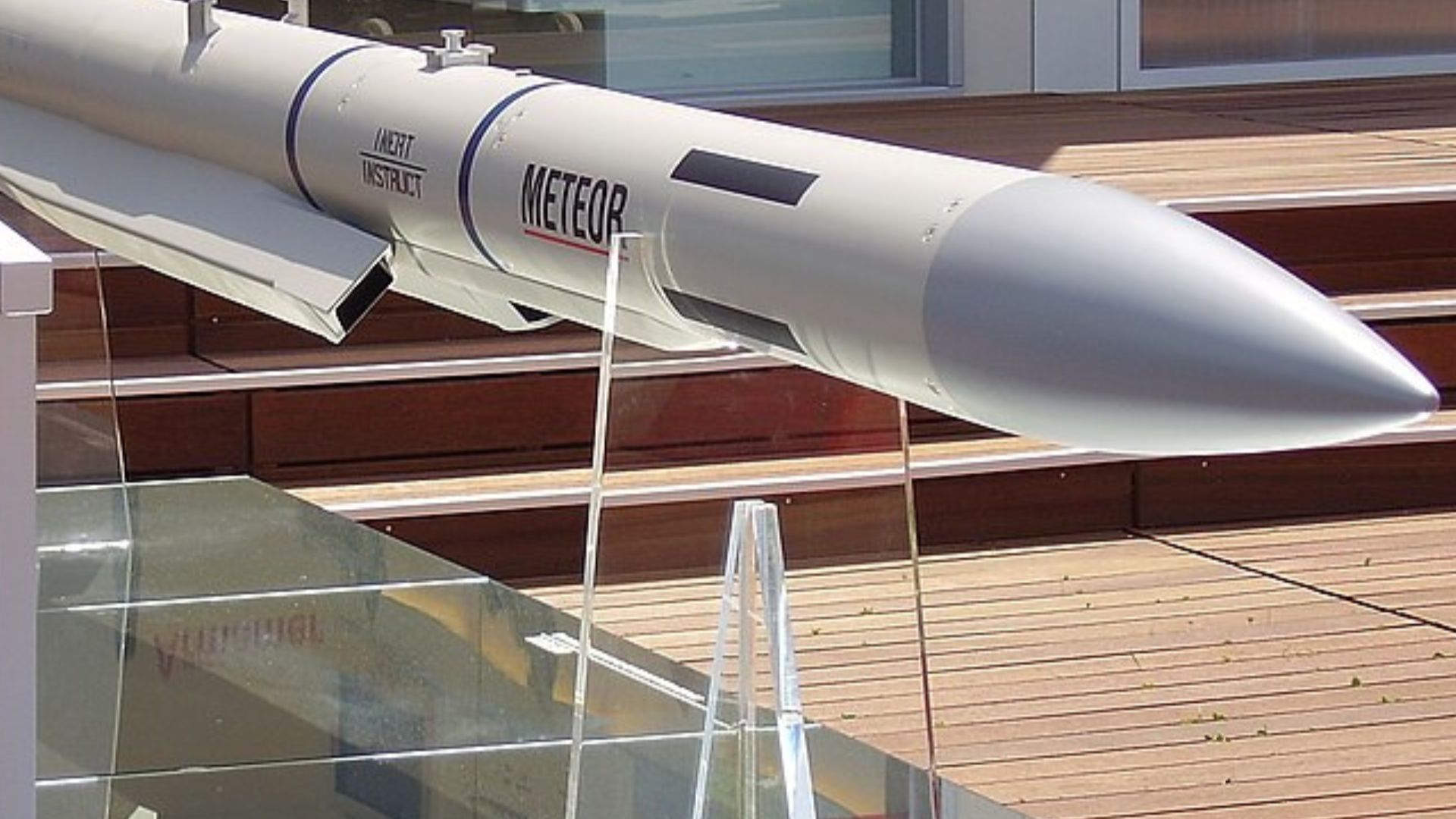
To challenge Russia’s long-range air dominance, Ukraine may soon gain access to one of Europe’s most powerful air-to-air missiles, the Meteor.
But there is a significant condition attached. Kyiv is unlikely to receive the missile unless it also acquires Swedish Gripen fighter jets—a plan that remains uncertain and time-consuming.
Powerful Missile, Complicated Path
According to Ukraine’s Ministry of Defense, the Meteor long-range air-to-air missile is being considered as part of Sweden’s next military aid package. The announcement came after talks between Ukrainian Defense Minister Mykhailo Fedorov and Swedish Defense Minister Paul Jonsson.
Along with the Meteor, the defense discussions included Saab Gripen E fighter jets, air defense systems, advanced radars, electronic warfare equipment, and long-range attack drones. Though no final decisions have been made yet, the confirmation marks a significant step toward strengthening Ukraine’s air combat capabilities against Russia.
At the Singapore Airshow, Saab officials openly acknowledged that the Meteor missile is closely linked to the Gripen fighter.
“The Meteor missile would be a natural part of any Gripen weapons package,” said Jussi Halmetoja, Saab’s operations advisor for air systems. “Discussions are ongoing with several export nations, including Ukraine.”
READ ALSO: https://modernmechanics24.com/post/china-automated-robot-joint-production/
Meteor Matters to Ukraine
Amid the ongoing air war with Russia, Ukraine’s need for a missile like the Meteor has been clear for years. Ukrainian pilots face Russian aircraft armed with missiles that can strike from far beyond Ukraine’s current reach.
Being one of the most advanced air-to-air missiles in the world, the meter has a ramjet engine that can adjust thrust during flight.
While traditional missiles burn all their fuel early, the Meteor saves energy for the final moments of an engagement, when agility matters most, giving the missile a much larger “no-escape zone.” That means enemy aircraft have far fewer chances to evade it once targeted.
Apart, the missile can choose the most efficient flight path for very long-range shots.
WATCH ALSO: https://modernmechanics24.com/post/south-korea-showcases-multi-purpose-military-ugv/
According to Western defense experts, the Meteor can engage certain targets at distances of up to 130 miles, making it one of the longest-ranged air-to-air missiles in operational service.
The missile uses an active radar seeker in its final phase and is supported by a two-way data link. This two-way linkage provides pilots or airborne radar aircraft a space to update the missile mid-flight and monitor its fuel and energy status, improving decision-making during combat.
Ukraine’s Current Position in Air
The Ukrainian Air Force relies mainly on the AIM-120 AMRAAM missile, carried by its newly acquired F-16 fighters. The AIM-120C variant offers improved performance over older models and gives pilots a long-desired “fire-and-forget” capability.
READ ALSO: https://modernmechanics24.com/post/sun-x42-flare-radio-blackout-africa-europe/
Late Andrii Pilshchykov, a Ukrainian pilot known by his callsign “Juice,” once stated about this adversity. ”The lack of fire-and-forget missiles is our biggest problem,” he said in a 2022 interview.
The AMRAAM’s effective range is believed to be around 40 to 50 miles, which is far shorter than Russia’s most dangerous air-to-air weapon.
Russia’s Air Advantage
Russia’s R-37M missile, carried by Su-35S fighters and MiG-31BM interceptors, has an estimated range of up to 124 miles. With this advantage, Russia often fires it from deep inside its own airspace, putting Ukrainian jets at risk so that they can hardly respond.
Pilshchykov described the danger bluntly, saying, “If you don’t know a missile has been launched, you’re dead. It restricts everything we do.”
This imbalance has forced Ukrainian pilots to fly defensively, reducing their ability to conduct airstrikes or support ground forces.
As the Meteor is widely known as the only Western missile that could directly counter the R-37M, Ukraine finally has the capacity to put Russian aircraft at risk from similar distances.
WATCH ALSO: https://modernmechanics24.com/post/lightweight-materials-transform-aerospace/
Technology Risk Attached
The Meteor is produced by MBDA, a European missile consortium led by the United Kingdom, with France, Germany, Italy, Spain, and Sweden as partners. Though all these countries strongly support Ukraine, approving a transfer is beyond a political decision.
Additionally, there is a significant intelligence risk involved. If a Meteor were shot down or crashed inside Russian territory, Russia wouldn’t miss a chance to study and exploit its advanced technology. This concern weighs heavily on export decisions for such high-end weapons.
Aircraft Hurdle: Gripen or Rafale
Ukraine cannot use the Meteor without compatible aircraft even after political approval is sorted. Currently, the missile is integrated with Saab Gripen fighters and Dassault Rafale jets, not with F-16s.
Ukraine has signed letters of intent to acquire up to 150 Gripen E fighters from Sweden and up to 100 Rafales from France over the next decade. However, these are not binding purchase agreements.
According to reports, Sweden’s newly built Gripen E jets are expected to be delivered over the next three years. Given the ambitious timeline, training, logistics, and production constraints, Ukraine has repeatedly demanded its first Gripens by 2026.
READ ALSO: https://modernmechanics24.com/post/abf-crystal-china-most-energetic-laser/
An Option on Card
There is an alternative for Ukraine, as the older Swedish Gripen C/D fighters are already compatible with the Meteor and could be delivered far sooner than the new Gripen Es.
If combined with the two Saab 340 airborne early warning aircraft already donated by Sweden, the effect could be powerful.
Using the Erieye radar system, these planes can detect targets, assign them to fighters, and even guide missiles mid-flight—sometimes without the fighter pilot turning on their own radar at all.
The Meteor remains a promise rather than a delivery. Still, Ukraine has taken its first concrete step toward acquiring a weapon that could fundamentally change the balance of air power and allow its pilots to fight back on equal terms.