Scientists have discovered how a powerful solar superstorm dramatically affected Mars in May 2024.
Two spacecraft orbiting the Red Planet recorded the impact and provided new insights into how extreme space weather can alter a planet’s atmosphere.
The European Space Agency (ESA) said its Mars missions, Mars Express and the ExoMars Trace Gas Orbiter (TGO), observed the solar superstorm when it struck Mars. Instruments on board the spacecraft captured important data showing how the planet’s atmosphere reacted to the storm.
The findings were published in a new study in the journal Nature Communications. Researchers say the event created the strongest atmospheric response ever recorded on Mars during a solar storm.
Scientists reported that the storm caused a massive surge of electrons in Mars’s upper atmosphere. These charged particles flooded two layers of the planet’s atmosphere at heights of around 110 kilometers and 130 kilometers above the surface.
“The impact was remarkable. Mars’s upper atmosphere was flooded by electrons,” said Jacob Parrott, an ESA research fellow and the lead author of the study. “It was the biggest response to a solar storm we’ve ever seen at Mars.”
According to the study, electron levels increased by about 45 percent in one atmospheric layer and by an astonishing 278 percent in another.
These levels represent the highest concentration of electrons scientists have ever observed in that part of Mars’s atmosphere.
What Is the May 2024 Solar Superstorm?
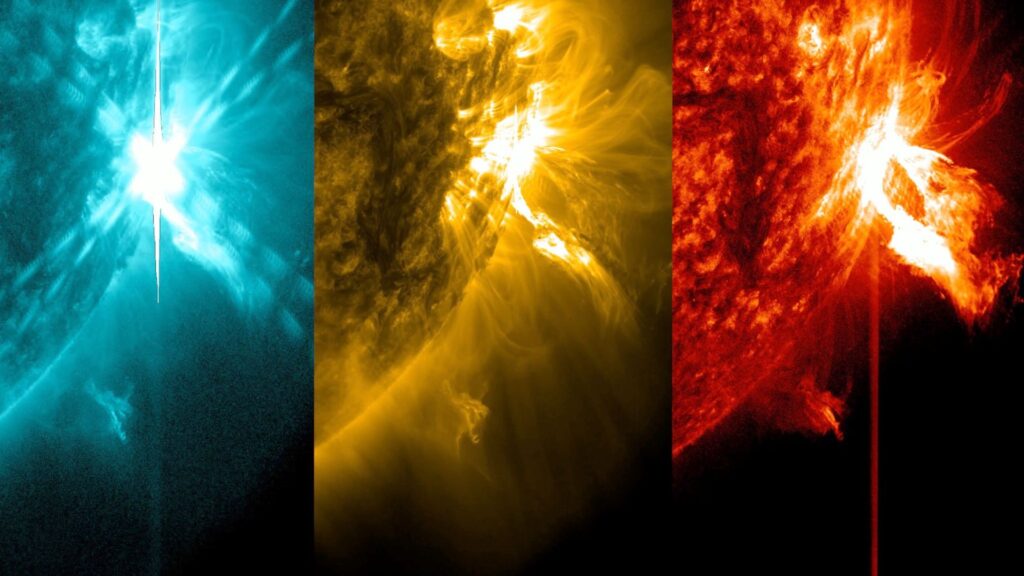
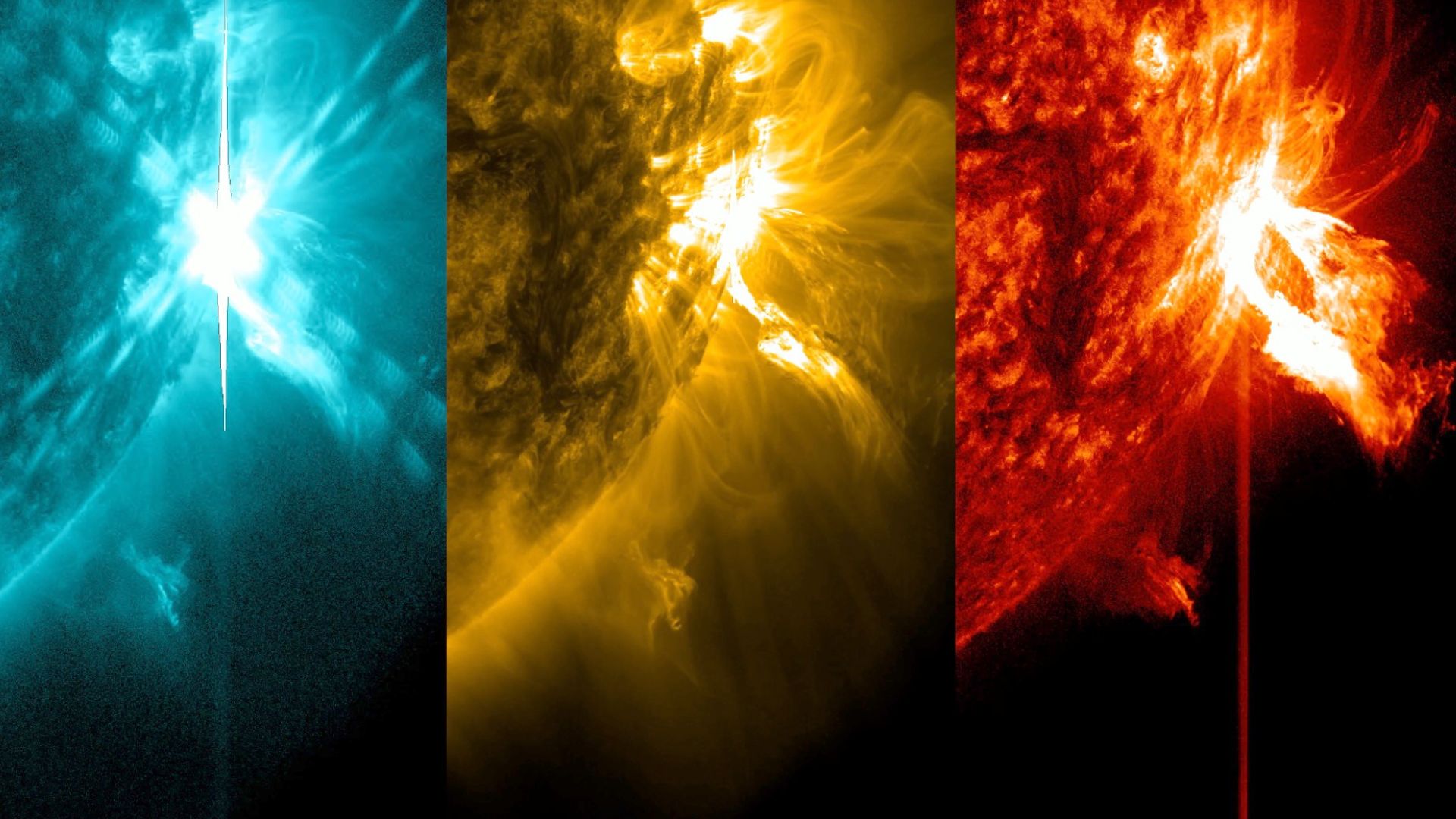
The May 2024 solar storm was one of the strongest space weather events recorded in more than two decades. The storm began with powerful eruptions from the Sun that sent large amounts of radiation, energetic particles, and magnetized plasma into space.
When these solar emissions reached Earth, they triggered spectacular auroras in the night sky. These colorful light displays appeared much farther south than usual, even becoming visible in parts of Mexico.
READ ALSO: https://modernmechanics24.com/post/cas-sets-15-45-kesterite-solar-record/
Solar storms occur when the Sun releases sudden bursts of energy. These bursts can take several forms, including solar flares, high-energy particle streams, and massive eruptions of solar material known as coronal mass ejections (CMEs).
These events push enormous clouds of charged particles into space at high speed. When such particles collide with planetary atmospheres, they can create dramatic changes.
The May 2024 storm included several such solar events happening close together. Together, they produced a powerful wave of radiation and energetic particles that traveled across the solar system and eventually reached Mars.
Spacecraft Witness the Storm at Mars
ESA’s Mars orbiters were in an ideal position to observe the storm when it arrived.
The Trace Gas Orbiter carries a radiation monitor that measures energetic particles in space. During the solar storm, the instrument recorded an extremely high radiation dose.
Scientists said the radiation level measured during the storm was equal to about 200 days of normal radiation exposure, all occurring within just 64 hours.
WATCH ALSO: https://modernmechanics24.com/post/iss-crew-new-year-2026-wishes/
The storm also caused temporary technical problems for the orbiters.
“The storm also caused computer errors for both orbiters,” Parrott said. “This is a typical risk of space weather because the particles involved are extremely energetic and difficult to predict.”
However, the spacecraft was designed to handle such conditions.
Engineers equipped them with radiation-resistant components and built-in systems that automatically detect and correct errors. Because of these protections, both orbiters recovered quickly after the disturbance.
To understand the storm’s effect on Mars, researchers used a scientific method known as radio occultation.
In this technique, one spacecraft sends a radio signal while another spacecraft receives it. As the signal travels through the planet’s atmosphere, different atmospheric layers bend or refract the radio waves.
READ ALSO: https://modernmechanics24.com/post/how-b-52-bombers-hit-iranian-targets/
By analyzing these changes, scientists can determine the atmosphere’s density and composition.
For this study, Mars Express transmitted a radio signal to the Trace Gas Orbiter just as it was disappearing behind the Martian horizon.
As the receiving spacecraft moved behind the planet, the signal passed through multiple atmospheric layers. The way the signal changed revealed important information about the atmosphere’s structure.
Researchers also compared their results with observations from NASA’s MAVEN mission, which studies the Martian atmosphere and solar wind interactions.
ESA project scientist Colin Wilson explained how this technique has evolved over the past few years.
“This method has been used for decades to study planets,” Wilson said. “Traditionally, spacecraft send radio signals back to Earth, but now we are using signals between two spacecraft orbiting Mars.”
He added that this approach allows scientists to gather more detailed measurements of atmospheric conditions.
“It’s exciting to see this technique working between orbiters at Mars,” Wilson said.
ESA already uses orbiter-to-orbiter radio occultation regularly in Earth-orbiting missions and plans to apply it more widely in future planetary exploration missions.
Why Solar Storms Affect Mars Differently Than Earth
The solar superstorm produced very different effects on Mars compared to Earth.
READ ALSO: https://modernmechanics24.com/post/eth-zurich-hydrogel-transform-bone/
Earth has a strong magnetic field that protects the planet from many charged particles coming from the Sun. This magnetic shield deflects most of the solar storm particles away from the atmosphere.
Some particles still reach Earth’s poles, where they create beautiful auroras in the sky.
Mars, however, lacks a strong global magnetic field like Earth’s. Without this protective shield, the planet’s atmosphere is much more exposed to solar storms.
As a result, charged particles from the storm can interact directly with the Martian atmosphere. When the high-energy particles hit neutral atoms in the atmosphere, they knock electrons away and create large numbers of charged particles.
This process explains why scientists saw such a dramatic rise in electron levels during the storm.
What the Discovery Means for Mars Research
The new findings help scientists understand how solar storms influence Mars’s atmosphere over time.
WATCH ALSO: https://modernmechanics24.com/post/humanoid-robot-towel-task/
Mars once had a thicker atmosphere and abundant surface water. However, scientists believe much of the atmosphere gradually escaped into space.
One possible reason is the continuous stream of energetic particles from the Sun, which slowly stripped away the planet’s atmosphere.
“The results help us understand how solar storms deposit energy and particles into Mars’s atmosphere,” Wilson said.
Studying these effects may also help scientists understand how Mars lost its water and most of its atmosphere billions of years ago.
Impact on Future Mars Missions
The discovery also has practical importance for future Mars missions.
A planet’s atmosphere affects how radio signals travel through space. When large numbers of electrons fill the upper atmosphere, they can interfere with radio communication.
This interference could block radar signals used by spacecraft to explore the Martian surface.
Scientists say understanding these effects will help mission planners design better systems for exploring Mars.
READ ALSO: https://modernmechanics24.com/post/humanoid-robots-beat-ultimate-test/
“If Mars’s upper atmosphere becomes packed with electrons, it can block the radar signals we use to study the surface,” Wilson said. “This is an important factor for mission planning.”
Researchers say continued monitoring of space weather will be essential for future exploration of Mars and other planets.
Solar activity is difficult to predict because the Sun releases bursts of energy unpredictably. Scientists often rely on rare opportunities when spacecraft are in the right place at the right time.
In this case, the timing was extremely fortunate.
“We used this new technique just 10 minutes after a large solar flare hit Mars,” Parrott said. “Since we normally perform only two observations per week, the timing was incredibly lucky.”
The study highlights how modern spacecraft and innovative research methods are helping scientists better understand the powerful forces shaping planets across the solar system.