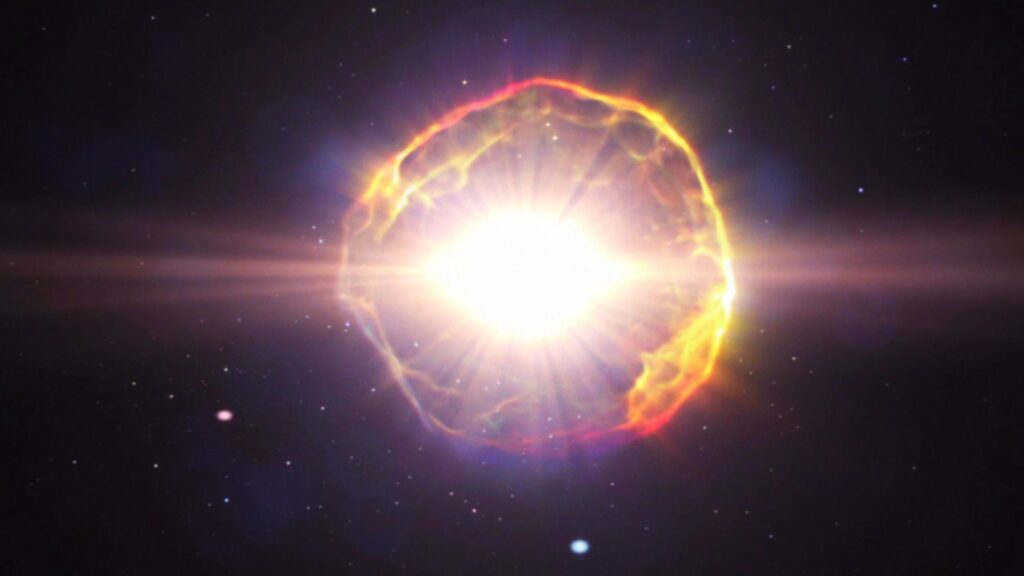
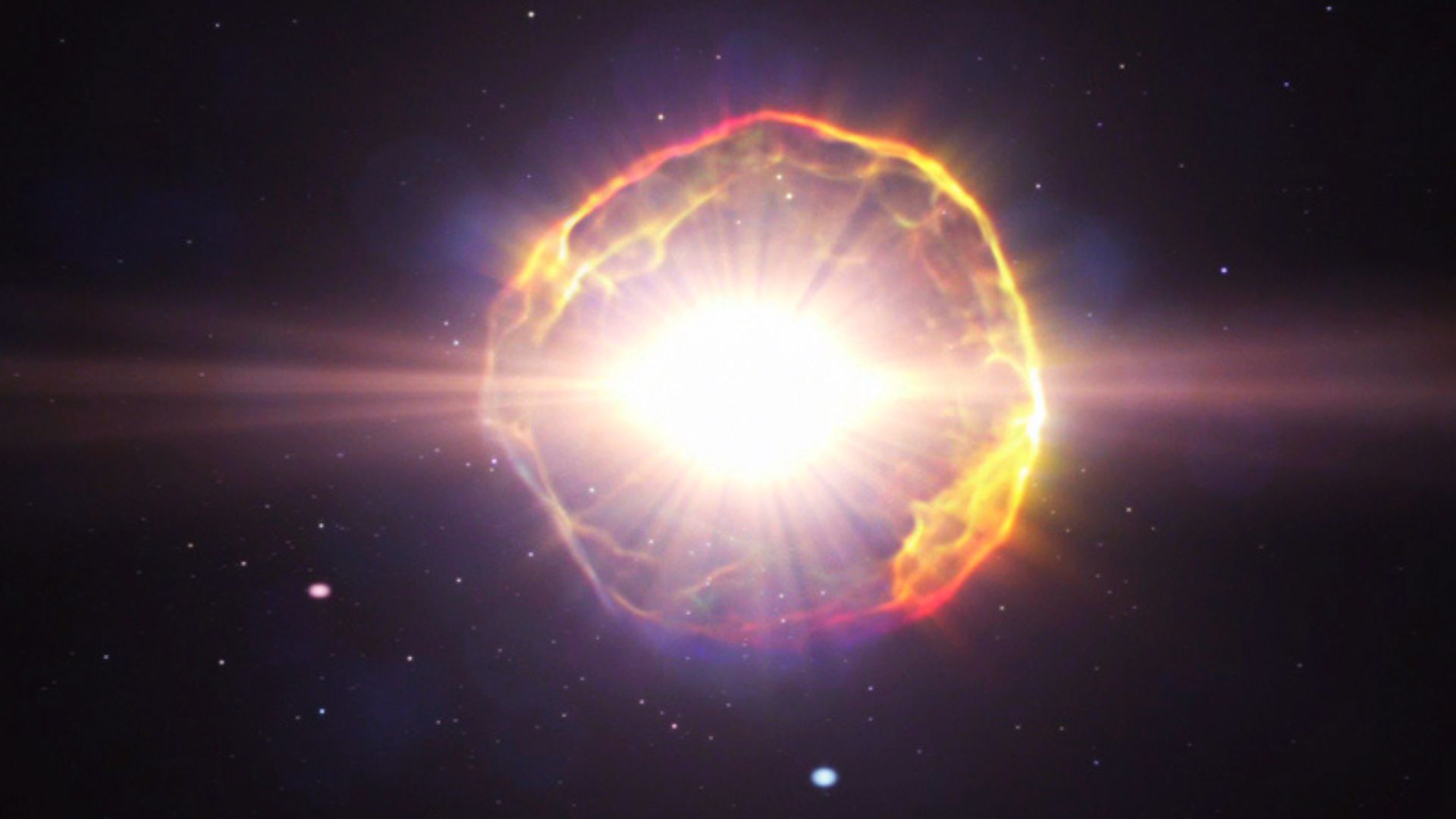
Astronomers captured the clearest evidence of a massive star collapsing directly into a black hole without exploding as a supernova.
The discovery centered on a star, M31-2014-DS1, in the neighboring Andromeda Galaxy. Instead of ending its life in a bright explosion, the star simply faded away. Scientists now say it collapsed inward, forming a black hole.
The findings were published on February 12 in the Journal Science. Researchers described the event as the most complete observation ever recorded of a star turning into a black hole through direct collapse.
The research team was led by Kishalay De of the Flatiron Institute and Columbia University. His group analyzed more than a decade of archival observations from NASA’s NEOWISE mission, along with data from several ground- and space-based telescopes.
READ ALSO: https://modernmechanics24.com/wp-admin/post.php?post=12703&action=edit
“This has probably been the most surprising discovery of my life,” De said. “The evidence of the disappearance of the star was lying in public archival data and nobody noticed for years until we picked it out.”
The team tracked changes in the star from 2005 to 2023. They noticed that its infrared brightness increased in 2014. By 2016, the star dimmed dramatically. Observations in 2022 and 2023 showed it had almost completely vanished in visible and near-infrared light.
Now, the object is only faintly visible in mid-infrared wavelengths, shining at just a fraction of its former brightness.
M31-2014-DS1 was located about 2.5 million light-years away in the Andromeda Galaxy. When it first formed, it had around 13 times the mass of the Sun. Powerful stellar winds stripped away much of its mass over time. At the end of its life, it weighed about 5 times the Sun’s mass.
Basically, massive stars explode as supernovae when they run out of fuel. Their cores collapse, triggering a powerful shock wave that blows the outer layers into space. That explosion often leaves behind a neutron star or black hole.
But in this case, the explosion never happened.
“The dramatic and sustained fading of this star is very unusual, and suggests a supernova failed to occur,” De said. “Stars with this mass have long been assumed to always explode as supernovae.”
Instead, the star’s core collapsed inward under gravity. Without a strong shock wave to push material outward, most of the inner matter fell back, forming a black hole.
WATCH ALSO: https://modernmechanics24.com/post/china-40000t-sichuan-assault-ship/
Role of Convection and Dust
The researchers also found that convection played a key role in the event. Inside massive stars, hot material rises and cooler material sinks. This movement continues even as the core collapses.
When the core of M31-2014-DS1 gave way, its outer layers did not immediately fall into the black hole. Some of the inner layers orbited the newborn black hole and helped eject the outermost material.
As this expelled gas cooled, it formed dust. That dust absorbed heat from the remaining hot material and glowed in infrared light. This explains the bright infrared signal seen between 2014 and 2016.
The faint red glow could remain visible for decades with powerful telescopes like the James Webb Space Telescope.
Black holes were first predicted decades ago. Scientists have since detected many through X-ray signals and gravitational waves. Still, astronomers debate which stars become black holes and how.
READ ALSO: https://modernmechanics24.com/post/startup-turns-pigeon-into-cyborg-drones/
“We’ve known that black holes must come from stars,” said Morgan MacLeod, a co-author of the study. “With these events, we’re getting to watch it happen and are learning a huge amount about how that process works.”
A similar case was reported years ago in another galaxy, but the data were unclear. This new observation provides much stronger evidence that some massive stars may collapse quietly without any explosion.
“It comes as a shock to know that a massive star basically disappeared without an explosion and nobody noticed it for more than five years,” De said.
The discovery suggests that silent stellar deaths may be more common than previously thought. That could change estimates of how many black holes exist in the universe. This vanishing star marks the beginning of a deeper understanding of how black holes form.