Scientists from leading US research labs have joined the race to build scalable quantum computers.
Researchers successfully trapped and controlled ions using advanced cryoelectronics inside a vacuum environment. The result could help scale up systems to practical sizes.
The experiment was led by teams at Fermi National Accelerator Laboratory and MIT Lincoln Laboratory.
The project was supported by two US Department of Energy national quantum research centers: the Quantum Science Center, led by Oak Ridge National Laboratory, and the Quantum Systems Accelerator, led by Lawrence Berkeley National Laboratory.
Within the Quantum Systems Accelerator, the effort was led by Sandia National Laboratories in collaboration with MIT Lincoln Laboratory.
Why Ion Traps Matter
Ion-trap quantum computers use charged atoms, called ions, as quantum bits or qubits. These ions are held in place using electric or magnetic fields. Ion-trap systems are known for long coherence times and highly accurate operations. This makes them strong candidates for building reliable quantum computers.
READ ALSO: https://modernmechanics24.com/post/hip-exoskeleton-stroke-survivor-recover/
However, scaling ion-trap systems to millions of qubits remains a major obstacle. Current systems rely heavily on lasers and complex wiring between room-temperature electronics and ultra-cold quantum hardware.
As the number of ions increases, this setup becomes impractical. To solve this, researchers explored a new approach.
Cryoelectronics developed at Fermilab are the key to this experiment. These are special electronic circuits designed to operate at extremely low temperatures. Quantum computers require such cold environments to function properly.
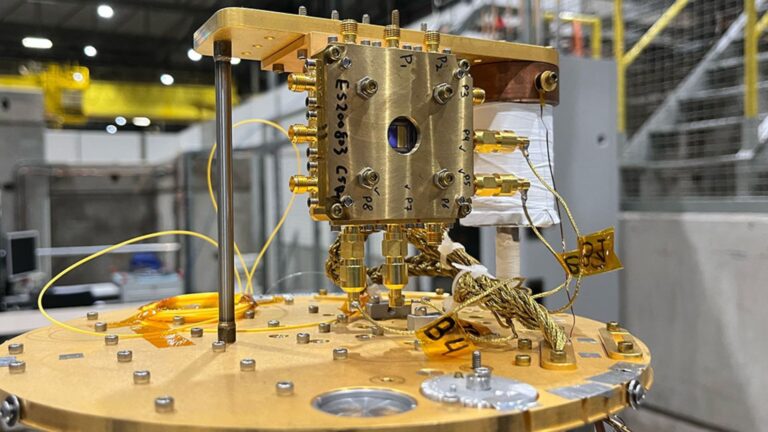
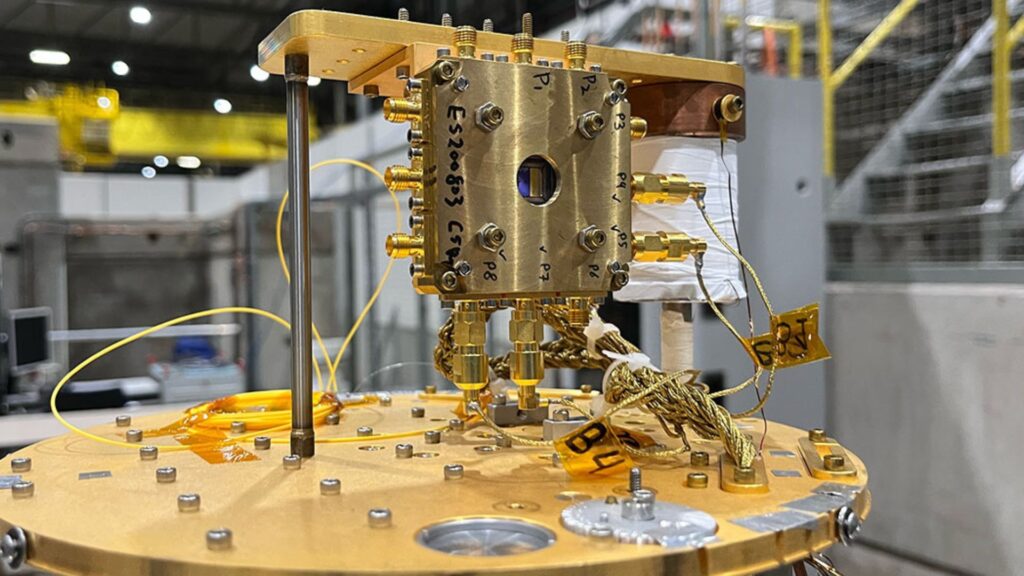
The Fermilab cryoelectronics were integrated into MIT Lincoln Laboratory’s ion-trap platform. Instead of keeping control electronics at room temperature, researchers placed ultra-low-power control chips close to the ion traps inside the cryogenic environment.
READ ALSO: https://modernmechanics24.com/post/epic-fury-us-fires-prsm-missile-in-iran/
The team tested whether these chips could move individual ions, hold them in specific positions, and measure electronic noise. The proof-of-principle experiment showed that this hybrid system works.
Travis Humble, director of the Quantum Science Center, says, “This remarkable research integrates state-of-the-art capabilities in quantum technologies to deliver an exciting new direction for scalable ion trap quantum computing using cryoelectronic control chips.”
The new system replaced some room-temperature controls with compact chips that operate at extreme cold. This reduced wiring complexity and improved performance.
Farah Fahim, head of Fermilab’s Microelectronics Division, says, “By showing that low-power cryoelectronics can work inside ion-trap systems, we may be able to accelerate the timeline for scaling quantum computers.” She adds, “This approach could ultimately support systems with tens of thousands of electrodes or more.”
The ability to scale up ion-trap arrays is essential to building powerful quantum computers capable of solving real-world problems in science, medicine, and materials research.
The experiment also revealed important technical challenges. Some transistors that performed well at Fermilab did not function as expected in the colder environment at MIT Lincoln Laboratory. This affected the performance range of the control circuits.
READ ALSO: https://modernmechanics24.com/post/building-resilient-plant-cell-by-cell/
Another issue involved voltage hold times. Initially, the circuits could hold voltages only for milliseconds. Modifications extended this time, but future systems will need to maintain stable voltages for minutes or even hours.
Robert McConnell, a technical staff member at MIT Lincoln Laboratory, says, “While there are still significant challenges to establishing the technology needed to control ion arrays of a practical scale, this demonstration lays the foundation for hybrid-integrated systems we hope to develop in the near future.”
The invention highlights the importance of collaboration among national labs and research centers. By combining expertise in microelectronics, quantum systems, and cryogenic engineering, the teams achieved a key milestone.
Future experiments will directly connect the cryoelectronics to ion-trap chips. This could further improve efficiency and performance.
While large-scale quantum computers are not yet here, this achievement brings them closer to reality. It marks a concrete step toward scalable quantum computing technologies that could transform science and industry in the coming decades.